Saturday, February 28, 2009


Friday, February 27, 2009
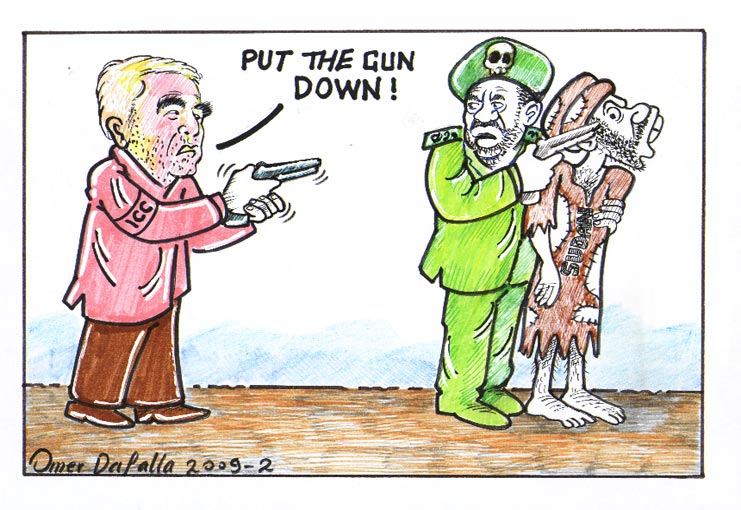
Pre-Trial Chamber I’s decision concerning President Al Bashir of Sudan to be announced during press conference on 4 March 2009
Press Release: 26.02.2009
Pre-Trial Chamber I’s decision concerning President Al Bashir of Sudan to be announced during press conference on 4 March 2009
ICC-CPI-20090226-MA35
Situation: Darfur, Sudan
The decision of Pre-Trial Chamber I of the International Criminal Court with regard to the Prosecution application of 14 July 2008 for the issuance of a warrant of arrest against President Omar Al Bashir of Sudan will be announced during a press conference which will take place on 4 March 2009 at the seat of the Court. The press conference will start at 2 p.m.
The Registrar, Ms Silvana Arbia, and the ICC Spokesperson, Ms Laurence Blairon, will make statements in English, after which there will be an opportunity for journalists to ask them questions. Interpretation into French and Arabic will be available.
Separate interviews after the press conference with audiovisual media are possible but will need to be arranged in advance. Please note that only a limited number of such requests will be granted. Read more >>>>>>>>>
Monday, February 23, 2009
Decision of Pre-Trial Chamber I concerning President Al Bashir of Sudan to be issued on Wednesday 4 March 2009
Situation: Darfur, Sudan
Today Pre-Trial Chamber I announced that it would issue on Wednesday 4 March 2009 its decision concerning the Prosecution application of 14 July 2008 for the issuance of a warrant of arrest against President Omar Al Bashir of Sudan.
The decision will be made public by the normal way of a press release and publication on the Court’s website. Read more >>>>>>>>>>
Sunday, February 22, 2009
Sisters, Victims, Heroes
By NICHOLAS D. KRISTOF
GOZ BEIDA, Chad
So I’m bunking with George Clooney in a little room in a guest house here in eastern Chad, near Darfur in Sudan. We each have a mattress on the floor, the “shower” is a rubber hose that doesn’t actually produce any water, and George’s side of the room has a big splotch of something that sure looks like blood.
He’s using me to learn more about Darfur, and I’m using him to ease you into a column about genocide. Manipulation all around — and, luckily, neither of us snores. (But stay tuned to this series for salacious gossip if he talks in his sleep.)
The slaughter in Darfur has continued for six years largely because world leaders have been complacent and preoccupied. In the coming weeks, the International Criminal Court is expected to issue an arrest warrant for Sudan’s president, Omar Hassan al-Bashir, for orchestrating the killings — and that will give the world a new opportunity to end the slaughter.
But to seize that opportunity, world leaders will have to summon some of the same moral courage that Darfuris show all the time.
Take Suad Ahmed, who is in the pantheon of my personal heroes. I introduced her to George in her little thatch hut.
Suad, 27, fled from Darfur to a refugee camp in Chad five years ago with her husband and beloved younger sister, Halima, who is now 12 — if she is still alive. Read more >>>>>>>>>
Friday, February 20, 2009
Ex-SPLM official says Sudan’s Bashir must ‘face ICC or commit suicide’

February 19, 2009 (CAIRO) — Edward Lino, a former official with the Sudan People’s Liberation Movement (SPLM) which rules the semi-autonomous south urged the Sudanese government to cooperate with the International Criminal Court (ICC) if an arrest warrant is issued for president Omer Hassan Al-Bashir.
Lino who was the former SPLM administrator for Abyei region told the Kuwaiti newspaper Al-Jarida that Sudan is a member of the United Nations and is therefore obligated to comply with the ICC.
The UN Security Council (UNSC) issued resolution 1593 under chapter VII in March 2005 referring the situation in Darfur to the ICC.
The ICC judges are expected to release a decision before the end of the month in which they agree to issue an arrest warrant for Al-Bashir on an unspecified number of counts. Read more >>>>>>>>>>>>
Friday, February 06, 2009
U.N. says 30,000 displaced by South Darfur fighting
KHARTOUM (Reuters) - At least 30,000 people have fled their homes in South Darfur state in western Sudan in recent days because of fighting between rebels and government forces, the United Nations said in a statement received on Friday.
The office of the U.N. humanitarian coordinator for Sudan said the people were from the Muhajiriya and Shearia areas. The Sudanese army said on Wednesday it had captured Muhajiriya town from rebels of the Justice and Equality Movement.
In three weeks of clashes around Muhajiriya, 80 km (50 miles) from the South Darfur capital of Nyala, at least 30 people were killed, U.N. officials have said. Read more >>>>>>
Friday, January 30, 2009
Obama’s Envoy Voices Support for International Court
By Bill Varner
Jan. 29 (Bloomberg) -- Ambassador Susan Rice signaled a shift in U.S. policy toward support for the International Criminal Court, a tribunal the Bush administration opposed, in her first speech to the United Nations Security Council.
The International Criminal Court “looks to become an important and credible instrument for trying to hold accountable the senior leadership responsible for atrocities committed in the Congo, Uganda and Darfur,” Rice said in a closed council meeting, according to a text provided by the U.S. mission.
President George W. Bush opposed U.S. ratification of the treaty that created the court out of concern that it didn’t include adequate protections against politically motivated prosecutions. The U.S. sought and received UN immunity for its citizens from tribunal prosecution from 2002 to 2004.
Crimes against humanity in Yugoslavia, Rwanda and Cambodia gave impetus to creation of the Hague court, whose jurisdiction took effect on July 1, 2002. The court’s prosecutor last July sought the arrest of Sudanese President Umar Hasan al-Bashir for war crimes in the Darfur region of Sudan.
Rice’s remarks at the Security Council meeting on international humanitarian law won praise from envoys used to seeing the U.S. isolated on issues such as the International Criminal Court’s jurisdiction.
‘She Was Incredible’ Read more >>>>>>>>>>>>>>>>
Thursday, January 29, 2009
Condemnation of Darfur Bombings
Press Statement
Robert Wood
Acting Spokesman
Washington, DC
January 27, 2009
The United States condemns the military activity carried out by the Sudanese Armed Forces (SAF) in North and South Darfur since January 22, as well as the incursion by the Justice and Equality Movement (JEM) into Muhajaria and other areas of South Darfur, which resulted in an increase of violence over the last week. This fighting and subsequent Government of Sudan bombing campaigns have reportedly resulted in the deaths, injuries and displacements of civilians. The bombing campaigns in particular are a violation of the Darfur Peace Agreement, of the Government of Sudan-initiated ceasefire, and of United Nations Security Council (UNSC) resolutions on Darfur. We welcome the statement by the Secretary-General condemning these hostilities. We demand that all parties to the conflict, including rebel movements, cease all violence and provocations in Darfur immediately, and commit to the peace process under the leadership of Joint Chief Mediator Djibril Yipènè Bassolé.
2009/083
Saturday, January 17, 2009
U.N. condemns Sudan air bombing in Darfur
KHARTOUM, Sudan, Jan. 16 (UPI) -- The United Nations is calling for an end to hostilities in the Darfur region of Sudan after the government launched airstrikes Thursday.
U.N. Secretary-General Ban Ki-moon Thursday said military violence would not bring peace to the war-ravaged Darfur, where ongoing violence between government forces and the rebel militants has resulted in an estimated 300,000 deaths and the displacement of millions of civilians.
Thursday the Sudanese government launched an aerial bombing campaign and ground offensive targeting militiamen in the southern Muhajeria region of Darfur. Ban called on the Sudanese government and rebel leaders to end the military aggression, the United Nations reported. Read more >>>>>>>>>>>
Monday, January 05, 2009
High noon at genocide in Darfur
Sudan's president, Gen. Omar al-Bashir, is scared. Having flimflammed the United Nations and flouted its resolutions warning him to stop the mass killings and rapings of his black citizens in Darfur, the victims' avenger Luis Moreno-Ocampo, chief prosecutor of the International Criminal Court in The Hague, may finally be close to bringing this monstrous dictator to trial, the first sitting president indicted by the World Court.
Last July, Moreno-Ocampo had asked the ICC to issue arrest warrants for Al-Bashir on three counts of genocide, five counts of crimes against humanity and two of murder. The legal definition of genocide is: "intent to destroy, in whole or in part, a national, ethical, racial or religious group."
The prosecutor accuses Al-Bashir of a campaign to eliminate African Darfur tribes.
After the ICC asked for more supporting material to justify arrest warrants, on Nov. 21, Moreno-Ocampo submitted more than 700 pages of documented evidence, including witness statements. All of his previous requests for arrest warrants in other cases have been successful.
Adding to Al-Bashir's fears is the prospect of national elections next year demanded by foreign donor governments, and supported by the United Nations and many in Sudan. The Economist (Nov. 20) reports that the dictator and his henchmen "know that if even vaguely free and fair ballots were to take place throughout Sudan, they would lose heavily." Read more >>>>>>>>>>>>>>>>>
Sunday, January 04, 2009
Add your voice for Darfur
JEFFREY GOVENDO, Hopkinton
Overshadowed by the barrage of news stories on the economy and two wars we are fighting, is the genocide in Sudan which has entered its 6th year. Up to 400,000 have perished, with nearly three million displaced and living in refugee camps with insufficient food, water and medicine.
Darfur activists have been heartened by the election of Barack Obama, who during the campaign promised "unstinting resolve" to end the genocide against the Darfuri people by the government and its surrogates.
We need to hold him to his word. The national Save Darfur Coalition is coordinating a nationwide postcard campaign - one million voices for Darfur - to be delivered electronically or in person to our new president during his first week in office.
Please add your voice! Go to www.AddYourVoice.org and let President Obama know that you support America exerting its leadership in bringing this tragedy to an end. Read more >>>>>>>>>
Friday, January 02, 2009
Darfur Enmeshed Within Sudan’s Broadening National Crisis
By: Eric Reeves
As Darfur’s humanitarian crisis deepens, potential intra-national conflict reveals the broader failures of the National Islamic Front regime---and the ultimate threats to international humanitarian and development assistance throughout the country
With dismaying predictability, the continuing catastrophe in Darfur commands less and less news attention, largely because it has settled into a grim “genocide by attrition,” defined not so much by massive atrocities---although these continue to occur---as by relentless, if undramatic, human suffering and destruction consequent upon the Khartoum regime’s deliberate exacerbating of insecurity confronting civilians and aid workers. Most of the region has only a tenuous and fitful humanitarian presence, and many distressed populations are completely beyond reach (see UN access map at http://www.unsudanig.org/library/mapcatalogue/darfur/index.php?fid=access). Darfur’s visibility has diminished not only because the observational presence of humanitarian workers is much reduced (even as their fear of speaking out has increased), but because the Khartoum regime has imposed severe restrictions on journalists seeking access to Darfur.
As the conflict enters its seventh year, with no end in sight, the risk is that it will become perceived as a chronic problem rather than an acute threat to the lives of millions of conflict-affected Darfuris. This number has now reached a staggering 4.7 million civilians according to the UN Office for the Coordination of Humanitarian Affairs (Darfur Humanitarian Profile No. 33, representing conditions as of October 1, 2008 [hereafter DHP 33] at www.unsudanig.org/docs/DHP33_narrative_1%20October%202008.pdf )---three quarters of Darfur’s pre-war population. Conditions for these people vary tremendously, but at least 3 million depend upon international aid for all or some of their food. And yet because of insecurity, the UN’s World Food Program can provide Darfuris with only 70 percent of the minimum daily human food requirements. Malnutrition is again on the rise, and recent data from West Darfur reveal that Global Acute Malnutrition (GAM) has reached the emergency threshold (and this comes following the fall harvests, an extremely ominous development). Severe Acute Malnutrition (SAM), affecting primarily children under five, is approaching 3 percent, portending significant mortality. Read more >>>>>>>>>>>>>
Thursday, January 01, 2009
Darfur: The tragedy continues
WHILE THE CURTAIN descends on 2008, a great tragedy continues to play out unabated onstage: genocide in Darfur. Since 2003, more than 300,000 people have died in the western Sudan region and 2.7 million have been forced to flee their homes. The world's response? Impotence.
The Darfurian conflict is the latest segment in a half-century of strife in Sudan. A war between the largely Muslim north and the Christian south escalated in 1983 after the north tried to impose Muslim law on the entire nation. That violence killed nearly 2 million people and left millions homeless or orphaned. A 2005 treaty ended the conflict and gave the south autonomy for six years, after which a referendum will determine the region's fate.
As the north-south conflagration began to die down, hostilities between Arab and black Sudanese heated up. The janjaweed militia, Arabs armed by the government and riding horses or camels, raided Darfurian villages, killed the men, raped the women, and forced survivors to flee to camps farther west, or across the border in Chad. Their intent was "ethnic cleansing," reducing the number of blacks or diluting their race through rape.
Even in the camps, the Darfurians are not safe. Women and girls who venture away from camp looking for firewood are raped and/or abducted and used as sexual slaves, according to the human rights group Darfur Consortium. For those in the camps, disease, famine, and hopelessness are their daily fare. Read more >>>>>>>>>>>
Sunday, December 28, 2008
A New Chance for Darfur
By NICHOLAS D. KRISTOF
If Barack Obama wants to help end the genocide in Darfur, he doesn’t have to look far for ideas of how to accomplish that. President Bush and his top aides have been given, and ignored, a menu of options for tough steps to squeeze Sudan — even destroy its air force — and those will soon be on the new president’s desk.
The State Department’s policy planning staff prepared the first set of possible responses back in 2004 (never pursued), and this year Ambassador Richard Williamson has privately pushed the White House to squeeze Sudan until it stops the killing.
Mr. Williamson, who is President Bush’s special envoy to Sudan, wrote a tough memo to Mr. Bush this fall outlining three particular steps the United States could take to press Sudan’s leader, President Omar Hassan al-Bashir. Read more >>>>>>
Monday, December 22, 2008
The Arab and Muslim Indifference Regarding the Suffering in Darfur
The Arab and Muslim Indifference Regarding the Suffering in Darfur
Muslims suffer in the hands of an Arab regime, then there is barely any condemnation of the violence and crimes in the Arab and Muslim world, notes Savo Heleta.
When Muslims suffer around the world in the hands of Americans, Russians, Serbs, or Israelis, the Arab and Muslim countries are very active in condemning the attacks and violence. Their governments complain and raise funds, diplomats protest, the media report, and the citizens demonstrate against "crusaders and infidels."
But when Muslims suffer in the hands of an Arab regime, then there is barely any condemnation of the violence and crimes in the Arab and Muslim world.
Since 2003, Sudan's western province of Darfur is an epicenter of a conflict between the mainly "African" rebels and the Arab-controlled Sudanese government and their proxy militias. It is estimated that about 200,000 people have died in the conflict from fighting, disease, and starvation. The UN and aid agencies estimate that over two million Darfurians, out of a population of about six million, are living in refugee camps in Darfur and neighboring countries.
The Sudan's ruling elite portrays itself as an "Arab" regime both at home and abroad. Some would say that this explains the lack of concern for the Darfur conflict in the Arab world. But things change when we consider the fact that both sides in the Darfur conflict are Muslim and that the Darfurians, both Arabs and Africans, are Sudan's most devout Muslims.
Even though Muslims are the victims in Darfur, the fact that they are the victims of an Arab regime prevents Arab and Muslim countries from acknowledging the humanitarian catastrophe in Darfur, let alone speaking against the horrendous crimes committed against innocent civilians in this Sudanese province.
Many people in the Arab world don't even know about the conflict and human suffering in Darfur as there is hardly any news about Darfur in the Arab media. The only exceptions are the Aljazeera and Alarabya news networks.
According to Lawrence Pintak, a journalist and Arab media expert, the Darfur conflict is not covered by the Arab media as "it does not fit the template of Arabs being the victims and other people the aggressors."
The involvement of many international humanitarian organizations in Darfur and the attention given to the conflict by the Western governments and media are "perceived by a large portion of Arab public opinion as yet another 'Western intervention' in an Arab country's affairs." Some Arab journalists even claim that the Darfur conflict is nothing but a "Zionist-American conspiracy to carve up Sudan and plunder its resources." Read more >>>>>>>
Wednesday, December 17, 2008
Kalma Outrage Victims Demand Investigation
Kalma Outrage Victims Demand Investigation
They say an ICC probe would deter further attacks on the internal refugee camp.
By Tajeldin Adam in Belgium and Katy Glassborow in The Hague (AR No. 196, 17-Dec-08)
Victims of a brutal attack on a Darfur camp for displaced people, in which over 30 civilians were killed and scores more injured, are calling on the International Criminal Court, ICC, to investigate the outrage.
In August, Sudanese government, GoS, forces and allied janjaweed militias are reported to have surrounded the Kalma camp near Nyala in south Darfur, before allegedly pounding it with machine-gun fire, in an apparent bid to root out rebels they believed to be stashing weapons there.
Kalma is one of the largest internal refugee camps in Darfur, housing about 90,000 displaced people, or IDPs. Those who survived the attack, like Mariam Ishak, want the ICC to launch a thorough investigation, and hold the perpetrators to account.
“I want the ICC to punish these criminals and stop their crimes so that we [can] live in peace like any human being,” said Ishak.
The woman described scenes of terror during the onslaught, which lasted for two hours.
“I looked outside and saw men in uniform with rifles shouting and shooting indiscriminately at people. They just wanted to kill people. A few metres from our shelter, I saw a very small child covered with blood and lying helpless; he was dying after being shot.
“I approached to help him, but my husband didn't let me; afraid that I could become another victim. The shooting was so intense; flying bullets filled the air. It was hell. When the armed men left, the child was already dead.
“We buried him with the other victims the same day. I [will] never forget that horror for the rest of [my] life.” Read more >>>>>>>>>
'Thousands made slaves' in Darfur
Strong evidence has emerged of children and adults being used as slaves in Sudan's Darfur region, a study says.
Kidnapped men have been forced to work on farmland controlled by Janjaweed militias, a coalition of African charities says.
Eyewitnesses also say the Sudanese army has been involved in abducting women and children to be sex slaves and domestic staff for troops in Khartoum.
But Khartoum said the report was "very naive" and called the authors ignorant.
"The government does not condone abductions and it is not government policy," a government spokesman told the BBC.
"We are working hard to stop such violations. The rebel factions are mostly to blame for abductions in Darfur."
Up to 300,000 people have died since conflict began in Darfur in 2003 and at least 2.7 million people have fled their homes. Read more >>>>>>>>>>>>>>>>>>>>>>
Subscribe to:
Posts (Atom)