Friday, August 31, 2012

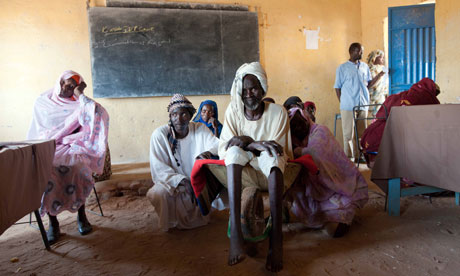
Sudan's Darfur region still living through troubled times

Two UN peacekeepers disappeared in Sudan's North Darfur state, last week, according to the UN. The two Jordanian officers from the UN-African Union force, Unamid, were declared missing in the town of Kabkabiya, about 140km west of El Fasher, North Darfur's capital.
Darfur no longer commands the headlines it used to, especially in 2004 when ethnic African tribes – the Fur, Masalit and Zaghawa – formed a broad alliance against Khartoum because of long-held grievances, including marginalisation and human rights abuses by Arab supremacist groups.
The Sudanese government responded by unleashing the janjaweed (Arabic for devil on horseback) militia on the rebels. The janjaweed carried out a campaign of murder and rape that drove more than a million black African villagers from their homes in the western region of Darfur.

In 2009, the international criminal court (ICC) indicted Omar Hassan al-Bashir, the Sudanese president, and issued an arrest warrant for Abdel Raheem Muhammad Hussein, the defence minister, for war crimes in Darfur. Sudan retaliated by expelling several foreign humanitarian organisations, accusing them of helping to build the charges against Bashir. The groups were thrown out despite their insistence they were independent and had no connection with the ICC. Among the NGOs expelled were Oxfam, Care and Save the Children.
The two men remain at large and Darfur largely disappeared from the news pages as the region lapsed into an uneasy calm – until this year. More than 700 people have been killed in clashes between rebels and government troops as well as in tribal unrest and criminal incidents, more than for the whole of 2011, according to UN peacekeepers. Read more >>>>>>>>>>>>>>>>>>>>>>>>

Thursday, August 30, 2012

Darfur’s invisible violence,” ReutersAlert (August 28, 2012)

Over the past month violence against civilians in Darfur has continued to explode upwards to levels not seen in years. On July 31 Khartoum’s security forces, using automatic weapons with live rounds, gunned down scores of student demonstrators in Nyala, killing twelve and leaving many critically injured. On August 4, I received an urgent email from North Darfur, informing me of the near total destruction of humanitarian capacity in the town of Kutum, which was overwhelmed by Arab militia on August 3, as was nearby Kassab IDP camp. On August 13 – 14 ethnic violence killed or injured dozens in Mellit. On August 17, following evening prayers, the town of Tabit was attacked by Khartoum’s paramilitary Central Reserve Police. The assault had hallmarks of a deliberate massacre.


There are almost daily reports from Radio Dabanga of girls and women being raped. It is difficult to know the full scale of sexual violence, since UNAMID and the UN don’t dare offend Khartoum by reporting or speaking about it. Astonishingly, there is no mention of rape in the last two reports on UNAMID by UN Secretary-General Ban Ki-moon. And his reports note only two instances of civilian bombings since the beginning of the year, despite the fact there have been dozens. Many attacks are in Jebel Marra, to which UNAMID, humanitarian organizations, and UN agencies are all denied access.

This sharp increase in violence and insecurity comes as UNAMID is preparing to reduce its force by over 4,000 troops and police. The justification? Security has improved sufficiently to justify this drawdown, and UNAMID force size should reflect “reality on the ground,” according to Hervé Ladsous, head of UN peacekeeping.


But the lack of security represented by the attacks on Kutum, Mellit, Tabit, and many other locations is the major “reality on the ground”; and growing insecurity means that humanitarians cannot reach many of those in camps who most need food, clean water, and primary health care. Dr. Mohamed Ahmed Eisa, former director of the Amal Center in Nyala, has indicated to me that based on his communications with medical professionals and others on the ground in Darfur, the health situation this rainy season is considerably worse than last year.

Water-borne diseases pose an especially grave threat, as the rains have been extremely heavy at times, and many locations have experienced serious flooding. Malaria, diarrheal diseases, and a host of other acute health risks are becoming more urgent by the day, especially in the wake of the withdrawal, expulsion, or suspension of operations by key medical relief organizations: MSF was force to suspend operations in Jebel Si, North Darfur; Médecins du Monde, active in Jebel Marra, was expelled by Khartoum in 2011; Aide Médicale Internationale and Medair both withdrew from West Darfur earlier this year. Read more >>>>>>>>>>>>>>>


Tuesday, August 21, 2012

No peace in Sudan's Darfur despite costly peacekeeping force


More than four years after an African Union-UN peacekeeping force costing billions of dollars arrived in Sudan's restive western region of Darfur, peace remains elusive and some question the mission's value.


Critics say the United Nations-African Union Mission in Darfur (UNAMID), the world's largest peacekeeping operation, is too close to the Sudanese government and not aggressive enough in fulfilling its core mandate of protecting civilians.

"It may be better than nothing," one analyst said, asking for anonymity. "But they are really focused on protecting themselves."

The concern comes as Darfur suffers a surge in violence.
More than 700 people have already been killed this year in clashes between rebels and government troops as well as in tribal unrest and criminal incidents, more than for the whole of 2011, UNAMID data show.


Rebels drawn from black African tribes rose up against the Arab-dominated Khartoum government in 2003. The conflict peaked years ago, killing at least 300,000 people, according to UN estimates. The government said 10,000 died.


Overall, there has been a "drastic decrease" in the number of people killed in clashes, and things would have been worse without UNAMID's roughly 16,700 troops, the force commander says.

"The mere presence of us on the ground flying the flag is a substantial deterrent," Lieutenant General Patrick Nyamvumba of Rwanda said.

Since he took over three years ago, UNAMID patrols have roughly doubled to around 150 a day, and more people displaced by the conflict have returned home.

The UN recorded 178,000 returnees between January 2011 and March this year.

"This could not be possible if there were not increased security," Nyamvumba said.

But an estimated 1.7 million remain in camps -- which more closely resemble poor villages -- where residents have reported shootings, arson and other violence.

In a July report focused on Khartoum's use since late 2010 of non-Arab militia to displace ethnic Zaghawa rebels and civilians from east Darfur, Swiss-based independent researchers alleged that in several cases "abuses against civilians, looting, and burning of property occurred in the immediate vicinity of UNAMID positions".

Nyamvumba says his troops are clearly mandated to give "physical protection" to civilians in imminent danger, which they have done.

The fact that 38 UNAMID peacekeepers have been killed in hostile action shows they are doing their job, he said, adding: "I think the mission has accomplished quite a lot."

'They were not able to protect themselves'

But Darfur's top official, Eltigani Seisi, said the protection mandate seems to lack clarity.

"We saw incidences where UNAMID forces have been attacked and they were not able to... protect themselves," he said.

UN figures show that 13 UNAMID vehicles were carjacked in the first half of this year.

"If they are not able to protect themselves, they cannot protect the civilians," said Seisi, who heads the Darfur Regional Authority, set up to implement a peace deal signed last year between Khartoum and rebel splinter factions. Read more >>>>>>>>>>>>>>>>>>>>>>>>>>>>>>>>>>>>>>>>


Sunday, August 19, 2012

Parts of Darfur See Stability, but Others Are Seething

NAIROBI, Kenya -- It was a scene that seemed to belong to a different time, say, early 2004, when war was raging across Sudan's vast desert region of Darfur. Hundreds of armed men -- on horseback, camels, donkeys and in four-by-four trucks -- some in street clothes, some in camouflage fatigues, swept into the Kassab displaced persons camp and began looting, burning, raping and shooting.
In the span of a few hours, several people were killed and tens of thousands were sent running for their lives.

But this was not 2004. It happened this month, this year, and United Nations officials and aid workers said it was among the more troubling violence Darfur has experienced in years.
"We haven't had a crisis like this in awhile," said Christopher Cycmanick, a spokesman for the United Nations-African Union peacekeeping mission in Darfur, known as Unamid.
Nearly a decade after war first arrived, Darfur is a land of mixed signals.
Some areas have become stable -- even peaceful, many residents say -- like parts of western Darfur, where thousands of families are finally returning home.

But at the same time, other areas are seething.
The overall trend for the past couple of years had been one of cautious improvement, United Nations officials say, with civilian deaths gradually declining. But this year is on track to be a setback, they warn, with more criminality, rebel attacks, rapes, displacements and assorted mayhem than in the recent past.
Activists contend that official pronouncements of progress have long been misleadingly rosy, and they are increasingly fed up with the huge, $1.5-billion-a-year peacekeeping mission in Darfur, saying that it is failing at its core mission: protecting civilians.

"This is probably the least cost-effective peacekeeping mission in U.N. history, but it's simply not possible to say that out loud, given A.U. sensitivities," said Eric Reeves, a Smith College professor and a prolific blogger on Sudan. "There are factitious claims about 'improved' security, and woe to the man who disputes the U.N./Unamid line."
In the case of Kassab, many of the victims begged for help when the marauders stormed into the camp, but because of the intensity of the violence and some flooding along the roads, United Nations peacekeepers did not arrive until three days later. When they did get there, they pulled back because government forces were still battling the militia fighters. It took several more days before government troops were able to restore a semblance of control.

Government forces in Darfur are stretched thin these days, but beyond that, they seem to be living up to their history as some of the worst perpetrators. Just this Friday, there were reports of renegade soldiers ransacking the market in Tabit, breaking into shops and shooting civilians.

In the past few months, there have been heavy bombings in eastern Jebel Marra; deadly protests in Nyala; vicious clashes near Tabun; and further attacks on displaced people in several other camps across Darfur. Read more >>>>>>>>>>>>>>>>>>>>


Tuesday, August 07, 2012

Flawed Peace Process Fails in Darfur, Again: Enough Project Report .

WASHINGTON--(ENEWSPF)--August 6, 2012. The African Union and U.N. Security Council renewed Darfur’s hybrid peacekeeping mission, UNAMID, this week without acknowledging the glaring failures of the Doha peace process. The Doha Document for Peace in Darfur, or DDPD, signed in July 2011, is yet another attempt by the Khartoum regime to continue its ongoing divide-and-conquer strategy of dealing with each of the country’s conflicts in isolation, argues a new Enough Project report.


The DDP was inherently flawed from the beginning because it does not address the root security or political issues of the Darfur conflict. Moreover, the only signatures to the DDPD are the government of Sudan and the Liberation and Justice Movement, excluding the three most prominent rebel groups in the region—the Justice and Equality Movement, and both factions of the Sudan Liberation Movement.

“Despite the head of UNAMID Ibrahim Gambari briefing the U.N. Security Council earlier this week on the progress in Darfur implemented as part of the Doha process, it has been an operational failure due to a lack of compliance among other things” said Omer Ismail, Enough Project senior policy advisor and co-author of the report. “One of the Khartoum regime’s hallmark moves is to appease international pressure and agree to an accord but not follow through on obligations in the agreement, which is exactly what is happening with the Doha Document for Peace in Darfur.”

The Enough Project report outlines Khartoum’s three significant violations of the DDPD: a failure to transfer funds to the Darfur Regional Authority, reluctance to cooperate with UNAMID, and refusal to allow unfettered humanitarian access in Darfur. The report points out that all three of these violations are reflected in Khartoum’s behavior dealing with the other conflicts taking place in Sudan.

“The U.S. government and other key donors and multilateral organizations must rethink their Sudan policy portfolios so the Darfur crisis is not dealt with in isolation,” said Enough Project Executive Director John Bradshaw. “Each conflict in Sudan, including Darfur, stems from the Khartoum regime’s systematic marginalization and neglect of the periphery and requires a comprehensive approach to achieve lasting peace.” Read more >>>>>>>>>>>

Friday, August 03, 2012

Sudan: Security forces must stop using live roundsagainst demonstrators

Sudanese security forces must stop shooting protesterswith live ammunition, Amnesty International said after confirming thatat least eight demonstrators killed on Tuesday had bullet wounds in theirchests, some inflicted at close range.
At least 10 people, many of them high school students,were killed on July 31 when Security services and paramilitary police openedfire in Nyala, South Darfur, during a demonstration against fuel pricesand the cost of living. Dozens more were injured.
Medical staff at Nyala Public Hospital told Amnesty Internationalthat the wounds inflicted on the eight bodies admitted to their morguewere consistent with those caused by 5.56mm and 7.62mm automatic rifles.
“Any individual members of the security forces involvedin the events that caused this bloodbath must be suspended immediately,”said Paule Rigaud, Amnesty International’s Africa program director.
“The Sudanese government must investigate why protesterswere directly targeted by the security force personnel who opened fireon them with live bullets.”
The Sudanese authorities have routinely used excessiveforce against mostly peaceful demonstrations which have occurred regularlyin Sudan’s major cities since mid-June.
According to the United Nation’s Basic Principles of theUse of Force, live ammunition should not be used, either directly againstdemonstrators or as warning shots, unless it is absolutely necessary andonly after less extreme means have proved ineffective.
The security forces also fired Dushka-type heavy machine-gunsin the air, which injured residents in their homes as bullets fell downfrom the sky.
“The Sudanese security forces must not be allowed to policedemonstrations in such a reckless manner and with flagrant disregard forhuman life,” said Rigaud.
“Sudanese citizens must be allowed to express their opinionpeacefully without experiencing systematic repression. Attacks againstpeaceful protesters are an unacceptable violation of their right to freedomof expression, assembly and association.”
Amnesty International is also concerned that injured protestersmay have been denied medical care following eye witness reports some werearrested and that plain clothes National Security Service personnel weredeployed within Nyala General Hospital.
Amnesty International has documented a pattern in recentweeks of injured protesters being denied medical treatment in Khartoum.
Police forces have used batons, tear gas and rubber bulletsat close range against demonstrators.
And, in response to the protest movement, the NationalSecurity Services (NSS) arrested hundreds of known political and civilsociety activists, regardless of their involvement in demonstrations. Manytold Amnesty International they had been tortured with sticks, water hosesand fists, and made to stand under the scorching sun all day.
In some cases individuals who had been injured in demonstrationsor as a result of torture and ill-treatment by security forces told AmnestyInternational that they preferred not to seek treatment in hospitals becausethey feared arrest and intimidation.
Dozens of activists remain in administrative detention.
Notes to Editors
• Security forces involved in the Nyala shootingsinclude the Central Reserve Police – a combat-trained paramilitary police- and plainclothes agents of the National Security Services (NSS).
AI Index: PRE01/378/2012

"Vast humanitari​an crisis in Sudan—yet again"

"Vast humanitarian crisis in Sudan—yet again"

From The Christian Science Monitor, August 3, 2012
http://www.csmonitor.com/Commentary/Opinion/2012/0803/Vast-humanitarian-crisis-in-Sudan-again
 
By Eric Reeves

Yet again the grim title of "world's greatest humanitarian crisis" goes to Sudan—this time for developments in the border regions between Sudan and the newly independent country of South Sudan. The crisis is exploding as the rainy season descends fully upon this area, and humanitarian resources are overwhelmed.

Khartoum's denial of all humanitarian access to rebel-controlled areas within its borders, along with a relentless campaign of aerial bombardment, is generating a continuous flow of tens of thousands of refugees—4,000 per day according to Doctors Without Borders/Médecins Sans Frontières (MSF). But even that June figure is being quickly overtaken according to reports. And no wonder. The regime faces no significant international condemnation or consequences for its role in creating this crisis. That must change.

At various points over the last quarter century, greater Sudan has been the site of vast humanitarian crises, notably in Darfur, in western Sudan. These were foreseeable episodes of human suffering and destruction rooted in deliberate military and political decisions by the ruling National Islamic Front/National Congress Party and Sudan's president, Omar al-Bashir. If the regime's tactics have differed, its strategic goal has not. This is "counter-insurgency on the cheap," and it's painfully familiar.

At present, hundreds of thousands of civilians have been forced from their homes in South Kordofan and Blue Nile states—areas that are part of what is now (northern) Sudan, but which are substantially populated by people who sided with the South during the 1983-2005 civil war. Those fleeing are driven by desperate hunger, a lack of water, and air attacks. There is no accurate census for the numbers who have reached refugee camps in the South (in the Unity and Upper Nile states), but data suggest that the figure is approaching 300,000. Read more >>>>>>>>>>>>>>>>>>>>

UN CALLS FOR INDEPENDEN​T PROBE INTO VIOLENCE THAT KILLED EIGHT PEOPLE IN DARFUR

UN CALLS FOR INDEPENDENT PROBE INTO VIOLENCE THAT KILLED EIGHT PEOPLE IN DARFUR
New York, Aug  3 2012 10:05AM
The United Nations today urged Sudan to launch an independent investigation into the reported use of excessive force by Government security forces during a protest in Darfur on Tuesday, which resulted in eight deaths and injured more than 50 people.
According to eyewitnesses, security forces opened fire at demonstrators in Nyala, the capital of South Darfur, and used tear gas, killing eight people, five of whom were young students aged 17 and below.
“We urge the Government to promptly launch an independent and credible investigation into the violence and the apparent excessive use of force by security forces,” the spokesperson for the Office of the High Commissioner for Human Rights (OHCHR), Ravina Shamdasani, <"http://ohchr.org/EN/NewsEvents/Pages/DisplayNews.aspx?NewsID=12404&LangID=E">told reporters in Geneva.
Media reports state that the population was protesting against rising prices in Sudan’s western Darfur region after the Government announced a cut in fuel subsidies and other austerity measures last month.
“There are key international guidelines that must be respected in handling protests so that the legitimate right of people to freedom of expression and assembly are fully respected,” Ms. Shamdasani said. “We call on the Government to unequivocally condemn excessive use of force to suppress protests, and to hold accountable those who were responsible for the fatalities and injuries.”
High Commissioner for Human Rights Navi Pillay had earlier called on Sudanese authorities to ensure that demonstrations are allowed to proceed peacefully and for restraint from all sides.
“We also call again on the Government to immediately and unconditionally release those who have been detained for merely exercising their rights to freedom of assembly and expression,” Ms. Shamdasani said, adding that human rights staff of the UN-African Union peacekeeping mission in Darfur (UNAMID) will continue to monitor the situation.

Deployed at the beginning of 2008, UNAMID is tasked with protecting civilians, promoting an inclusive peace process and helping ensure the safe delivery of humanitarian assistance across Darfur, an arid region on Sudan’s western flank.

For more details go to UN News Centre at http://www.un.org/news

Janjaweed militias raided IDPs camp (Kasab) and killed three displaced people in front of the North Darfur governor Osman Yousif Kibir

Kuttum August 1st, 2012. In a striking development of events in the city of Kutum, Northern Darfur, following the killing of Mayor of Oasis Abdul Rahman Mohammed Isa on Wednesday, groups of the Janjaweed militia raided IDPs camp (Kasab) near the city Kuttum.


They surrounded the camp. The governor of the state of North Darfur, Osman Yusuf Kibir visited the area to see the developments. Upon his arrival in the camp (Kasab,) some individuals wanted to talk to him. But some Janjaweed immediately shot the camp dwellers dead in front of the governor and the commander of the army. One of the people killed was Adam Khamis. People are trying to investigate the identity of the others.

In another development of the events, another group of Janjaweed from El Fasher arrived to Kassab IDP camp on Thursday morning. They started looting, killing and abusing camp dwellers. They still continue to do so.


According to reports from Kuttum, the town has become a ghost city. Only herds of the janjaweed militias can be see roaming different parts of the city, terrorizing the town inhabitants and committing crimes.

The regular Sudanese army and police have so far kept silent. UNAMID force, mandated to protect the civilians in Darfur, is nowhere to be seen.

This arises suspicion and doubt in the effectiveness of these forces in executing their mandate and the collusion between them and the Sudanese government.

The source in Kuttum said "The Janjaweed militias in Kuttum are mostly foreign elements under the command of Ali Osman Mohamed Taha, First Vice President".

Wednesday, August 01, 2012

Sudan transport price protests kill six in Darfur

Six people have been killed in violent protests against high transport prices in the Darfur region of western Sudan, local officials say.


Police in Nyala, the capital of South Darfur state, fired tear gas at protesters throwing stones and burning tyres in the streets, witnesses said.

Several protesters chanted slogans calling for the government's downfall.

Since June, Sudan has seen sporadic protests against government austerity measures, including fuel subsidy cuts.

The country's authorities have been trying to cut spending since Sudan lost three-quarters of its oil revenue when South Sudan seceded last year.

Demonstrators in Nyala chanted "No to high prices" and "People want to change the regime", according to witnesses.


Bothina Mohmed Ahmed, a spokeswoman for the state of South Darfur, said it was not known how the six deaths had happened, and that an investigation had been launched. Read more >>>>>>>>>>>>>>>


Monday, June 18, 2012

Darfuris Union organizes cultural festival at The Hague under the theme: Let us join hands together for Darfur

Darfuris Union organizes cultural festival at The Hague under the theme: Let us join hands together for Darfur


In the context of contact with different communities in The Netherlands and to pinpoint cultural and social reality of Darfur, Darfur Union organizes an Open Day. The program contains:

1.Exhibition

2.History and heritage of Darfur

3.Songs

4.Special program for kids

5.Miscellaneous

Time: July 7th, 2012 at 13.00 hours

Place: The Hague

Direction: Take trams 16 from Hollandspoor train station going to Wateringen. Step out at the station Alberding Thijmstraat. From there, it is 1 minutes walk to Ferrandweg 4T

For queries, please contact bellow numbers:

Al-Sadig Khamis 0684283940

Kamal Yacoub 0643771256

You are all welcome. Entrée is free.

Wednesday, June 13, 2012

World’s most murderous dictator thrives

By: Nat Hentoff, The Dickinson Press


Except primarily for the ironhanded rulers in Russia and China, the most despised global dictator is President Bashar al-Assad of Syria, who is inflicting monstrous genocide on his own people. As usual, the United Nations is useless. But meanwhile, another monster is thriving, someone who has killed and starved to death hundreds of thousands more of his people than al-Assad.


President Omar al-Bashir of Sudan has had arrest warrants issued against him by the International Criminal Court (ICC) on counts of war crimes, crimes against humanity and, yes, genocide. Swashbuckingly unintimidated, al-Bashir is making initial martial moves against recently independent South Sudan that could bring back the years of horrors he unleashed in the country as a whole, including Darfur in the west.


In the past, the U.N. issued paper resolutions of concern and helped negotiate the now continually vulnerable independence of South Sudan. However, as al-Bashir’s Army continues to rape and murder, creating omens of a renewed civil war, the U.N. is silent, as are nations that have demonstrated concern about human rights, including Barack Obama’s United States.


And just about everywhere, the rushing media is otherwise occupied. But, as I expected, the most courageous American investigative reporter, The New York Times’ Nicholas Kristof, has been writing from the remote, almost inaccessible Nuba Mountains of Sudan. Read more >>>>>>>>>>>>>>>>>>>>>


Wednesday, June 06, 2012

Mukesh Kapila: Act Now or It will Be Too Late

The former head of the United Nations in Sudan said humanitarian situation in the Nuba mountains is very disturbing. Mukesh Kapila recently visited villages in southern Kordofan and said he has witnessed illegal weapons such as landmine and cluster bombs being used against civilians in the Nuba Mountains.


He also said many children in the region showed signs of malnourishment. Kapila warned of what he termed the ‘’second genocide of the century’’ unless the international community takes action. Fighting between Sudan Armed Forces and rebels of Sudan People’s Liberation Army – North (SPLA North) erupted in June of last year, forcing thousands of civilians to take refuge in South Sudan.


Fighting in Nuba Mountains


He accused Sudan of using heavy weapons against civilian targets. ‘’ What is going on in Nuba mountains is even worse because ten years after Darfur we have much more sophisticated weaponry being used by Sudan Armed Forces’’ Kapila said.


The former United Nations diplomat said Sudan's government is using proxy popular

defense militia to terrorize the people of Nuba mountains. He said Darfur was the first

genocide of the 21st Century, adding that what he has witnessed on his most recent trip to the area suggests a second genocide is occurring in Sudan. Read more >>>>>>>>>>>>>>>>>>>>>>>>>>>>


ICC asks UN to help arrest Sudan's president

UNITED NATIONS (AP) — Sudan's refusal to arrest President Omar al-Bashir and three others accused of war crimes in Darfur is "a direct challenge" to the U.N. Security Council, and it should now consider asking all countries and regional organizations to carry out the arrests, the International Criminal Court's chief prosecutor said Tuesday.


Luis Moreno-Ocampo conceded that council discussions of other possibilities to arrest the four Sudanese, including seeking help from member states and regional bodies, "will be problematic."


"But the victims will receive a clear message: They are not ignored," he said. "And the perpetrators will receive a clear message: There will be no impunity."


The court, set up in 2002 to prosecute the most senior perpetrators of genocide, crimes against humanity and war crimes from nations that cannot or will not put them on trial, has no police force of its own to arrest suspects. More than 100 countries that are parties to the Rome statute are required to arrest those sought by the tribunal — but al-Bashir has traveled to friendly nations without being detained. Read more >>>>>>>>>>>>>>


Darfur War Crimes Prosecutor Urges Tougher Action Against Sudan President

The outgoing prosecutor at the International Criminal Court, frustrated over his inability to enforce arrest warrants for the Sudanese president and three others accused of war crimes in the Darfur conflict, recommended to the Security Council on Tuesday that it take more severe action against the defendants, including possibly seizing them inside Sudan for trial in The Hague.


The prosecutor, Luis Moreno-Ocampo, whose term expires at the end of June, told council members in his 15th and final report on the Darfur prosecution effort that the council also should consider requesting that all 193 members of the United Nations — not just those that recognize the court’s authority — take action to enforce the arrest warrants on President Omar Hassan al-Bashir of Sudan and the others, who include two powerful subordinates and the leader of a feared militia accused of large-scale killings, pillage and rapes.


Mr. Bashir, the only sitting head of state to be indicted on charges of genocide, war crimes and crimes against humanity, has repeatedly scoffed at the arrest warrants and has even traveled abroad despite the risk of arrest, although he could face that threat again next month if he attends an African Union summit meeting in Malawi. Read more >>>>>>>>>>>>>>>>>>>>>>>


Monday, June 04, 2012

Ocampo last briefed the Council on the work of the ICC in Sudan on 15 December 2011

http://www.securitycouncilreport.org/site/c.glKWLeMTIsG/b.8102701/k.516C/June_2012brSudanDarfur.htmExpected Council Action


In early June, the Council is scheduled to receive the biannual briefing from Prosecutor Luis Moreno-Ocampo on the work of the International Criminal Court (ICC) in Sudan. Ocampo is expected to deliver his report in a public meeting of the Council, followed by a private meeting. (This will be his final briefing to the Council as ICC Prosecutor, as he is expected to leave his post mid-month. He will be succeeded by Fatou Bensouda of Gambia.)

Key Recent Developments

Ocampo last briefed the Council on the work of the ICC in Sudan on 15 December 2011. He outlined the evidence that the ICC had mustered against the various Sudanese officials and rebels that it had indicted. He also noted that only days prior to the briefing his office had requested an arrest warrant for Sudan’s Minister of Defence, Abdelrahim Mohamed Hussein, for crimes against humanity and war crimes he allegedly committed while serving as Interior Minister and Special Representative of the President in Darfur. In particular, Ocampo said that Hussein “played a central role in coordinating the crimes, including in recruiting, mobilizing, funding, arming, training and deploying the militia/Janjaweed as part of the Government of Sudan forces, with the knowledge that these forces would commit crimes.”


Ocampo also emphasised the importance of implementing ICC arrest warrants and respecting Security Council resolutions. He called for the AU and the Arab League to play a key part in helping to find a solution that respects the authority of the Council and the decisions of ICC judges.


Regarding the situation in Darfur more generally, Ocampo said that, despite numerous requests from the Council, aerial bombardments continued and the Janjaweed (a pro-Khartoum militia) had not been disarmed.


Ambassador Daffa-Alla Elhag Ali-Osman (Sudan) also addressed the Council in December. He said that Ocampo’s remarks contained “baseless accusations” and ignored improved security conditions in Darfur. Ali-Osman also noted that Ocampo had not mentioned the Doha Document for Peace in Darfur, which he said reflected the Sudanese government’s desire for peace.


On 1 March, the ICC issued an arrest warrant for Hussein for crimes against humanity and war crimes allegedly committed in Darfur between August 2003 and March 2004. (Ocampo had requested the pre-trial chamber to issue the warrant for Hussein’s arrest, on 2 December 2011.)


On 20 April, a formed police unit that had been patrolling a camp for internally displaced persons in Western Darfur was fired upon while returning to base. Four Togolese peacekeepers were wounded in the assault, and one later died. The Council adopted a press statement (SC/10623) on 24 April condemning the attack and calling on the Sudanese government to bring those responsible to justice. Read more >>>>>>>>>>>>>>>>>>>


Monday, May 28, 2012

Somebody Help: The Forgotten Population in North Darfur

In the remote Jebel Si area of North Darfur, Doctors Without Borders/Médecins Sans Frontières (MSF) runs a hospital, five health posts, and a mobile clinic. These are the only health facilities in the area, and they serve a permanent population of 100,000, as well as about 10,000 seasonal nomads. The majority of MSF’s patients in Jebel Si are women and children.

As the only medical organization with a permanent presence in Jebel Si, the population is entirely dependent on MSF for health care and emergency assistance. MSF’s relationship with the local community is one of mutual trust and cooperation.

But now a series of obstacles threaten to seriously hamper MSF’s ability to deliver medical assistance. Vital medical and logistical supplies have been prevented from reaching the area, work permits have not been granted, and physical access to the region has become increasingly difficult.

As a result of these obstacles, MSF has been forced to scale down its activities dramatically. Unless urgent steps are taken to rectify the situation, the people of Jebel Si will be faced with the reality of a future without essential health care. Read more >>>>>>>>>>>>>>>>>>>>>>>>>>>

GOC Charges Soldiers On Sexual Conduct In Darfur

Another troop of 800 officers and men of the Nigerian Army have been prepared for deployment on peacekeeping mission to Darfur Region of Sudan, with a stern warning to stay away from sexual misconduct. The 26-battalion troop was also warned to avoid circumstances that may lead to being disarmed by the Darfur rebels and guard against any act that would tarnish Nigeria’s image.
General Officer Commanding (GOC) 1 Mechanised Division Nigerian Army, Major General Garba A. Wahab, gave the warning at the graduation ceremony of the 26 Battalion Pre-Deployment Training at the Nigerian Army Peace Keeping Centre (NAPKC), Jaji, near Kaduna, yesterday. According to the GOC, “as you are aware, Nigeria is the largest troop contributor to the United Nations Mission in Darfur (UNAMID) operations. In this regard, you should strive to live above board and avoid anything that would ridicule the good image our dear country has built over the years in the area of international peace and security.
“As your General Officer Commanding, I have confidence in your ability to execute your task in accordance with UNAMID’s mandate. But, I must remind you that the Nigerian Army will not accept any situation where its soldiers are disarmed hence the need for effective leadership at all levels,” he said. Noting that the situation in the crisis areas of Sudan were unpredictable, Wahab told the peace keepers to avoid engaging in any form of sexual misconduct, saying, “don’t go to Darfur and start sleeping with women. It is highly unprofessional. Aside that, AIDS is real,” he warned. He stressed that having expended huge resources on their training, the Nigerian government placed high premium on their capability as a peace-keeping force. Read more >>>>>>>>>>>>>>>>>>>>>>

Wednesday, May 23, 2012

Sudan restrictions hamper aid work in Darfur - MSF

KHARTOUM (Reuters) - Government restrictions on Medecins Sans Frontieres (MSF) have forced the group to suspend key medical activities in part of Sudan's Darfur region, leaving tens of thousands of people without health care, the aid agency said on Tuesday.


The western Darfur area has been racked by violence since 2003, when rebels took up arms against a central government they accused of neglecting the remote region.


While fighting is down from its peak and the United Nations runs a large peacekeeping operation in Darfur, banditry and tribal fighting in addition to clashes between rebels and government forces have continued to plague the region.


MSF said hurdles to procedures like getting permits and shipping in medical supplies forced it to suspend most of its medical activities in the Jebel Si area, a conflict area in North Darfur state, where it is the only healthcare provider.


"With the reduction of our activities in Jebel Si, more than 100,000 people in the region are left entirely without healthcare," Alberto Cristina, MSF's operational manager for Sudan, said in the statement. Read more >>>>>>>>>>>>>>>


Tuesday, May 22, 2012

Sudanese civil society organizations urge Dutch government and entrepreneurs Not to invest in the Sudan

For Immediate Release                                                                                       May 21st, 2012

Sudanese civil society organizations urge Dutch government and entrepreneurs Not to invest in the Sudan

The Sudanese Dutch Private Investment Forum will be organized by The Chamber of Commerce Haaglanden on May 21st, 2012 at The Hague.

Almost all members of the Sudanese delegation are government officials. The International Criminal Court (ICC) issued warrants for the arrest of Sudan's president for war crimes, crimes against humanity and genocide and other senior government officials who are still in power. Violations of human rights are on daily basis, civil liberties are denied and security is non-existent across the country.

The Sudanese government relies on foreign investments to fund its military and the brutal militias to commit war crimes and crimes against humanity against the people of the Sudan. The revenue from the investment will be used to purchase arms to commit more crimes on innocent people in South Kordofan, Eastern Sudan, Blue Nile, Darfur and the rest of the Sudan.

The Sudanese civil society organizations sent letters to The Dutch government, entrepreneurs, people of The Netherlands and the participants in The Sudanese Dutch Private Investment Forum, urging them to divest instead of investing in the Sudan, to pressure the government of Sudan to improve human rights records, to fully cooperate with the International Criminal Court and to allow the humanitarian aid organizations to access the people in a dire need.

Darfur Union
darfurunion@yahoo.com

Nuba Mountains Solidarity Abroad
sabiraglain@hotmail.com

Sudan Youth for Change Movement
nasir518@hotmail.com

Sudan Democratic forum