Mon Dec 19, 2005 9:11 AM ET
Reuters
EL-GENEINA, Sudan (Reuters) - Arab militias on camels and horses attacked a village in West Darfur on Monday, killing 12 people, rebels and government officials said.
"The Janjaweed attacked this morning and killed 12 innocent civilians, including one man who was over 60-years old," said Hassan Khamis, a commander in the Darfur rebel National Movement for Reform and Development (NMRD).
Janjaweed is the local name given to mostly Arab militias, mobilised by the government to fight Darfur rebels.
A source in the government in Darfur confirmed that attack. "It was Arab nomads," he said, asking not to be identified.
"We are not sure yet of the details but the governor has gone to the site of the attack," he added. The attack was on the Abu Surooj village north-west of the main town el-Geneina.
The NMRD controls areas along the border with Chad, which has seen sporadic fighting in recent days between Chadian government forces and deserters.
On Sunday Chad's communications minister said government troops had repulsed a rebel attack on a town near the border and blamed Sudan for the fighting that killed 100 people.
Sudan said it was not involved.
The violence involving troops from Chad comes amid a surge in fighting involving Sudanese rebels and militias.
Earlier this month the United Nations grounded some aid flights and evacuated workers in parts of West Darfur State because of the escalating violence.
Tens of thousands have been killed in Darfur since February 2003 when rebels, saying they had been marginalised by the government in Khartoum, took up arms. More than 2 million people have been driven from their homes.
Peace talks are under way in the Nigerian capital Abuja to try to reach a deal to end the conflict the United States has called genocide.
Monday, December 19, 2005


Shining light on genocide in Sudan
Monday, December 19, 2005
By PRASHANT GOPAL
STAFF WRITER
Ten runners carrying a torch Sunday between Temple Beth Rishon in Wyckoff and Barnert Temple in Franklin Lakes were doing more than heralding the approach of Hanukkah.
The 6-mile torch run had a new purpose this year: to shine light on a genocide in Sudan that has claimed more than 180,000 lives and displaced about 2 million people since 2003.
Organizers said they hope to raise awareness and encourage politicians to get involved.
"During the Holocaust, everybody felt that they didn't want to speak out," said one of the runners, Larry Silverman, a member of Barnert Temple. "We've gone through it and few people spoke up for us, and we're not going to let that happen to anybody else."
The runners - members of both synagogues - left Beth Rishon at about 9:45 a.m., arriving at Barnert Temple a half-hour later. About 100 children - students at Barnert's religious school — greeted the runners with songs, including Peter Yarrow's "Light One Candle." One of the runners used the torch to light the menorah.
Sara Losch, director of education at Barnert, said the event is a display of Jewish unity.
The torch run began about 20 years ago. It originally included a third synagogue in Oakland that has since moved out of the area.
"We need to raise our voices for the people dying in Africa today," Losch said.
The runners returned to Beth Rishon, where they sat down for a lunch of fruit and bagels.
Barkley Calkins, a board member of the Darfur Rehabilitation Project in Newark, spoke about his group's effort to educate and spur the U.S. government to act.
The Arab-dominated Sudanese government is accused of backing a brutal militia in a campaign to stamp out a rebellion. The Arab-tribal militia has reportedly raped and murdered thousands of ethnic Africans during the last few years.
Calkins said the public needs to know that the genocide continues.
"There might be some confusion because the [Bush] administration is not speaking out and the mainstream media is all but silent," he said.
E-mail: gopal@northjersey.com
Copyright © 2005 North Jersey Media Group Inc.
By PRASHANT GOPAL
STAFF WRITER
Ten runners carrying a torch Sunday between Temple Beth Rishon in Wyckoff and Barnert Temple in Franklin Lakes were doing more than heralding the approach of Hanukkah.
The 6-mile torch run had a new purpose this year: to shine light on a genocide in Sudan that has claimed more than 180,000 lives and displaced about 2 million people since 2003.
Organizers said they hope to raise awareness and encourage politicians to get involved.
"During the Holocaust, everybody felt that they didn't want to speak out," said one of the runners, Larry Silverman, a member of Barnert Temple. "We've gone through it and few people spoke up for us, and we're not going to let that happen to anybody else."
The runners - members of both synagogues - left Beth Rishon at about 9:45 a.m., arriving at Barnert Temple a half-hour later. About 100 children - students at Barnert's religious school — greeted the runners with songs, including Peter Yarrow's "Light One Candle." One of the runners used the torch to light the menorah.
Sara Losch, director of education at Barnert, said the event is a display of Jewish unity.
The torch run began about 20 years ago. It originally included a third synagogue in Oakland that has since moved out of the area.
"We need to raise our voices for the people dying in Africa today," Losch said.
The runners returned to Beth Rishon, where they sat down for a lunch of fruit and bagels.
Barkley Calkins, a board member of the Darfur Rehabilitation Project in Newark, spoke about his group's effort to educate and spur the U.S. government to act.
The Arab-dominated Sudanese government is accused of backing a brutal militia in a campaign to stamp out a rebellion. The Arab-tribal militia has reportedly raped and murdered thousands of ethnic Africans during the last few years.
Calkins said the public needs to know that the genocide continues.
"There might be some confusion because the [Bush] administration is not speaking out and the mainstream media is all but silent," he said.
E-mail: gopal@northjersey.com
Copyright © 2005 North Jersey Media Group Inc.
Saturday, December 17, 2005
Sudan's Special Court On Darfur Crimes Not Satisfactory, UN Genocide Expert Says
UN News Service (New York)
NEWS
December 16, 2005
Posted to the web December 17, 2005
A United Nations genocide expert today voiced disappointment in the efforts of Sudan's Government to address the crimes committed in the country's western Darfur region, where conflict has been marked by massive displacement, rights abuses and widespread killings.
The UN Security Council has asked the International Criminal Court (ICC) to probe the situation, but earlier this week, the Sudanese Government indicated that it would not cooperate with the ICC.
Speaking to reporters in New York, Juan Mendez, Special Adviser of the Secretary-General on the Prevention of Genocide, pointed out that this was not an option but a legal obligation. "I have consistently stressed that ensuring accountability is an essential element of genocide prevention," said Mr. Mendez, who visited Darfur in September.
Asked whether the Government was living up to its pledges, he replied: "My impression is very discouraging, quite frankly. For months nothing was done about the literally hundreds of cases of destruction of villages."
He said the Government's own special court had also produced "discouraging" results. "They have dealt with some cases that seem to be marginal to the serious events that happened in 2003 and 2004," he said.
He added that if the Khartoum Government refuses to cooperate with the ICC then "the Security Council should take appropriate action."
During his visit to Sudan in September, he said, he expected to see a more stable situation. "Unfortunately, the situation that I found was of great concern." He cited a "significant disconnect" between the account of the Government on its actions to address the situation in Darfur and those of the region's people.
Mr. Mendez also reported on his visit to Côte d'Ivoire earlier this month, where he witnessed significant tensions which posed a risk of massive human rights violations based on ethnicity, religion or national origin.
In response, he called for measures to address the issue, including starting disarmament, holding legitimate elections, and strengthening the UN Operation in Côte d'Ivoire (UNOCI).
NEWS
December 16, 2005
Posted to the web December 17, 2005
A United Nations genocide expert today voiced disappointment in the efforts of Sudan's Government to address the crimes committed in the country's western Darfur region, where conflict has been marked by massive displacement, rights abuses and widespread killings.
The UN Security Council has asked the International Criminal Court (ICC) to probe the situation, but earlier this week, the Sudanese Government indicated that it would not cooperate with the ICC.
Speaking to reporters in New York, Juan Mendez, Special Adviser of the Secretary-General on the Prevention of Genocide, pointed out that this was not an option but a legal obligation. "I have consistently stressed that ensuring accountability is an essential element of genocide prevention," said Mr. Mendez, who visited Darfur in September.
Asked whether the Government was living up to its pledges, he replied: "My impression is very discouraging, quite frankly. For months nothing was done about the literally hundreds of cases of destruction of villages."
He said the Government's own special court had also produced "discouraging" results. "They have dealt with some cases that seem to be marginal to the serious events that happened in 2003 and 2004," he said.
He added that if the Khartoum Government refuses to cooperate with the ICC then "the Security Council should take appropriate action."
During his visit to Sudan in September, he said, he expected to see a more stable situation. "Unfortunately, the situation that I found was of great concern." He cited a "significant disconnect" between the account of the Government on its actions to address the situation in Darfur and those of the region's people.
Mr. Mendez also reported on his visit to Côte d'Ivoire earlier this month, where he witnessed significant tensions which posed a risk of massive human rights violations based on ethnicity, religion or national origin.
In response, he called for measures to address the issue, including starting disarmament, holding legitimate elections, and strengthening the UN Operation in Côte d'Ivoire (UNOCI).
Kristof challenges O'Reilly to visit Darfur with him
12/17/2005 @ 5:04 pm
Filed by RAW STORY
In Sunday's New York Times, columnist Nicholas D. Kristof challenges Fox News Channel's Bill O'Reilly to take a trip to Darfur with him to see "a real war against Christmas values," RAW STORY has learned.
Kristof offers "prayers" that O'Reilly and "other money-changers in the temple" will realize that the spirit of Christmas is about helping the needy and that fighting against genocide is a more worthy cause than "hectoring people to say 'Merry Christmas,' rather than 'Happy Holidays.'"
Excerpts from Nicholas D. Kristof's "A Challenge for Bill O'Reilly" follow:
#
After I suggested in last Sunday's column that a better way to honor the season might be to stand up to genocide in Darfur (a calamity that O'Reilly has ignored), O'Reilly denounced me on his show as a "left-wing ideologue." Bless you, Mr. O'Reilly, and Merry Christmas to you, too!
Later in the show, O'Reilly described us print journalists in general as "a bunch of vicious SOBs." Bless you again, Mr. O'Reilly; I'll pray harder for the Christmas spirit to soften your pugnacious soul.
....
So I have a challenge for you, Mr. O'Reilly: If you really want to defend traditional values, then come with me on a trip to Darfur. I'll introduce you to mothers who have had their babies clubbed to death in front of them, to teenage girls who have been gang-raped and then mutilated -- and to the government-armed thugs who do these things.
You'll have to leave your studio, Bill. You'll encounter pure evil. If you're like me, you'll be scared. If you try to bully some of the goons in Darfur, they'll just hack your head off. But you'll also meet some genuine conservative Christians -- aid workers who live the Gospel instead of sputtering about it -- and you'll finally be using your talents for an important cause.
Filed by RAW STORY
In Sunday's New York Times, columnist Nicholas D. Kristof challenges Fox News Channel's Bill O'Reilly to take a trip to Darfur with him to see "a real war against Christmas values," RAW STORY has learned.
Kristof offers "prayers" that O'Reilly and "other money-changers in the temple" will realize that the spirit of Christmas is about helping the needy and that fighting against genocide is a more worthy cause than "hectoring people to say 'Merry Christmas,' rather than 'Happy Holidays.'"
Excerpts from Nicholas D. Kristof's "A Challenge for Bill O'Reilly" follow:
#
After I suggested in last Sunday's column that a better way to honor the season might be to stand up to genocide in Darfur (a calamity that O'Reilly has ignored), O'Reilly denounced me on his show as a "left-wing ideologue." Bless you, Mr. O'Reilly, and Merry Christmas to you, too!
Later in the show, O'Reilly described us print journalists in general as "a bunch of vicious SOBs." Bless you again, Mr. O'Reilly; I'll pray harder for the Christmas spirit to soften your pugnacious soul.
....
So I have a challenge for you, Mr. O'Reilly: If you really want to defend traditional values, then come with me on a trip to Darfur. I'll introduce you to mothers who have had their babies clubbed to death in front of them, to teenage girls who have been gang-raped and then mutilated -- and to the government-armed thugs who do these things.
You'll have to leave your studio, Bill. You'll encounter pure evil. If you're like me, you'll be scared. If you try to bully some of the goons in Darfur, they'll just hack your head off. But you'll also meet some genuine conservative Christians -- aid workers who live the Gospel instead of sputtering about it -- and you'll finally be using your talents for an important cause.
Wednesday, December 14, 2005
Sudan bars global court investigators from Darfur
Wed Dec 14, 2005 9:08 AM GMT
By Opheera McDoom
KHARTOUM (Reuters) - Sudan will not allow International Criminal Court investigators to enter its Darfur region to probe suspected war crimes committed during the conflict there, the justice minister said on Tuesday.
Mohammed Ali al-Mardi spoke to Reuters as ICC prosecutor Luis Moreno Ocampo told the U.N. Security Council that killings, mass rapes and other atrocities had been identified and some criminal incidents would be fully investigated.
But Mardi said the ICC investigation, requested by the Security Council, was not necessary because the Sudanese judicial system was capable of trying any crimes in Darfur.
"The ICC officials have no jurisdiction inside the Sudan or with regards to Sudanese citizens," Mardi told Reuters. "They cannot investigate anything on Darfur -- they have no jurisdiction. This is quite clear and they know it."
Sudan has signed but not ratified the treaty forming the ICC, which is the first permanent global war crimes court.
Moreno Ocampo's team has not been able to interview witnesses in Sudan, instead it has "screened" 100 potential witnesses outside the country.
Tens of thousands of people have been killed in Darfur and more than 2 million forced to flee their homes during a revolt launched by mostly non-Arab rebels in early 2003, who say they are marginalised by central government.
The United Nations says Khartoum armed Arab militias and bombed civilian villages to fight the insurgency.
Those fighters are accused by rights groups and villagers of a widespread campaign of rape, looting and killing, that the Untied States calls genocide. Khartoum denies the charge.
Now the International Criminal Court is investigating suspected war crimes in the remote region, the size of France.
LAWLESS
Mardi said the government had signed a memorandum of understanding with the ICC to cooperate on the arrest of the Ugandan rebel Lord's Resistance Army (LRA), who are suspected of hiding in Sudan's lawless south.
"We are already cooperating with them ... we are discussing with them what we have been doing in Darfur and our readiness to cooperate with them in arresting the leaders of the LRA."
But cooperation on Darfur would be based on talks only, he said, without elaborating.
Mardi said there was no evidence of any systematic killings or rape in Darfur and said a court established to try crimes in Darfur was capable of prosecuting any individuals responsible.
He said no senior government or military officials were under investigation.
Rights group Human Rights Watch said in a report on Sunday that senior officials and militia leaders, including the Sudanese president, were responsible for systematic abuses in Darfur and should be investigated by the ICC.
Mardi said an investigation had been completed into an attack on Hamada village in January in which rights groups said more than 60 civilians died and government Antonov aircraft bombed the area.
But he said no officials had been investigated and the issue of why government planes were used to bombard the village would not be addressed when the case comes to court.
"We don't ask why they were used -- we investigate complaints," he said. He added the only complaints brought before the court were by individuals complaining about tribal strife.
By Opheera McDoom
KHARTOUM (Reuters) - Sudan will not allow International Criminal Court investigators to enter its Darfur region to probe suspected war crimes committed during the conflict there, the justice minister said on Tuesday.
Mohammed Ali al-Mardi spoke to Reuters as ICC prosecutor Luis Moreno Ocampo told the U.N. Security Council that killings, mass rapes and other atrocities had been identified and some criminal incidents would be fully investigated.
But Mardi said the ICC investigation, requested by the Security Council, was not necessary because the Sudanese judicial system was capable of trying any crimes in Darfur.
"The ICC officials have no jurisdiction inside the Sudan or with regards to Sudanese citizens," Mardi told Reuters. "They cannot investigate anything on Darfur -- they have no jurisdiction. This is quite clear and they know it."
Sudan has signed but not ratified the treaty forming the ICC, which is the first permanent global war crimes court.
Moreno Ocampo's team has not been able to interview witnesses in Sudan, instead it has "screened" 100 potential witnesses outside the country.
Tens of thousands of people have been killed in Darfur and more than 2 million forced to flee their homes during a revolt launched by mostly non-Arab rebels in early 2003, who say they are marginalised by central government.
The United Nations says Khartoum armed Arab militias and bombed civilian villages to fight the insurgency.
Those fighters are accused by rights groups and villagers of a widespread campaign of rape, looting and killing, that the Untied States calls genocide. Khartoum denies the charge.
Now the International Criminal Court is investigating suspected war crimes in the remote region, the size of France.
LAWLESS
Mardi said the government had signed a memorandum of understanding with the ICC to cooperate on the arrest of the Ugandan rebel Lord's Resistance Army (LRA), who are suspected of hiding in Sudan's lawless south.
"We are already cooperating with them ... we are discussing with them what we have been doing in Darfur and our readiness to cooperate with them in arresting the leaders of the LRA."
But cooperation on Darfur would be based on talks only, he said, without elaborating.
Mardi said there was no evidence of any systematic killings or rape in Darfur and said a court established to try crimes in Darfur was capable of prosecuting any individuals responsible.
He said no senior government or military officials were under investigation.
Rights group Human Rights Watch said in a report on Sunday that senior officials and militia leaders, including the Sudanese president, were responsible for systematic abuses in Darfur and should be investigated by the ICC.
Mardi said an investigation had been completed into an attack on Hamada village in January in which rights groups said more than 60 civilians died and government Antonov aircraft bombed the area.
But he said no officials had been investigated and the issue of why government planes were used to bombard the village would not be addressed when the case comes to court.
"We don't ask why they were used -- we investigate complaints," he said. He added the only complaints brought before the court were by individuals complaining about tribal strife.
Killings, mass rapes in Darfur
14/12/2005 08:38 - (SA)
New York - A great number of killings, mass rapes and "extremely" serious gender violence were committed in Sudan's Darfur region, the prosecutor of the International Criminal Court (ICC) said on Tuesday, calling for further investigation.
Luis Moreno Ocampo told the UN Security Council that the ICC has gathered a comprehensive "picture of crime" in Darfur.
But he appeared to have rejected a previous UN investigation, which reported the killing, but fell short of calling it genocide.
Ocampo provided no details of the ICC investigation.
The UN investigation last year listed 51 individuals in Sudan believed involved in the killing and the 15-nation council asked the ICC to prosecute them.
But Ocampo said the conclusions of the UN investigation and names of 51 people are not binding on the ICC.
The ICC functions as an independent and separate court, financed and administered by the 100 countries that ratified its convention adopted in Rome in late 1990s.
It is based in The Hague and is co-operating with the UN to prosecute war crimes, crimes against humanity and genocide.
The US is opposed to the ICC, claiming that it can be used by countries to persecute American diplomats and peacekeepers abroad.
Ocampo said the ICC will investigate and identify persons to be prosecuted for crimes in Darfur.
The UN said more than 180 000 people have been killed since the ethnic conflict erupted in Darfur in February 2003. But human rights organisations said the death toll could be over 300 000.
The Sudanese government has been accused of backing Arab militias fighting two African rebel groups in Darfur.
The fighting has made more than two million people homeless and caused massive economic and social disruption. - Sapa-dpa
New York - A great number of killings, mass rapes and "extremely" serious gender violence were committed in Sudan's Darfur region, the prosecutor of the International Criminal Court (ICC) said on Tuesday, calling for further investigation.
Luis Moreno Ocampo told the UN Security Council that the ICC has gathered a comprehensive "picture of crime" in Darfur.
But he appeared to have rejected a previous UN investigation, which reported the killing, but fell short of calling it genocide.
Ocampo provided no details of the ICC investigation.
The UN investigation last year listed 51 individuals in Sudan believed involved in the killing and the 15-nation council asked the ICC to prosecute them.
But Ocampo said the conclusions of the UN investigation and names of 51 people are not binding on the ICC.
The ICC functions as an independent and separate court, financed and administered by the 100 countries that ratified its convention adopted in Rome in late 1990s.
It is based in The Hague and is co-operating with the UN to prosecute war crimes, crimes against humanity and genocide.
The US is opposed to the ICC, claiming that it can be used by countries to persecute American diplomats and peacekeepers abroad.
Ocampo said the ICC will investigate and identify persons to be prosecuted for crimes in Darfur.
The UN said more than 180 000 people have been killed since the ethnic conflict erupted in Darfur in February 2003. But human rights organisations said the death toll could be over 300 000.
The Sudanese government has been accused of backing Arab militias fighting two African rebel groups in Darfur.
The fighting has made more than two million people homeless and caused massive economic and social disruption. - Sapa-dpa
Sudan: Witness Protection Vital for Darfur Probe
Thursday, 15 December 2005, 9:14 am
Press Release: United Nations
Sudan: Witness Protection Vital for Probe Into Darfur Rights Abuses, UN Reports
New York, Dec 13 2005 5:00PM
The Prosecutor of the International Criminal Court (ICC), entrusted by the United Nations Security Council with investigating human rights abuses in Sudan’s Darfur conflict today reported good progress in gathering facts but stressed that an effective system of witness and victim protection, at present non-existent, is vital.
“From this overall picture we have identified particularly grave events, involving high numbers of killings, mass rapes and other forms of extremely serious gender violence and other crimes within the jurisdiction of the Court,” Prosecutor Luis Moreno Ocampo told the 15-member body, noting the first steps “towards a cooperative relationship” with the Government.
The Council called for an ICC probe in Darfur, where tens of thousands of people have been killed and 2 million more displaced in two years of fighting between the Government, pro-government militias and rebels, after an earlier enquiry set up by Secretary-General Kofi Annan found there had been war crimes and crimes against humanity committed by both sides, but primarily by Government forces and militias.
“We still have very serious problems in Darfur,” Mr. Annan said after today’s Council meeting, stressing the need to bring to account those who committed crimes.
“We have criminal elements; we have violence; we have attacks on humanitarian activities. There are some areas where our humanitarian people cannot go and therefore the Government and the rebels have to honour the ceasefire agreement they signed and take all measures to ensure security and protection of the people in the region.”
Mr. Ocampo termed witness protection “an issue of paramount concern to the ICC,” noting that continuing insecurity, which prevented him and his team from so far visiting Darfur, also prohibited the establishment of an effective system for protecting victims and witness.
“Despite these limitations significant progress has been made in the investigation,” he said, adding that well over 100 potential witnesses in 17 countries had been screened and that he had visited Khartoum, the Sudanese capital, for contacts with the Government. “We have a road map now,” he told reporters later.
“Having made the first steps towards a cooperative relationship, during the next phase the OTP (Office of the Prosecutor) will seek further assistance and cooperation of the Government in relation to the process of fact-finding and evidence gathering. This cooperation will be essential,” he said in the report.
Asked by reporters about Government cooperation, the Council President for December, Emyr Jones Parry of the United Kingdom said: “We will judge the Government of Sudan by its actions.
“If it becomes apparent that the Prosecutor is not receiving the cooperation that we expect from the Government, then the Council will have such a report from the Prosecutor, and will need to respond to that, and we will respond to that. At the moment that’s hypothetical,” he added.
“In terms of what the Prosecutor is saying now on the basis of the contacts which took place last month in Khartoum, things are reasonable and progressing.”
The Council repeated again the need to end impunity, prevent atrocities and ensure that those involved are brought to justice, Mr. Jones Parry said.
“Our discussions this morning confirm that the Prosecutor is in close cooperation with the Government of Sudan, that those discussions are proceeding so far well. The Council expects them to be maintained so that any cooperation that the Prosecutor expects from that Government should be forthcoming, especially on the question of access to witnesses.”
Meanwhile, Mr. Annan’s Special Representative for Sudan, Jan Pronk, reported that he believed it was still possible to have a framework agreement in the conflict by the end of the year. The various sides are now meeting in the Nigerian capital of Abuja.
On the ground in Darfur, the UN Mission in Sudan (UNMIS) reported that the security situation remained tense, with increasing banditry. Tribal clashes have been reported in West Darfur, where some roads remain closed for UN movement due to insecurity. Some UN flights are also suspended in West Darfur.
ENDS
Press Release: United Nations
Sudan: Witness Protection Vital for Probe Into Darfur Rights Abuses, UN Reports
New York, Dec 13 2005 5:00PM
The Prosecutor of the International Criminal Court (ICC), entrusted by the United Nations Security Council with investigating human rights abuses in Sudan’s Darfur conflict today reported good progress in gathering facts but stressed that an effective system of witness and victim protection, at present non-existent, is vital.
“From this overall picture we have identified particularly grave events, involving high numbers of killings, mass rapes and other forms of extremely serious gender violence and other crimes within the jurisdiction of the Court,” Prosecutor Luis Moreno Ocampo told the 15-member body, noting the first steps “towards a cooperative relationship” with the Government.
The Council called for an ICC probe in Darfur, where tens of thousands of people have been killed and 2 million more displaced in two years of fighting between the Government, pro-government militias and rebels, after an earlier enquiry set up by Secretary-General Kofi Annan found there had been war crimes and crimes against humanity committed by both sides, but primarily by Government forces and militias.
“We still have very serious problems in Darfur,” Mr. Annan said after today’s Council meeting, stressing the need to bring to account those who committed crimes.
“We have criminal elements; we have violence; we have attacks on humanitarian activities. There are some areas where our humanitarian people cannot go and therefore the Government and the rebels have to honour the ceasefire agreement they signed and take all measures to ensure security and protection of the people in the region.”
Mr. Ocampo termed witness protection “an issue of paramount concern to the ICC,” noting that continuing insecurity, which prevented him and his team from so far visiting Darfur, also prohibited the establishment of an effective system for protecting victims and witness.
“Despite these limitations significant progress has been made in the investigation,” he said, adding that well over 100 potential witnesses in 17 countries had been screened and that he had visited Khartoum, the Sudanese capital, for contacts with the Government. “We have a road map now,” he told reporters later.
“Having made the first steps towards a cooperative relationship, during the next phase the OTP (Office of the Prosecutor) will seek further assistance and cooperation of the Government in relation to the process of fact-finding and evidence gathering. This cooperation will be essential,” he said in the report.
Asked by reporters about Government cooperation, the Council President for December, Emyr Jones Parry of the United Kingdom said: “We will judge the Government of Sudan by its actions.
“If it becomes apparent that the Prosecutor is not receiving the cooperation that we expect from the Government, then the Council will have such a report from the Prosecutor, and will need to respond to that, and we will respond to that. At the moment that’s hypothetical,” he added.
“In terms of what the Prosecutor is saying now on the basis of the contacts which took place last month in Khartoum, things are reasonable and progressing.”
The Council repeated again the need to end impunity, prevent atrocities and ensure that those involved are brought to justice, Mr. Jones Parry said.
“Our discussions this morning confirm that the Prosecutor is in close cooperation with the Government of Sudan, that those discussions are proceeding so far well. The Council expects them to be maintained so that any cooperation that the Prosecutor expects from that Government should be forthcoming, especially on the question of access to witnesses.”
Meanwhile, Mr. Annan’s Special Representative for Sudan, Jan Pronk, reported that he believed it was still possible to have a framework agreement in the conflict by the end of the year. The various sides are now meeting in the Nigerian capital of Abuja.
On the ground in Darfur, the UN Mission in Sudan (UNMIS) reported that the security situation remained tense, with increasing banditry. Tribal clashes have been reported in West Darfur, where some roads remain closed for UN movement due to insecurity. Some UN flights are also suspended in West Darfur.
ENDS
ICC barred from Darfur
ISN SECURITY WATCH (Wednesday, 14 December: 13.30 CET) -
Sudanese officials have barred representatives of the International Criminal Court (ICC) from entering the region of Darfur, news agencies report.
Justice Minister Mohammed Ali al-Mardi told local media on Tuesday that ICC officials had no jurisdiction in Sudan.
The ICC is in the country to investigate killings, mass rapes, and other atrocities committed in western Sudan.
ICC prosecutors said they were in the process of interviewing 100 potential witnesses in 17 countries about the atrocities.
ICC prosecutor Moreno Ocampo told reporters he hoped to gain permission to visit Sudan’s special court and other judicial bodies that are investigating crimes in Darfur early next year.
Violence, killings, and rapes have escalated in the past two months in contravention of a ceasefire. Earlier this month, UN Secretary-General Kofi Annan warned that Darfur could descend into complete lawlessness and anarchy.
The Darfur conflict erupted in February 2003 when the two main rebel groups, the Sudan Liberation Army/Movement (SLA/M) and the Justice and Equality Movement (JEM), took up arms to fight what they called the discrimination and oppression practiced in the region by the Sudanese government.
The government is accused of unleashing an Arabic-speaking militia - known as the Janjaweed - on civilians in an attempt to quash the rebellion.
Sudanese officials have barred representatives of the International Criminal Court (ICC) from entering the region of Darfur, news agencies report.
Justice Minister Mohammed Ali al-Mardi told local media on Tuesday that ICC officials had no jurisdiction in Sudan.
The ICC is in the country to investigate killings, mass rapes, and other atrocities committed in western Sudan.
ICC prosecutors said they were in the process of interviewing 100 potential witnesses in 17 countries about the atrocities.
ICC prosecutor Moreno Ocampo told reporters he hoped to gain permission to visit Sudan’s special court and other judicial bodies that are investigating crimes in Darfur early next year.
Violence, killings, and rapes have escalated in the past two months in contravention of a ceasefire. Earlier this month, UN Secretary-General Kofi Annan warned that Darfur could descend into complete lawlessness and anarchy.
The Darfur conflict erupted in February 2003 when the two main rebel groups, the Sudan Liberation Army/Movement (SLA/M) and the Justice and Equality Movement (JEM), took up arms to fight what they called the discrimination and oppression practiced in the region by the Sudanese government.
The government is accused of unleashing an Arabic-speaking militia - known as the Janjaweed - on civilians in an attempt to quash the rebellion.
Tuesday, December 13, 2005
Sudan bars Darfur atrocity probe

Sudan's government says it will not allow international investigators into the troubled province of Darfur to collect evidence on alleged war crimes.
The ban comes as the chief prosecutor from the International Criminal Court told the UN Security Council that he wanted more co-operation from Sudan.
Luis Moreno Ocampo said he had identified mass killings and rape but had not decided who to prosecute.
Some two million people have fled their homes in the three-year Darfur war.
Sudan's Justice Minister Muhammad Ali al-Mardi told the BBC that the ICC had no jurisdiction to try Sudanese nationals.
"We have the national law authority... The government is willing and able to try to these cases," he said.
President targeted
The BBC's Jonah Fisher in Khartoum says only a few low-level military officers have faced charges over the violence in Darfur, which has left tens of thousands dead.
An earlier investigation by a UN-appointed commission drew up a list of 51 possible suspects for alleged war crimes in Darfur.
But Mr Ocampo said the ICC would conduct its own investigations and no decision had been taken as to whom to prosecute.
On Monday, lobby group Human Rights Watch called for senior Sudanese officials - including the president - to be investigated for crimes against humanity in Darfur.
Its latest report names more than a dozen civilian and military officials it says helped co-ordinate militias and armed forces who attacked civilians.
It adds that the leadership in Khartoum relied on the civilian administration, the military and Janjaweed militias to implement a counter-insurgency policy that deliberately targeted civilians.
A Sudanese official dismissed the report as "ridiculous" and "baseless".
Sudan's government has said that the violence in Darfur is a tribal conflict and the attacks are carried out by militias and rebels.
It denies that the state has co-ordinated the violence.
Story from BBC NEWS:
Monday, December 12, 2005
Sunday, December 11, 2005
Friday, December 09, 2005
Ignoring the Genocide in Darfur
By René Wadlow and David G. Littman
FrontPageMagazine.com | December 9, 2005
Faced with the challenge of massive displacement of people in Darfur, Sudan, a destabilizing flow of refugees to Chad, the systematic and multiple rape of women, and the wide-spread destruction of villages, the United Nations General Assembly voted on November 23 to take "No Action". A "No Action" motion, systematically practiced by China in the Commission on Human Rights, is rarely used in the General Assembly. A "No Action" motion prevents a vote on a resolution and cuts off any debate.
A resolution on Sudan, following the resolution in April by the Commission on Human Rights, was introduced in the General Assembly's Third Committee, which deals with human rights, by Britain's UN Ambassador Sir Emyr Jones Parry on behalf of the European Union – Britain currently holding the presidency of the EU. In introducing the resolution, Sir Emyr confirmed that "civilians are still being killed, rape is still widespread, and the situation of hundreds of thousands of displaced people remains dire." The resolution stressed "the continuing climate of impunity in the Darfur region, particularly in the area of violence against women and girls." Ms. Sima Samar, the Special Rapporteur on Sudan of the Commission on Human Rights, had presented a very complete report highlighting the increasingly dangerous situation and the growing danger to humanitarian workers in the Darfur area. She noted that not much had been done (which is diplomatic style for saying that nothing had been done) in terms of disarmament, demobilization and rehabilitation of the Janjaweed militia and other military groups.
Despite the fact that there are Nigerian military among the African Union's Mission in Sudan (AMIS) who know that the AU forces are unable to protect civilians, particularly those in internally displaced-persons camps, it was the Nigerian representative which moved the "No Action" motion which passed by 84 votes in favour, 79 against and 12 abstentions. Nigeria currently holds the presidency of the African Union, and Sudan is proposed for that post in 2006.
There was a specifically African aspect to the vote. Partly, this is a reflection of bloc voting. No matter what the situation, States in the UN vote to protect their neighbors from criticism. Thus both the African and the Arab states voted to protect Sudan. The Chinese representatives helped behind the scenes in structuring support for the vote and in explaining the "No Action" procedure. China buys nearly all of Sudan's oil and the Chinese government-owned oil company is the producer/refiner of Sudan oil.
The other aspect concerns the current discussion in the General Assembly on improving the UN structures for dealing with human rights. The September Summit had agreed that the UN Commission on Human Rights should be replaced by a smaller, but more competent UN Human Rights Council, leaving the details for the General Assembly to work out. States that do not wish to see stronger and more effective structures had to fire a warning shot without having to put it into obvious words. The success of the "No Action" motion is a sign to all that any resolution from a human rights body can be shot down in the General Assembly no matter what the facts are 'on the ground'.
"No Action" has been the response of many countries to serious accusations of genocide in the past, but never before have they flown a white flag with "No Action" so boldly printed in large black letters.
With bloc voting in the UN General Assembly, is there any other avenue based on universally-recognized international law? A major possibility is the use of the Convention for the Prevention and Punishment of the Crime of Genocide – commonly called the 1948 Genocide Convention – whose 57th commemoration falls on 9 December 2005.
The 1948 Genocide Convention followed the declaration made by the General Assembly in its resolution of 11 December 1946 “that genocide is a crime under international law, contrary to the spirit and aims of the United Nations and condemned by the civilized world.”
The Genocide Convention, in its Article III, states that "the following acts shall be punishable:
(a) Genocide;
(b) Conspiracy to commit genocide;
(c) Direct and public incitement to commit genocide;
(d) Attempt to commit genocide;
(e) Complicity in genocide."
Article IV states that: "Persons committing genocide or any of the other acts enumerated in Article III shall be punished, whether they are constitutionally responsible rules, public officials or private individuals" The fact that private individuals can be punished is relevant in the Darfur case as the Sudanese government claims it does not have control over the Janjaweed militias.
Article VIII of the Convention states: "Any Contracting Party [Member State] may call upon the competent organs of the United Nations as they consider appropriate for the prevention and suppression of acts of genocide or any of the other acts enumerated in Article III.”
The Special Rapporteurs of the UN Commission on Human Rights, staff of UN Agencies, as well as field workers of Non-Governmental Humanitarian Organizations have all reported the massive displacement of people; the refugee flows to neighbouring Chad, systematic and multiple rapes of women and girls, and other forms of torture; and the wide-spread destruction of the agricultural infrastructure of wells, livestock, and grain-storage buildings in Darfur. All observers have repeatedly reported that this destruction and rape are accompanied by verbal threats to destroy whole peoples such as the Fur, Massaliet, and Zaghawa tribal groups, among others.
The evidence of systematic actions – to quote from Article II of the Genocide Convention – "committed with intent to destroy, in whole or in part, a national, ethnical, racial or religious group, as such" is clear. What is less clear is the determination of the Member States of the United Nations to act to end this violence. Until now the efforts of governments in Darfur have been inadequate as reliable reports indicate that human rights violations have grown far worse in October and November 2005. The Genocide Convention provides an adequate framework for urgent action. Only one State needs to call on the United Nations to act under Article VIII.
One should not forget the unity of purpose of the 1948 Genocide Convention and the Universal Declaration of Human Rights, adopted on consecutive days (December 9 and 10). Urgent action is required to stop genocidal practices currently being carried out in the Darfur provinces of Sudan. These two anniversaries should provide the political will for rapid UN action to stop genocide in Darfur now – and not after it is all over, when that cry will go up, as in the past, “Never Again!”
René Wadlow and David G. Littman are the representatives of the Association for World Education to the United Nations in Geneva. This text is based on their AWE Press Release of December 7 (“Human Rights Day & Genocide Day: Stop Torture and Genocidal crimes in Darfur-Sudan / Urgent Appeal to States”) and their letter of December 2, signed by 22 NGOs and conveyed to High Commissioner for Human Rights Louise Arbour by the President of CONGO (the NGO community at the UN, Geneva).
FrontPageMagazine.com | December 9, 2005
Faced with the challenge of massive displacement of people in Darfur, Sudan, a destabilizing flow of refugees to Chad, the systematic and multiple rape of women, and the wide-spread destruction of villages, the United Nations General Assembly voted on November 23 to take "No Action". A "No Action" motion, systematically practiced by China in the Commission on Human Rights, is rarely used in the General Assembly. A "No Action" motion prevents a vote on a resolution and cuts off any debate.
A resolution on Sudan, following the resolution in April by the Commission on Human Rights, was introduced in the General Assembly's Third Committee, which deals with human rights, by Britain's UN Ambassador Sir Emyr Jones Parry on behalf of the European Union – Britain currently holding the presidency of the EU. In introducing the resolution, Sir Emyr confirmed that "civilians are still being killed, rape is still widespread, and the situation of hundreds of thousands of displaced people remains dire." The resolution stressed "the continuing climate of impunity in the Darfur region, particularly in the area of violence against women and girls." Ms. Sima Samar, the Special Rapporteur on Sudan of the Commission on Human Rights, had presented a very complete report highlighting the increasingly dangerous situation and the growing danger to humanitarian workers in the Darfur area. She noted that not much had been done (which is diplomatic style for saying that nothing had been done) in terms of disarmament, demobilization and rehabilitation of the Janjaweed militia and other military groups.
Despite the fact that there are Nigerian military among the African Union's Mission in Sudan (AMIS) who know that the AU forces are unable to protect civilians, particularly those in internally displaced-persons camps, it was the Nigerian representative which moved the "No Action" motion which passed by 84 votes in favour, 79 against and 12 abstentions. Nigeria currently holds the presidency of the African Union, and Sudan is proposed for that post in 2006.
There was a specifically African aspect to the vote. Partly, this is a reflection of bloc voting. No matter what the situation, States in the UN vote to protect their neighbors from criticism. Thus both the African and the Arab states voted to protect Sudan. The Chinese representatives helped behind the scenes in structuring support for the vote and in explaining the "No Action" procedure. China buys nearly all of Sudan's oil and the Chinese government-owned oil company is the producer/refiner of Sudan oil.
The other aspect concerns the current discussion in the General Assembly on improving the UN structures for dealing with human rights. The September Summit had agreed that the UN Commission on Human Rights should be replaced by a smaller, but more competent UN Human Rights Council, leaving the details for the General Assembly to work out. States that do not wish to see stronger and more effective structures had to fire a warning shot without having to put it into obvious words. The success of the "No Action" motion is a sign to all that any resolution from a human rights body can be shot down in the General Assembly no matter what the facts are 'on the ground'.
"No Action" has been the response of many countries to serious accusations of genocide in the past, but never before have they flown a white flag with "No Action" so boldly printed in large black letters.
With bloc voting in the UN General Assembly, is there any other avenue based on universally-recognized international law? A major possibility is the use of the Convention for the Prevention and Punishment of the Crime of Genocide – commonly called the 1948 Genocide Convention – whose 57th commemoration falls on 9 December 2005.
The 1948 Genocide Convention followed the declaration made by the General Assembly in its resolution of 11 December 1946 “that genocide is a crime under international law, contrary to the spirit and aims of the United Nations and condemned by the civilized world.”
The Genocide Convention, in its Article III, states that "the following acts shall be punishable:
(a) Genocide;
(b) Conspiracy to commit genocide;
(c) Direct and public incitement to commit genocide;
(d) Attempt to commit genocide;
(e) Complicity in genocide."
Article IV states that: "Persons committing genocide or any of the other acts enumerated in Article III shall be punished, whether they are constitutionally responsible rules, public officials or private individuals" The fact that private individuals can be punished is relevant in the Darfur case as the Sudanese government claims it does not have control over the Janjaweed militias.
Article VIII of the Convention states: "Any Contracting Party [Member State] may call upon the competent organs of the United Nations as they consider appropriate for the prevention and suppression of acts of genocide or any of the other acts enumerated in Article III.”
The Special Rapporteurs of the UN Commission on Human Rights, staff of UN Agencies, as well as field workers of Non-Governmental Humanitarian Organizations have all reported the massive displacement of people; the refugee flows to neighbouring Chad, systematic and multiple rapes of women and girls, and other forms of torture; and the wide-spread destruction of the agricultural infrastructure of wells, livestock, and grain-storage buildings in Darfur. All observers have repeatedly reported that this destruction and rape are accompanied by verbal threats to destroy whole peoples such as the Fur, Massaliet, and Zaghawa tribal groups, among others.
The evidence of systematic actions – to quote from Article II of the Genocide Convention – "committed with intent to destroy, in whole or in part, a national, ethnical, racial or religious group, as such" is clear. What is less clear is the determination of the Member States of the United Nations to act to end this violence. Until now the efforts of governments in Darfur have been inadequate as reliable reports indicate that human rights violations have grown far worse in October and November 2005. The Genocide Convention provides an adequate framework for urgent action. Only one State needs to call on the United Nations to act under Article VIII.
One should not forget the unity of purpose of the 1948 Genocide Convention and the Universal Declaration of Human Rights, adopted on consecutive days (December 9 and 10). Urgent action is required to stop genocidal practices currently being carried out in the Darfur provinces of Sudan. These two anniversaries should provide the political will for rapid UN action to stop genocide in Darfur now – and not after it is all over, when that cry will go up, as in the past, “Never Again!”
René Wadlow and David G. Littman are the representatives of the Association for World Education to the United Nations in Geneva. This text is based on their AWE Press Release of December 7 (“Human Rights Day & Genocide Day: Stop Torture and Genocidal crimes in Darfur-Sudan / Urgent Appeal to States”) and their letter of December 2, signed by 22 NGOs and conveyed to High Commissioner for Human Rights Louise Arbour by the President of CONGO (the NGO community at the UN, Geneva).
Thursday, December 08, 2005
SUDAN: Darfur situation becoming increasingly hostile - aid workers
UN Office for the Coordination of Humanitarian Affairs
Thursday 8 December 2005
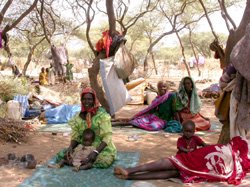
Newly arrived IDPs at Zamzam camp in North Darfur.
NAIROBI, 8 Dec 2005 (IRIN) - The humanitarian environment in the western Sudanese region of Darfur is becoming increasingly hostile and clashes between various groups continue to flare up, aid workers warned.
"There has been a huge increase in the number of attacks and robberies [on humanitarian workers]," said Mike McDonagh, senior humanitarian affairs officer at the UN Office for the Coordination of Humanitarian Affairs (OCHA) in Khartoum, on Thursday.
"Harassment is too weak a term," he added. "The physical danger aid workers have been exposed to over the last four months is a huge concern. We are very lucky that none of our staff has been killed so far."
On Saturday, Sudanese Armed Forces (SAF) and militia reportedly jointly attacked the villages of Hemmeda, Um Boru and Koka in the Um Nkunya area, approximately 40 km northeast of Nyala, the capital of South Darfur, the UN Mission in Sudan (UNMIS) reported. The fighting resulted in an unknown number of civilian casualties and displaced about 7,000 people.
"The United Nations is concerned that the parties continue to violate the ceasefire agreement in what seems to be a resumption of the vicious circle of attacks and retaliation that we witnessed in earlier months," Radhia Achouri, UNMIS spokeswoman, told reporters in Khartoum on Wednesday.
According to reports, the attack on Saturday had been launched against the rebel Sudan Liberation Movement/Army (SLM/A) in the area. In apparent retaliation the following day, the SLM/A attacked Donkey Dereisa, 60 km south of Nyala.
Another attack occurred in West Darfur on Tuesday when Arab militia raided the town of Congo Harasa. They destroyed all the wells that had been constructed by the humanitarian workers to provide water to the local population.
"The UN condemns these attacks that targeted the very livelihood of the people," Achouri said.
The ongoing deliberate destruction of farmland and crops was negatively affecting the optimistic agricultural output expected for this season, Achouri added. Redisplacements of large groups of civilians to settlements for internally displaced persons (IDPs) or to the outskirts of towns had also continued throughout Darfur.
According to the Geneva Conventions, destroying or rendering useless items essential to the survival of civilian populations is a war crime.
Aid workers in the region had also faced increased violence, threats, beatings and harassment, both within and outside the camps, according to sources in Darfur.
On 5 December, 13 international NGO staff members in West Darfur were relocated with an African Union (AU) escort from Silea to the region's capital, Geneina, due to insecurity in the area.
Insecurity also forced the AU to airlift three international NGO staff from Kulbus to El Fasher, the capital of North Darfur State. Some local personnel remained behind to provide essential services.
On 4 December, an international NGO compound was caught in the crossfire when fighting broke out between rebel groups and government forces near Masteri. A stray bullet hit a guard in the stomach.
On 1 December, two unidentified gunmen shot and killed a Sudanese driver working for the Sudanese Red Crescent Society in the organisation's premises in Abu Shouk IDP camp on the outskirts of El Fasher.
"The security situation in Abu Shouk is deteriorating each day," said a local source. "IDPs are reporting continuous military presence inside the camps during the nights with threats, detentions, harassment to the civil population and shootings."
Tension had also risen in IDP camps across Darfur due to the proliferation of people posing as community leaders and presenting inflated numbers of newly arrived IDPs to demand food and other relief items.
"They are not just businessmen - they are a real mafia. They sold around 12,000 rations of food in front of our noses," one aid worker said.
"This business is a time bomb for the stability of the camp," he added. "The [genuine community] leaders that try to collaborate [with us] are exhausted and very scared. All of us have been threatened many times."
The Darfur conflict erupted in February 2003 when the two main rebel groups, the SLM/A and the Justice and Equality Movement, took up arms to fight what they called the discrimination and oppression of the region by the Sudanese government.
The government is accused of unleashing militia - known as the Janjawid - on civilians in an attempt to quash the rebellion. According to the UN, the conflict continues to affect some 3.4 million people, of whom 1.8 million are IDPs and 200,000 have fled to neighbouring Chad.
[ENDS]
Tuesday, December 06, 2005
Jewish Community Launches 'DC Loves Darfur' Fundraising Campaign for Sudan Victims
12/6/2005 12:07:00 PM
To: National and International Desks
Contact: Julie Weingrad of the Jewish Community Relations Council of Greater Washington, 301-348-7365 or jweingrad@jcouncil.org
WASHINGTON, Dec. 6 /U.S. Newswire/ -- In December, Jewish people everywhere prepare for Chanukah, the commemoration of Jewish survival and the rededication of the Temple. This year, the Greater Washington Jewish community can honor the Jewish story of survival by acting to stop the genocide in Darfur, where hundreds of innocent people die each day. The Jewish Community Relations Council of Greater Washington (JCRC) in conjunction with the Greater Washington Jewish Task Force on Darfur, has launched the DC Loves Darfur fundraising campaign to raise funds for humanitarian aid, education and advocacy through the American Jewish World Service Sudan Fund.
In Judaism, the word "chai" means life, and the numerical equivalent of the letters is 18. Between Thanksgiving and Chanukah (11/24/05-01/01/06), the Greater Washington Jewish Community hopes to give life by raising at least 18 cents for each of the 215,000 Jews in our Greater Washington community ($38,700) to support humanitarian aid as well as education & advocacy programs. As of Dec. 5, the campaign has raised $23,382.41.
"How can anyone, but especially how can Jews, not come to the aide of a population threatened with extinction, a community threatened with violence and murder and destitution? We must not look away or go deaf. We have to learn and then do. We must speak up. We must give financially," says Judy Herr, a member of Adas Israel Congregation and the Greater Washington Jewish Task Force on Darfur.
Contribution cans be made via mail, phone or online.
Mail -- Make check out to American Jewish World Service and write "DC Loves Darfur" in the subject line: AJWS Sudan Fund, 45 West 36th Street, 10th Floor, New York, NY 10018.
Phone -- Make a credit card donation at 800-889-7146.
Online -- Donate at http://www.ajws.org/dclovesdarfur
------
The Jewish Community Relations Council of Greater Washington (JCRC) is the public affairs and community relations arm of the Jewish community representing 210 Jewish organizations and synagogues throughout DC, Maryland, and Virginia. The JCRC focuses on government relations, Israel advocacy, inter-group relations, and social justice.
http://www.usnewswire.com/
/© 2005 U.S. Newswire 202-347-2770/
To: National and International Desks
Contact: Julie Weingrad of the Jewish Community Relations Council of Greater Washington, 301-348-7365 or jweingrad@jcouncil.org
WASHINGTON, Dec. 6 /U.S. Newswire/ -- In December, Jewish people everywhere prepare for Chanukah, the commemoration of Jewish survival and the rededication of the Temple. This year, the Greater Washington Jewish community can honor the Jewish story of survival by acting to stop the genocide in Darfur, where hundreds of innocent people die each day. The Jewish Community Relations Council of Greater Washington (JCRC) in conjunction with the Greater Washington Jewish Task Force on Darfur, has launched the DC Loves Darfur fundraising campaign to raise funds for humanitarian aid, education and advocacy through the American Jewish World Service Sudan Fund.
In Judaism, the word "chai" means life, and the numerical equivalent of the letters is 18. Between Thanksgiving and Chanukah (11/24/05-01/01/06), the Greater Washington Jewish Community hopes to give life by raising at least 18 cents for each of the 215,000 Jews in our Greater Washington community ($38,700) to support humanitarian aid as well as education & advocacy programs. As of Dec. 5, the campaign has raised $23,382.41.
"How can anyone, but especially how can Jews, not come to the aide of a population threatened with extinction, a community threatened with violence and murder and destitution? We must not look away or go deaf. We have to learn and then do. We must speak up. We must give financially," says Judy Herr, a member of Adas Israel Congregation and the Greater Washington Jewish Task Force on Darfur.
Contribution cans be made via mail, phone or online.
Mail -- Make check out to American Jewish World Service and write "DC Loves Darfur" in the subject line: AJWS Sudan Fund, 45 West 36th Street, 10th Floor, New York, NY 10018.
Phone -- Make a credit card donation at 800-889-7146.
Online -- Donate at http://www.ajws.org/dclovesdarfur
------
The Jewish Community Relations Council of Greater Washington (JCRC) is the public affairs and community relations arm of the Jewish community representing 210 Jewish organizations and synagogues throughout DC, Maryland, and Virginia. The JCRC focuses on government relations, Israel advocacy, inter-group relations, and social justice.
http://www.usnewswire.com/
/© 2005 U.S. Newswire 202-347-2770/
World must act quickly to stop Sudan violence: UN
Reuters
COPENHAGEN - The international community must act quickly to stop violence in Sudan getting worse and to get the peace process back on track, the U.N.'s refugee chief said on Tuesday.
"The situation has been worsening and worsening in Darfur. In the east ... (it) is also very complicated and the conflict between Ethiopia and Eritrea is only widening it," said Antonio Guterres, the U.N. Nations High Commissioner for Refugees.
"Even in the south things are not as easy as they were," he said referring to south Sudan, site of a long war between rebels and the government that ended with a peace deal in January.
Guterres was speaking to reporters before a meeting with Denmark's Development Minister Ulla Tornaes.
In October, Guterres said the world only had weeks to help restore the peace process in Sudan' Darfur region, where rebels are fighting the government, and prevent the country's slide back into civil war.
A few months ago there was a clear will to reach an agreement on the conflict in western region of Darfur, while the situation in the east was also improving. Since then things have got worse, Guterrez said.
"Sudan is without any doubt, from the perspective of a refugee agency, the worst problem we are facing in the world today," he said, adding "The window of opportunity is narrowing but it is still there."
In Darfur tens of thousands of people have been killed and more than 2 million have fled their homes since rebels took up arms in 2003 against the government. The fighting in Darfur is separate from the war in the south.
Rebels in the east of Sudan have also fought government troops and tension has risen recently between Ethiopia and Eritrea, Sudan's eastern neighbors, who fought a 1998-2000 border war.
Copyright 2005 Reuters News Service. All rights reserved. This material may not be published, broadcast, rewritten, or redistributed.
Copyright © 2005 ABC News Internet Ventures
COPENHAGEN - The international community must act quickly to stop violence in Sudan getting worse and to get the peace process back on track, the U.N.'s refugee chief said on Tuesday.
"The situation has been worsening and worsening in Darfur. In the east ... (it) is also very complicated and the conflict between Ethiopia and Eritrea is only widening it," said Antonio Guterres, the U.N. Nations High Commissioner for Refugees.
"Even in the south things are not as easy as they were," he said referring to south Sudan, site of a long war between rebels and the government that ended with a peace deal in January.
Guterres was speaking to reporters before a meeting with Denmark's Development Minister Ulla Tornaes.
In October, Guterres said the world only had weeks to help restore the peace process in Sudan' Darfur region, where rebels are fighting the government, and prevent the country's slide back into civil war.
A few months ago there was a clear will to reach an agreement on the conflict in western region of Darfur, while the situation in the east was also improving. Since then things have got worse, Guterrez said.
"Sudan is without any doubt, from the perspective of a refugee agency, the worst problem we are facing in the world today," he said, adding "The window of opportunity is narrowing but it is still there."
In Darfur tens of thousands of people have been killed and more than 2 million have fled their homes since rebels took up arms in 2003 against the government. The fighting in Darfur is separate from the war in the south.
Rebels in the east of Sudan have also fought government troops and tension has risen recently between Ethiopia and Eritrea, Sudan's eastern neighbors, who fought a 1998-2000 border war.
Copyright 2005 Reuters News Service. All rights reserved. This material may not be published, broadcast, rewritten, or redistributed.
Copyright © 2005 ABC News Internet Ventures
Tuesday, November 29, 2005
Numb in the face of genocide
By Gabe Bradley
November 29, 2005
Acts of genocide are routinely described as “incomprehensible.†This descriptor may be more accurate then we know.
In the last several years, hundreds of thousands of innocent civilians have been murdered in the Darfur region of Sudan. It has been underreported in the American media and underrepresented on the American foreign policy agenda. The rest of the world has been just as reluctant to take action. Now, a University psychology professor seems to have found an answer: Our brains just can’t understand genocide.
Professor Paul Slovic recently delivered a paper in which he claims the emotional side of the human brain numbs in response to mass murder, according to an article in Monday’s Register-Guard.
Slovic says this is a “fundamental deficiency in our humanity,†because the numbing effect prevents a person from feeling empathy and taking action. This could help explain why people across America and the world have yet to formulate a substantial response to the genocide in Darfur.
“The only reason to know how many have died is to have a number to report when we memorialize another genocide 10 years after the fact,†said Slovic in the article.
What does this say about our humanity? Do we, as Slovic says, have a fundamental deficiency? I believe the answer is yes. Moving away from the physiological and psychological science of the issue and into the realm of philosophy, the fact that we are virtually unable to respond to acts of genocide is a serious problem.
Certainly the fact that humans have organized for the purpose of exterminating one another since the dawn of recorded history suggests that there is something fundamentally corrupt, or at least corruptible, in our nature. However, a small minority of the world’s population actually plan and participate in genocide. For every country in the world where genocide is taking place, there are hundreds where there is currently no genocide.
So it’s easy for us to ignore genocide, especially when it’s on the other side of the world, because the refugees rarely end up here. But in this era of information technology, there’s nothing keeping us in the dark except for our own unwillingness to care.
I say the American media have underreported the Darfur genocide. The media, though, are only giving the people what they want. If average American viewers gave even a slight inkling that they cared about the situation in Darfur, we would be bombarded with information about Darfur 24/7.
Can you imagine the ratings on genocide coverage? There’s no need to sensationalize that story. The problem is, people across the country and the world are so totally apathetic that the media have no incentive to provide substantial coverage.
Both the media and our government are affected by the same forces that shape our markets: supply and demand. Until there is significant demand for information and action with regard to genocide throughout the world, the powers that be will have no incentive to supply any solutions; right now, there just isn’t the demand.
For those of us who believe that being complacent in the face of genocide is a breach of our obligations to one another as humans, this is a problem.
Slovic’s finding that we are paralyzed to the point of inaction by genocide is interesting because it presents us with a situation wherein the right thing to do is to struggle against our natural inclinations — to do the right thing despite how we’re wired.
Most people would agree that we’re not perfect the way we are. That’s why so many of us seek to change, learn and grow. For many of us, this means living the beautiful life, the good life, the excellent life.
So perhaps it’s not breaking news that in our struggle to live life in the best way we can, our biggest obstacles come not from our circumstances or from others, but from ourselves. This fact has been so well-documented in the realm of exercise and sport that it has become a cliché. However, in the realm of moral philosophy, this point is very much in dispute.
Irish philosopher Edmund Burke is often quoted as having said, “The only thing necessary for the triumph of evil is for good men to do nothing.†We now know that it’s incredibly easy for good people to do nothing.
I don’t particularly care for the movie “Schindler’s List.†However, the final scene is one of the most emotionally powerful scenes I have ever watched in any movie. Though Liam Neeson’s character has risked his life and livelihood to save Jews from the death camps and sabotage the Nazi war effort, he still breaks down in tears, bemoaning the fact that he could have done more. The implication here is not merely that he could have done more but that he should have done more.
Now we are faced with yet another genocide. Most of us could do more. Most of us should do more.
Slovic will be one of the speakers at a forum tomorrow night on how local residents can help stop the Darfur genocide. The forum, sponsored by the Jewish Community Relations Council, will take place at 7 p.m. at Temple Beth Israel.
gbradley@dailyemerald.com
source: dailyemerald.com
November 29, 2005
Acts of genocide are routinely described as “incomprehensible.†This descriptor may be more accurate then we know.
In the last several years, hundreds of thousands of innocent civilians have been murdered in the Darfur region of Sudan. It has been underreported in the American media and underrepresented on the American foreign policy agenda. The rest of the world has been just as reluctant to take action. Now, a University psychology professor seems to have found an answer: Our brains just can’t understand genocide.
Professor Paul Slovic recently delivered a paper in which he claims the emotional side of the human brain numbs in response to mass murder, according to an article in Monday’s Register-Guard.
Slovic says this is a “fundamental deficiency in our humanity,†because the numbing effect prevents a person from feeling empathy and taking action. This could help explain why people across America and the world have yet to formulate a substantial response to the genocide in Darfur.
“The only reason to know how many have died is to have a number to report when we memorialize another genocide 10 years after the fact,†said Slovic in the article.
What does this say about our humanity? Do we, as Slovic says, have a fundamental deficiency? I believe the answer is yes. Moving away from the physiological and psychological science of the issue and into the realm of philosophy, the fact that we are virtually unable to respond to acts of genocide is a serious problem.
Certainly the fact that humans have organized for the purpose of exterminating one another since the dawn of recorded history suggests that there is something fundamentally corrupt, or at least corruptible, in our nature. However, a small minority of the world’s population actually plan and participate in genocide. For every country in the world where genocide is taking place, there are hundreds where there is currently no genocide.
So it’s easy for us to ignore genocide, especially when it’s on the other side of the world, because the refugees rarely end up here. But in this era of information technology, there’s nothing keeping us in the dark except for our own unwillingness to care.
I say the American media have underreported the Darfur genocide. The media, though, are only giving the people what they want. If average American viewers gave even a slight inkling that they cared about the situation in Darfur, we would be bombarded with information about Darfur 24/7.
Can you imagine the ratings on genocide coverage? There’s no need to sensationalize that story. The problem is, people across the country and the world are so totally apathetic that the media have no incentive to provide substantial coverage.
Both the media and our government are affected by the same forces that shape our markets: supply and demand. Until there is significant demand for information and action with regard to genocide throughout the world, the powers that be will have no incentive to supply any solutions; right now, there just isn’t the demand.
For those of us who believe that being complacent in the face of genocide is a breach of our obligations to one another as humans, this is a problem.
Slovic’s finding that we are paralyzed to the point of inaction by genocide is interesting because it presents us with a situation wherein the right thing to do is to struggle against our natural inclinations — to do the right thing despite how we’re wired.
Most people would agree that we’re not perfect the way we are. That’s why so many of us seek to change, learn and grow. For many of us, this means living the beautiful life, the good life, the excellent life.
So perhaps it’s not breaking news that in our struggle to live life in the best way we can, our biggest obstacles come not from our circumstances or from others, but from ourselves. This fact has been so well-documented in the realm of exercise and sport that it has become a cliché. However, in the realm of moral philosophy, this point is very much in dispute.
Irish philosopher Edmund Burke is often quoted as having said, “The only thing necessary for the triumph of evil is for good men to do nothing.†We now know that it’s incredibly easy for good people to do nothing.
I don’t particularly care for the movie “Schindler’s List.†However, the final scene is one of the most emotionally powerful scenes I have ever watched in any movie. Though Liam Neeson’s character has risked his life and livelihood to save Jews from the death camps and sabotage the Nazi war effort, he still breaks down in tears, bemoaning the fact that he could have done more. The implication here is not merely that he could have done more but that he should have done more.
Now we are faced with yet another genocide. Most of us could do more. Most of us should do more.
Slovic will be one of the speakers at a forum tomorrow night on how local residents can help stop the Darfur genocide. The forum, sponsored by the Jewish Community Relations Council, will take place at 7 p.m. at Temple Beth Israel.
gbradley@dailyemerald.com
source: dailyemerald.com
Monday, November 28, 2005
"Why Time is Running out in Darfur"
The New Republic (on-line), November 28, 2005
[www.tnr.com]
By Eric Reeves
WHAT will happen after humanitarian organizations leave Darfur? The question grows more relevant daily. For much of 2004, humanitarian groups ramped up their operations in Darfur. These efforts temporarily blocked the genocidal aims of the Sudanese government from coming to full fruition. Throughout 2003 and 2004, government-backed militias terrorized Darfur's African tribal populations, evicting them from their villages and cutting them off from their livelihoods. Many ended up in refugee camps, where only the efforts of humanitarian groups have allowed them to stay alive. Sudan's leaders would like nothing more than to see these groups leave the country, so that disease and malnutrition can finish the work the militias started three years ago.
They may soon get their wish. There is considerable evidence that many humanitarian organizations are on the brink of withdrawing from Darfur--or at least suspending operations. An upsurge in violence against humanitarian workers has pushed many groups to the very limit of tolerable risk. The consequences of such a withdrawal will be stark: hundreds of thousands dead. As a result, the reality facing America and its allies is simple: If we really believe that something should be done to save Darfur, then we have to do it now. Soon, it will be too late to do anything at all.
HOW likely is humanitarian evacuation? For one thing, withdrawals have already begun in West Darfur. Kofi Annan reports that the United Nations withdrew "non-essential" staff from the region in October and that some international humanitarian organizations did so as well. Aid workers have told me of subsequent quiet withdrawals from West Darfur and elsewhere. Sometimes these evacuations are also noted publicly, as in a recent Darfur report by Refugees International:
"According to the U.S. Agency for International Development, due to rising insecurity ... on September 25, 2005 three NGOs evacuated their staff from Shangil Tobayi, North Darfur, reportedly leaving the town without an international humanitarian presence. A week earlier Refugees International (RI) had witnessed the site director for one of the NGOs sending three of her staff home to Europe."
Eighty-one NGOs and thirteen U.N. agencies currently operate in Darfur, according to the latest U.N. data. These groups have evacuation plans defined by varying contingencies and thresholds for implementation. A year ago, for example, Save the Children UK withdrew its non-Sudanese staff and suspended all operations in Darfur following the deaths of several workers in two different incidents (one was a land-mine detonation). But no matter what the threshold for evacuation, the precipitating scenarios are daily becoming more likely.
Attacks on humanitarian workers and their convoys have been most frequent in West Darfur, and this is the region Annan explicitly invoked when he warned the U.N. Security Council in his November report on Darfur that "the looming threat of complete lawlessness and anarchy draws nearer." All roads leading out of the regional capital Geneina are off-limits to U.N. humanitarian personnel. Independent aid organizations use these roads only occasionally and on a highly selective basis. Humanitarian groups simply cannot be expected to operate in such an environment, even as their skills and oversight are critical for the work of saving civilian lives.
Meanwhile the Janjaweed have been appearing in ever more brazen and threatening fashion inside Geneina itself. Fighting has been reported within the city, as well as between Arab militia groups immediately northeast of town. Geneina airport, the only significant airport in West Darfur, is being actively used by helicopter gunships of the Khartoum government, evidently in support of its escalating military offensive against insurgents in the Jebel Moun area to the northeast.
More ominously, sources on the ground report that the Geneina airport has been surrounded by dug-in mortars and artillery. Geneina is only about 10 miles from the Chad-Darfur border; and as tensions between Chad and Sudan escalate, there is speculation that in the event of a significant military confrontation, the Sudanese government will either seize the airport or destroy it by shelling to prevent its seizure by Chad's army. Either way, this would leave humanitarian groups without a means of getting out. Facing the possibility that they will soon be stranded, it's no surprise that humanitarian organizations are considering a preemptive departure.
Across Darfur, humanitarian access is more restricted than it has been since April 2004, well before aid groups ramped up their operations following the July 2004 U.N. agreements with Khartoum. There are simply more and more places humanitarian workers can't go, forcing many residents either to flee toward already overcrowded camps or go without aid. The African Union force in Darfur, which has no mandate to protect civilians or humanitarian workers, can neither secure humanitarian corridors nor provide adequate military escorts to humanitarian convoys. The growing number of attacks on aid workers, even those of the International Committee of the Red Cross, reflect the understandable belief by all combatants that the international community does not care enough about its humanitarian operations to protect them appropriately.
On top of this, relief efforts in Darfur are beginning to suffer from donor fatigue, providing those who wish to exit a ready excuse for withdrawing international staff and operations. According to Reuters, "donors are becoming more reluctant to pay for a never-ending emergency and are starting to reduce aid[.] ... Narinder Sharma, a U.N. official in Darfur, said aid agencies were already phasing out their activities and any decrease in funding would spell disaster for millions of people."
THE evacuation of humanitarian workers essentially means the withdrawal of international staff; very few of the Sudanese nationals who make up approximately 90 percent of the more than 12,000 aid workers in Darfur would be withdrawn. But many of the Sudanese left behind would be intensely, and rightly, fearful for their physical security: The Khartoum government has made no secret of its contempt for international aid efforts, and reprisals against the Sudanese humanitarian workers who have assisted in these efforts would probably be brutal. As a result, they are likely to stop working in the event that their organizations withdraw; and humanitarian operations would almost certainly come to a standstill.
Even if Sudanese nationals were able to courageously continue some operations, health care in Darfur would be crippled. Medical supplies could no longer get through to clinics, and treatment of complicated medical conditions and injuries would cease. (The doctors capable of performing such procedures are virtually all foreigners.) In the crowded camps, maintenance of latrines, which are quite alien to most Darfuris, would end, as would other aggressive steps that have been taken to avert outbreaks of cholera and dysentery; we would almost certainly see outbreaks of these destructive diseases sooner rather than later. Other diseases, such as malaria and measles, that humanitarian groups have managed to keep under control in the camps would similarly go undetected and untreated. In a short time disease would become a devastating source of human destruction.
Further, many of the pumps that supply water to dense concentrations of displaced people, in areas that do not have sufficient water for a fraction of these populations, depend upon diesel-powered engines. If humanitarian workers withdraw, it is unlikely that fuel would reach the pumps to keep water flowing. One humanitarian group reports that it recently came within two days of running out of fuel at one large camp; and this is with highly resourceful international workers and communications abilities still in place. Water is critical to life in this extremely hot and arid region (it is currently the dry season). Thousands of people would quickly perish for lack of water in the event of evacuation, and those who drink untreated surface water near the camps would be exposed to a fearsome range of diseases. Those leaving the camps in search of water--or food, or medical assistance--would become vulnerable to the relentlessly marauding Janjaweed.
The first to die will be malnourished children under five years of age, especially those who presently require the assistance of specialized feeding centers. But these casualties will only be harbingers of greater death, both in the overcrowded camps, which are again swelling because of new violence, and throughout the vulnerable rural areas where people are increasingly unable to feed themselves. The United Nations currently estimates that there are almost 3.5 million conflict-affected civilians in Darfur, nearly all of them in need of food assistance. And while the United Nation's World Food Program has performed impressively, moving 57,000 metric tons of food into the area in October, this food simply cannot be delivered to areas that humanitarian workers cannot reach. Indeed, if humanitarian operations disintegrate, it is difficult to see how food will be delivered at all.
TWO months ago Jan Egeland, head of U.N. humanitarian operations, warned that if insecurity "continues to escalate, if it continues to be so dangerous on humanitarian work, we may not be able to sustain our operation[.] ... It could all end tomorrow--it's as serious as that." A year ago, when there were a million fewer conflict-affected people in Darfur, Egeland warned that in the event of humanitarian evacuation as many as 100,000 could die every month. Privately there was much scorn for this estimate. But as humanitarian withdrawal begins in Darfur, with surging violence that might at any moment spur full-scale evacuation, there can be no scorn for Egeland's estimate now. Hundreds of thousands of people are already beyond humanitarian relief, and the population is weakened by almost three years of intense conflict. The number without assistance may climb to over a million by year's end.
As humanitarian evacuation becomes more likely, the day draws near when the West will have to make its final decision on Darfur. African Union forces have failed to secure the region; and without security, there can be no humanitarian relief. Either America and its western allies put troops on the ground in Darfur soon, or the time to act will have passed. Perhaps 400,000 people have died in Darfur already, but after humanitarian workers leave, those numbers will swell quickly and considerably. After all, while humanitarian workers have an evacuation option, Darfur's residents do not.
[Eric Reeves is a professor of English Language and Literature at Smith College and has written extensively on Sudan.]
Eric Reeves
Smith College
Northampton, MA 01063
ereeves@smith.edu
413-585-3326
www.sudanreeves.org
[www.tnr.com]
By Eric Reeves
WHAT will happen after humanitarian organizations leave Darfur? The question grows more relevant daily. For much of 2004, humanitarian groups ramped up their operations in Darfur. These efforts temporarily blocked the genocidal aims of the Sudanese government from coming to full fruition. Throughout 2003 and 2004, government-backed militias terrorized Darfur's African tribal populations, evicting them from their villages and cutting them off from their livelihoods. Many ended up in refugee camps, where only the efforts of humanitarian groups have allowed them to stay alive. Sudan's leaders would like nothing more than to see these groups leave the country, so that disease and malnutrition can finish the work the militias started three years ago.
They may soon get their wish. There is considerable evidence that many humanitarian organizations are on the brink of withdrawing from Darfur--or at least suspending operations. An upsurge in violence against humanitarian workers has pushed many groups to the very limit of tolerable risk. The consequences of such a withdrawal will be stark: hundreds of thousands dead. As a result, the reality facing America and its allies is simple: If we really believe that something should be done to save Darfur, then we have to do it now. Soon, it will be too late to do anything at all.
HOW likely is humanitarian evacuation? For one thing, withdrawals have already begun in West Darfur. Kofi Annan reports that the United Nations withdrew "non-essential" staff from the region in October and that some international humanitarian organizations did so as well. Aid workers have told me of subsequent quiet withdrawals from West Darfur and elsewhere. Sometimes these evacuations are also noted publicly, as in a recent Darfur report by Refugees International:
"According to the U.S. Agency for International Development, due to rising insecurity ... on September 25, 2005 three NGOs evacuated their staff from Shangil Tobayi, North Darfur, reportedly leaving the town without an international humanitarian presence. A week earlier Refugees International (RI) had witnessed the site director for one of the NGOs sending three of her staff home to Europe."
Eighty-one NGOs and thirteen U.N. agencies currently operate in Darfur, according to the latest U.N. data. These groups have evacuation plans defined by varying contingencies and thresholds for implementation. A year ago, for example, Save the Children UK withdrew its non-Sudanese staff and suspended all operations in Darfur following the deaths of several workers in two different incidents (one was a land-mine detonation). But no matter what the threshold for evacuation, the precipitating scenarios are daily becoming more likely.
Attacks on humanitarian workers and their convoys have been most frequent in West Darfur, and this is the region Annan explicitly invoked when he warned the U.N. Security Council in his November report on Darfur that "the looming threat of complete lawlessness and anarchy draws nearer." All roads leading out of the regional capital Geneina are off-limits to U.N. humanitarian personnel. Independent aid organizations use these roads only occasionally and on a highly selective basis. Humanitarian groups simply cannot be expected to operate in such an environment, even as their skills and oversight are critical for the work of saving civilian lives.
Meanwhile the Janjaweed have been appearing in ever more brazen and threatening fashion inside Geneina itself. Fighting has been reported within the city, as well as between Arab militia groups immediately northeast of town. Geneina airport, the only significant airport in West Darfur, is being actively used by helicopter gunships of the Khartoum government, evidently in support of its escalating military offensive against insurgents in the Jebel Moun area to the northeast.
More ominously, sources on the ground report that the Geneina airport has been surrounded by dug-in mortars and artillery. Geneina is only about 10 miles from the Chad-Darfur border; and as tensions between Chad and Sudan escalate, there is speculation that in the event of a significant military confrontation, the Sudanese government will either seize the airport or destroy it by shelling to prevent its seizure by Chad's army. Either way, this would leave humanitarian groups without a means of getting out. Facing the possibility that they will soon be stranded, it's no surprise that humanitarian organizations are considering a preemptive departure.
Across Darfur, humanitarian access is more restricted than it has been since April 2004, well before aid groups ramped up their operations following the July 2004 U.N. agreements with Khartoum. There are simply more and more places humanitarian workers can't go, forcing many residents either to flee toward already overcrowded camps or go without aid. The African Union force in Darfur, which has no mandate to protect civilians or humanitarian workers, can neither secure humanitarian corridors nor provide adequate military escorts to humanitarian convoys. The growing number of attacks on aid workers, even those of the International Committee of the Red Cross, reflect the understandable belief by all combatants that the international community does not care enough about its humanitarian operations to protect them appropriately.
On top of this, relief efforts in Darfur are beginning to suffer from donor fatigue, providing those who wish to exit a ready excuse for withdrawing international staff and operations. According to Reuters, "donors are becoming more reluctant to pay for a never-ending emergency and are starting to reduce aid[.] ... Narinder Sharma, a U.N. official in Darfur, said aid agencies were already phasing out their activities and any decrease in funding would spell disaster for millions of people."
THE evacuation of humanitarian workers essentially means the withdrawal of international staff; very few of the Sudanese nationals who make up approximately 90 percent of the more than 12,000 aid workers in Darfur would be withdrawn. But many of the Sudanese left behind would be intensely, and rightly, fearful for their physical security: The Khartoum government has made no secret of its contempt for international aid efforts, and reprisals against the Sudanese humanitarian workers who have assisted in these efforts would probably be brutal. As a result, they are likely to stop working in the event that their organizations withdraw; and humanitarian operations would almost certainly come to a standstill.
Even if Sudanese nationals were able to courageously continue some operations, health care in Darfur would be crippled. Medical supplies could no longer get through to clinics, and treatment of complicated medical conditions and injuries would cease. (The doctors capable of performing such procedures are virtually all foreigners.) In the crowded camps, maintenance of latrines, which are quite alien to most Darfuris, would end, as would other aggressive steps that have been taken to avert outbreaks of cholera and dysentery; we would almost certainly see outbreaks of these destructive diseases sooner rather than later. Other diseases, such as malaria and measles, that humanitarian groups have managed to keep under control in the camps would similarly go undetected and untreated. In a short time disease would become a devastating source of human destruction.
Further, many of the pumps that supply water to dense concentrations of displaced people, in areas that do not have sufficient water for a fraction of these populations, depend upon diesel-powered engines. If humanitarian workers withdraw, it is unlikely that fuel would reach the pumps to keep water flowing. One humanitarian group reports that it recently came within two days of running out of fuel at one large camp; and this is with highly resourceful international workers and communications abilities still in place. Water is critical to life in this extremely hot and arid region (it is currently the dry season). Thousands of people would quickly perish for lack of water in the event of evacuation, and those who drink untreated surface water near the camps would be exposed to a fearsome range of diseases. Those leaving the camps in search of water--or food, or medical assistance--would become vulnerable to the relentlessly marauding Janjaweed.
The first to die will be malnourished children under five years of age, especially those who presently require the assistance of specialized feeding centers. But these casualties will only be harbingers of greater death, both in the overcrowded camps, which are again swelling because of new violence, and throughout the vulnerable rural areas where people are increasingly unable to feed themselves. The United Nations currently estimates that there are almost 3.5 million conflict-affected civilians in Darfur, nearly all of them in need of food assistance. And while the United Nation's World Food Program has performed impressively, moving 57,000 metric tons of food into the area in October, this food simply cannot be delivered to areas that humanitarian workers cannot reach. Indeed, if humanitarian operations disintegrate, it is difficult to see how food will be delivered at all.
TWO months ago Jan Egeland, head of U.N. humanitarian operations, warned that if insecurity "continues to escalate, if it continues to be so dangerous on humanitarian work, we may not be able to sustain our operation[.] ... It could all end tomorrow--it's as serious as that." A year ago, when there were a million fewer conflict-affected people in Darfur, Egeland warned that in the event of humanitarian evacuation as many as 100,000 could die every month. Privately there was much scorn for this estimate. But as humanitarian withdrawal begins in Darfur, with surging violence that might at any moment spur full-scale evacuation, there can be no scorn for Egeland's estimate now. Hundreds of thousands of people are already beyond humanitarian relief, and the population is weakened by almost three years of intense conflict. The number without assistance may climb to over a million by year's end.
As humanitarian evacuation becomes more likely, the day draws near when the West will have to make its final decision on Darfur. African Union forces have failed to secure the region; and without security, there can be no humanitarian relief. Either America and its western allies put troops on the ground in Darfur soon, or the time to act will have passed. Perhaps 400,000 people have died in Darfur already, but after humanitarian workers leave, those numbers will swell quickly and considerably. After all, while humanitarian workers have an evacuation option, Darfur's residents do not.
[Eric Reeves is a professor of English Language and Literature at Smith College and has written extensively on Sudan.]
Eric Reeves
Smith College
Northampton, MA 01063
ereeves@smith.edu
413-585-3326
www.sudanreeves.org
Saturday, November 26, 2005
African Union Warned Against Letting Sudan Lead
POLITICS:
Thalif Deen
Sudan, which has been lambasted for human rights violations and genocide in the beleaguered province of Darfur, is expected to be elected chair of the 53-member African Union (AU) next year following a summit meeting of African heads of state in the Sudanese capital of Khartoum in late January.
UNITED NATIONS, Nov 25 (IPS) - The possibility of Sudan leading the AU, the largest gathering of African states, has evoked strong protests from human rights organisations and African activist groups in the United States.
"The African Union has shown important leadership on the crisis in Darfur -- brokering the initial ceasefire between the government and the rebels, hosting ongoing peace talks, and deploying up to 7,000 troops to the region," Ann-Louise Colgan of the Washington-based Africa Action told IPS.
But the next AU Summit is scheduled to be held in Sudan in January and the world is now watching to see whether the Sudanese government, accused of authoring the human rights abuses in Darfur, will be elected to chair the AU next year, she added.
"This is a matter for the African Union member states. But it is to be hoped that African governments will choose not to ignore the ongoing crimes being perpetrated in Darfur, even as they may wish to acknowledge the progress toward North-South peace in Sudan in the past year," Colgan said.
She pointed out that it is important the international community also not lose its focus on the crisis in Darfur, and not continue to hide behind the AU and abdicate the broader responsibility to take action to protect the civilians of Darfur, the victims of crimes against humanity.
According to U.N. figures, more than 180,000 people have died and over two million people have been robbed and burnt out of their homes in Darfur since 2003. The attacks and killings have been attributed to the government-backed Janjaweed militias.
Asked whether Sudan should be the head of the AU under these circumstances, U.N. Secretary-General Kofi Annan diplomatically side-stepped the question by telling a reporter: "That is for the African Union to decide, my dear friend."
Dr. Kwame Akonor, director of the African Development Institute, focused his criticism on the AU for its role in the ongoing Darfur crisis.
"Thus far, the AU's leadership on the Sudan question leaves much to be desired," he told IPS.
Earlier, it mistakenly declared that the killings in the Darfur region did not amount to genocide, though all documented evidence pointed to a systematic campaign to physically destroy particular groups of people, he said.
"Just last month, the AU allowed Sudan to chair its Peace and Security Council meeting in Ethiopia, muting any discussions of that country's grave and constant human rights violations. Now, the collective AU body brazenly wants to take a resolution condemning the well-documented atrocities in that region off the table," Akonor said.
"Does the AU want to be viewed as a protector or accomplice on this issue?" he asked.
"The AU needs to get tough on any African government complicit in war crimes and crimes against humanity such as the Sudanese regime. The AU's legitimacy and moral authority will be irreparably damaged if it assigns special privileges to Sudan," he added.
He also warned that the AU should avoid going down the same ill-fated path as its predecessor, the Organisation of African Unity (OAU), "which in 1975 awarded the Ugandan dictator, Idi Amin, the OAU's chairmanship, despite his abominable human rights record."
Last week, the AU also collectively stood by Sudan, helping to adopt a "no-action" motion on a U.N. resolution aimed at condemning the Sudanese government for human rights violations.
The no-action motion, which was sponsored by the current AU chair Nigeria, was adopted by 84 votes in favour and 79 against, with 12 abstentions. As a result, Sudan was spared condemnation by the General Assembly's Third Committee.
In defence of the action, Nigeria told delegates that any condemnation of Sudan would endanger the ongoing peace talks.
Yvonne Terlingen, Amnesty International's representative at the United Nations, said her organisation "deeply regrets that a 'no-action motion' on the draft resolution on Sudan was adopted, thereby preventing the Third Committee from considering how to address one of the most serious human rights situations facing the international community today".
In a statement released here, she said that "grave and widespread human rights violations continue in Sudan and sweeping impunity applies to government officials".
Last week, Annan warned of a further deterioration of the situation in the Darfur region, highlighting increased violence against civilian populations, especially affecting children, and observed significant violations of international human rights and humanitarian law.
The strongest criticism of the impending AU decision on Sudan came from Human Rights Watch.
"By allowing Khartoum to host its summit in January, the African Union would tarnish its credibility and condone the Sudanese government's complicity in crimes against humanity in Darfur," HRW said in a letter to African heads of state last week.
The AU has played an important role in Darfur, sending a ceasefire-monitoring force, the AU Mission in Sudan (AMIS), which now numbers almost 7,000 personnel and includes civilian protection among its tasks.
HRW said the AU has also taken the lead in mediating between the Sudanese government and two Darfur rebel groups. A seventh round of peace negotiations is scheduled to resume in the Nigerian capital Abuja later this month, with Sudan's international donors pushing for a peace settlement before the end of the year.
"The African Union's efforts in Darfur have been met with constant obstruction by a government that refuses to change its abusive policies," said Peter Takirambudde, Africa director at Human Rights Watch.
The AU "should not reward the sponsors of crimes against humanity with the honour of hosting the AU summit or ascending to its presidency", he added, pointing out that Sudanese President Omar El Bashir is apparently one of the candidates for the African Union presidency, which this year will rotate to East Africa.
Although Sudan is also scheduled to host the AU summit, the two are no longer linked, he said. Previously, Sudan had been slated to host the AU summit in July and take over the presidency at that time.
But the AU changed the venue to Libya due to concern over the Sudanese government's continuing human rights abuses and ceasefire violations in Darfur. Since then, Nigeria has continued to hold the AU presidency. Under the AU's new procedure, the president will be elected by the member countries at the Khartoum summit on Jan. 23-24.
"How can the AU be seen as a credible mediator in Darfur if one of the warring parties hosts it's summit and becomes the head of the organisation as well?" asked Takirambudde. "It's not too late for the AU to hold its summit elsewhere, or for African leaders to encourage a better candidate to run for the presidency."
He also said that the government-backed Janjaweed militias continue to operate with impunity from prosecution -- despite demands from the U.N. Security Council and the AU Peace and Security Council that the Sudanese government disarm these groups. (FIN/2005)
source: ipsnews.net
Thalif Deen
Sudan, which has been lambasted for human rights violations and genocide in the beleaguered province of Darfur, is expected to be elected chair of the 53-member African Union (AU) next year following a summit meeting of African heads of state in the Sudanese capital of Khartoum in late January.
UNITED NATIONS, Nov 25 (IPS) - The possibility of Sudan leading the AU, the largest gathering of African states, has evoked strong protests from human rights organisations and African activist groups in the United States.
"The African Union has shown important leadership on the crisis in Darfur -- brokering the initial ceasefire between the government and the rebels, hosting ongoing peace talks, and deploying up to 7,000 troops to the region," Ann-Louise Colgan of the Washington-based Africa Action told IPS.
But the next AU Summit is scheduled to be held in Sudan in January and the world is now watching to see whether the Sudanese government, accused of authoring the human rights abuses in Darfur, will be elected to chair the AU next year, she added.
"This is a matter for the African Union member states. But it is to be hoped that African governments will choose not to ignore the ongoing crimes being perpetrated in Darfur, even as they may wish to acknowledge the progress toward North-South peace in Sudan in the past year," Colgan said.
She pointed out that it is important the international community also not lose its focus on the crisis in Darfur, and not continue to hide behind the AU and abdicate the broader responsibility to take action to protect the civilians of Darfur, the victims of crimes against humanity.
According to U.N. figures, more than 180,000 people have died and over two million people have been robbed and burnt out of their homes in Darfur since 2003. The attacks and killings have been attributed to the government-backed Janjaweed militias.
Asked whether Sudan should be the head of the AU under these circumstances, U.N. Secretary-General Kofi Annan diplomatically side-stepped the question by telling a reporter: "That is for the African Union to decide, my dear friend."
Dr. Kwame Akonor, director of the African Development Institute, focused his criticism on the AU for its role in the ongoing Darfur crisis.
"Thus far, the AU's leadership on the Sudan question leaves much to be desired," he told IPS.
Earlier, it mistakenly declared that the killings in the Darfur region did not amount to genocide, though all documented evidence pointed to a systematic campaign to physically destroy particular groups of people, he said.
"Just last month, the AU allowed Sudan to chair its Peace and Security Council meeting in Ethiopia, muting any discussions of that country's grave and constant human rights violations. Now, the collective AU body brazenly wants to take a resolution condemning the well-documented atrocities in that region off the table," Akonor said.
"Does the AU want to be viewed as a protector or accomplice on this issue?" he asked.
"The AU needs to get tough on any African government complicit in war crimes and crimes against humanity such as the Sudanese regime. The AU's legitimacy and moral authority will be irreparably damaged if it assigns special privileges to Sudan," he added.
He also warned that the AU should avoid going down the same ill-fated path as its predecessor, the Organisation of African Unity (OAU), "which in 1975 awarded the Ugandan dictator, Idi Amin, the OAU's chairmanship, despite his abominable human rights record."
Last week, the AU also collectively stood by Sudan, helping to adopt a "no-action" motion on a U.N. resolution aimed at condemning the Sudanese government for human rights violations.
The no-action motion, which was sponsored by the current AU chair Nigeria, was adopted by 84 votes in favour and 79 against, with 12 abstentions. As a result, Sudan was spared condemnation by the General Assembly's Third Committee.
In defence of the action, Nigeria told delegates that any condemnation of Sudan would endanger the ongoing peace talks.
Yvonne Terlingen, Amnesty International's representative at the United Nations, said her organisation "deeply regrets that a 'no-action motion' on the draft resolution on Sudan was adopted, thereby preventing the Third Committee from considering how to address one of the most serious human rights situations facing the international community today".
In a statement released here, she said that "grave and widespread human rights violations continue in Sudan and sweeping impunity applies to government officials".
Last week, Annan warned of a further deterioration of the situation in the Darfur region, highlighting increased violence against civilian populations, especially affecting children, and observed significant violations of international human rights and humanitarian law.
The strongest criticism of the impending AU decision on Sudan came from Human Rights Watch.
"By allowing Khartoum to host its summit in January, the African Union would tarnish its credibility and condone the Sudanese government's complicity in crimes against humanity in Darfur," HRW said in a letter to African heads of state last week.
The AU has played an important role in Darfur, sending a ceasefire-monitoring force, the AU Mission in Sudan (AMIS), which now numbers almost 7,000 personnel and includes civilian protection among its tasks.
HRW said the AU has also taken the lead in mediating between the Sudanese government and two Darfur rebel groups. A seventh round of peace negotiations is scheduled to resume in the Nigerian capital Abuja later this month, with Sudan's international donors pushing for a peace settlement before the end of the year.
"The African Union's efforts in Darfur have been met with constant obstruction by a government that refuses to change its abusive policies," said Peter Takirambudde, Africa director at Human Rights Watch.
The AU "should not reward the sponsors of crimes against humanity with the honour of hosting the AU summit or ascending to its presidency", he added, pointing out that Sudanese President Omar El Bashir is apparently one of the candidates for the African Union presidency, which this year will rotate to East Africa.
Although Sudan is also scheduled to host the AU summit, the two are no longer linked, he said. Previously, Sudan had been slated to host the AU summit in July and take over the presidency at that time.
But the AU changed the venue to Libya due to concern over the Sudanese government's continuing human rights abuses and ceasefire violations in Darfur. Since then, Nigeria has continued to hold the AU presidency. Under the AU's new procedure, the president will be elected by the member countries at the Khartoum summit on Jan. 23-24.
"How can the AU be seen as a credible mediator in Darfur if one of the warring parties hosts it's summit and becomes the head of the organisation as well?" asked Takirambudde. "It's not too late for the AU to hold its summit elsewhere, or for African leaders to encourage a better candidate to run for the presidency."
He also said that the government-backed Janjaweed militias continue to operate with impunity from prosecution -- despite demands from the U.N. Security Council and the AU Peace and Security Council that the Sudanese government disarm these groups. (FIN/2005)
source: ipsnews.net
Subscribe to:
Posts (Atom)