The historical narrative of the Darfur genocide is presently being re-written. Despite dozens of human rights reports that have established the basic realities of ethnically-targeted human destruction in Darfur and Eastern Chad over the past seven years, an effort is being made to minimise the scale of that destruction, elide the role of ethnicity in the conflict and downplay the responsibility of the Khartoum regime.
This large-scale revision has been taken up by those – particularly on the left – with an ideological aversion to humanitarian intervention. If the catastrophe can be portrayed as non-genocidal and essentially local in character, then advocacy efforts – initially for humanitarian intervention and currently for robust support of a weak and ineffectual UN/African Union peace operation – are misguided and misplaced.
The most conspicuous effort at re-writing history is Mahmood Mamdani’s “Saviors and Survivors: Darfur, Politics and the War on Terror.” The book focuses on the purported misperceptions and distortions of the American-based Save Darfur Coalition, which Mamdani argues is an unwitting supporter of the “war on terror”. “Darfur [has become] not just an illustration of the grand narrative of the War on Terror but also a part of its justification,” Mamdani writes. He would have us believe that in turning the Darfur conflict into a moral rather than a political issue, Americans in SDC can “feel themselves to be what they are not in Iraq: powerful saviors.” “Darfur is a place of refuge. It is a surrogate shelter. It is a cause about which they can feel good.”
It is true that some advocacy efforts have been prone to oversimplification, naïveté and occasionally misguided policy initiatives. Some corrective is no doubt needed. But Mamdani’s points are tendentious and overstated, and should not distract from the substantial consensus about events that has been authoritatively established by human rights reporting, UN investigations and some excellent on-the-ground news reporting. Perversely, human rights reporting on Darfur is invisible in Mamdani’s text. Read more >>>>>>>>>>>>>
Saturday, June 20, 2009


Obama's Darfur policy lacks clarity, advocates say
By WILLIAM C. MANN
WASHINGTON (AP) — Human rights groups working to end the dying in Darfur fear for the survival of 2.5 million people huddled in refugee camps if the Obama administration doesn't put on record its plans to bring security to them.
The administration said Thursday it still considers the Darfur problem genocide. State Department spokesman P.J. Crowley emphasized that to counter a comment by President Barack Obama's special envoy on Sudan, retired Air Force Gen. Scott Gration.
Gration said Wednesday from the same State Department podium that what is being seen in the vast Western Sudan region now are "the remnants of genocide" and "the consequences of genocide, the results of genocide."
Obama himself had spoken recently of "ongoing genocide" in Darfur, and the U.S. ambassador to the United Nations, Susan Rice, a Cabinet-level official, repeated in a speech Monday that genocide is being waged.
Although Gration's comments caught leaders of Darfur advocacy groups by surprise, they are more worried about the lack of a clear-cut U.S. policy than a semantic mistake by the special envoy.
Alex Meixner, director of policy and government relations for the Save Darfur Coalition, said Obama considers the situation genocide, and "he's the decider."
Meixner said in an interview that he thinks the verbal contretemps probably were overblown.
"I don't think they are at odds where they want to get, but in terms of semantics, this is sort of a red herring," he said. Genocide or not, he said, "everybody in Darfur has been purposefully on the brink of death for years." Read more >>>>>>>>>>
WASHINGTON (AP) — Human rights groups working to end the dying in Darfur fear for the survival of 2.5 million people huddled in refugee camps if the Obama administration doesn't put on record its plans to bring security to them.
The administration said Thursday it still considers the Darfur problem genocide. State Department spokesman P.J. Crowley emphasized that to counter a comment by President Barack Obama's special envoy on Sudan, retired Air Force Gen. Scott Gration.
Gration said Wednesday from the same State Department podium that what is being seen in the vast Western Sudan region now are "the remnants of genocide" and "the consequences of genocide, the results of genocide."
Obama himself had spoken recently of "ongoing genocide" in Darfur, and the U.S. ambassador to the United Nations, Susan Rice, a Cabinet-level official, repeated in a speech Monday that genocide is being waged.
Although Gration's comments caught leaders of Darfur advocacy groups by surprise, they are more worried about the lack of a clear-cut U.S. policy than a semantic mistake by the special envoy.
Alex Meixner, director of policy and government relations for the Save Darfur Coalition, said Obama considers the situation genocide, and "he's the decider."
Meixner said in an interview that he thinks the verbal contretemps probably were overblown.
"I don't think they are at odds where they want to get, but in terms of semantics, this is sort of a red herring," he said. Genocide or not, he said, "everybody in Darfur has been purposefully on the brink of death for years." Read more >>>>>>>>>>
Thursday, June 18, 2009
UN rights body votes to continue Sudan scrutiny
GENEVA -- The U.N. Human Rights Council has voted 20-18 to continue its close scrutiny of the situation in Sudan.
Western countries want the 47-member body to keep its independent expert who is probing abuses in Darfur and elsewhere in the African nation.
Thursday's vote, with nine abstentions, is a defeat for some African countries, who have argued that Sudan can protect its citizens without outside interference. Read more >>>>>>>
Western countries want the 47-member body to keep its independent expert who is probing abuses in Darfur and elsewhere in the African nation.
Thursday's vote, with nine abstentions, is a defeat for some African countries, who have argued that Sudan can protect its citizens without outside interference. Read more >>>>>>>
Tuesday, June 16, 2009
Sudan forces still attacking Darfur civilians -UN
By Stephanie Nebehay
GENEVA - The U.N. human rights investigator for Sudan said on Tuesday that Khartoum's forces continue to carry out land and air attacks on civilians in Darfur, and arrest and torture activists and aid workers there.
Sima Samar, U.N. special rapporteur on human rights in the Sudan, also voiced concern at "large scale killings" in the south, where several hundred civilians died in inter-tribal clashes in March and April amid growing violence in the region.
But diplomats said Sudan was trying at the United Nations Human Rights Council this week to win backing from African and Islamic states to block Western attempts to extend her mandate to report on violations in Sudan for a further year.
"I continue to receive reports of arbitrary arrests, detention, as well as allegations of ill-treatment and torture of human rights defenders and humanitarian workers by security forces," the former Afghan deputy prime minister told the 47-member forum.
Her latest report, covering from last August to her visit to Sudan earlier this month, was also issued on Tuesday. "Land and air attacks by government forces on civilians in Darfur took place during the reporting period," it said.
Air attacks in Darfur are banned under U.N. Security Council resolutions and failed ceasefires, but Khartoum has in the past reserved the right to attack the Justice and Equality Movement and other rebels who did not sign a 2006 Darfur peace deal. Read more >>>>>>>
GENEVA - The U.N. human rights investigator for Sudan said on Tuesday that Khartoum's forces continue to carry out land and air attacks on civilians in Darfur, and arrest and torture activists and aid workers there.
Sima Samar, U.N. special rapporteur on human rights in the Sudan, also voiced concern at "large scale killings" in the south, where several hundred civilians died in inter-tribal clashes in March and April amid growing violence in the region.
But diplomats said Sudan was trying at the United Nations Human Rights Council this week to win backing from African and Islamic states to block Western attempts to extend her mandate to report on violations in Sudan for a further year.
"I continue to receive reports of arbitrary arrests, detention, as well as allegations of ill-treatment and torture of human rights defenders and humanitarian workers by security forces," the former Afghan deputy prime minister told the 47-member forum.
Her latest report, covering from last August to her visit to Sudan earlier this month, was also issued on Tuesday. "Land and air attacks by government forces on civilians in Darfur took place during the reporting period," it said.
Air attacks in Darfur are banned under U.N. Security Council resolutions and failed ceasefires, but Khartoum has in the past reserved the right to attack the Justice and Equality Movement and other rebels who did not sign a 2006 Darfur peace deal. Read more >>>>>>>
ICC escalates pressure on Sudan
By Abayomi Azikiwe
International Criminal Court prosecutor Luis Moreno-Ocampo has called for the immediate arrest of Sudanese President Omar Hassan al-Bashir on charges of war crimes and crimes against humanity. The Hague-based court indicted Al-Bashir in March in connection with the government’s efforts to halt rebel attacks in the western Darfur region of the central African state.
“The government of Sudan has the responsibility to arrest him [al-Bashir],” Moreno-Ocampo told the United Nations Security Council on June 5, citing legal obligations mandated by the U.N. Charter and resolutions.
In addition, the ICC prosecutor told the Security Council that the Sudanese government “has also the duty to arrest” Sudanese ex-minister Ahmad Haroun and Civil Defense Forces leader Ali Kushayb who were also cited by Moreno-Ocampo for alleged war crimes in the Darfur region of the country.
Moreno-Ocampo then accused the Sudanese government of violating U.N. resolutions by appointing Haroun as governor of South Kordofan province. “We are at a crossroads. There’s a chance to stop the violence. Crimes have to be stopped,” the ICC prosecutor said. Read more >>>>>>>>>>
International Criminal Court prosecutor Luis Moreno-Ocampo has called for the immediate arrest of Sudanese President Omar Hassan al-Bashir on charges of war crimes and crimes against humanity. The Hague-based court indicted Al-Bashir in March in connection with the government’s efforts to halt rebel attacks in the western Darfur region of the central African state.
“The government of Sudan has the responsibility to arrest him [al-Bashir],” Moreno-Ocampo told the United Nations Security Council on June 5, citing legal obligations mandated by the U.N. Charter and resolutions.
In addition, the ICC prosecutor told the Security Council that the Sudanese government “has also the duty to arrest” Sudanese ex-minister Ahmad Haroun and Civil Defense Forces leader Ali Kushayb who were also cited by Moreno-Ocampo for alleged war crimes in the Darfur region of the country.
Moreno-Ocampo then accused the Sudanese government of violating U.N. resolutions by appointing Haroun as governor of South Kordofan province. “We are at a crossroads. There’s a chance to stop the violence. Crimes have to be stopped,” the ICC prosecutor said. Read more >>>>>>>>>>
Friday, June 12, 2009
'Desperate' al-Bashir cannot escape ICC: prosecutor
Johannesburg - Sudanese President Omar al-Bashir will eventually face justice, even if it takes six years to arrest him, the prosecutor who indicted him for war crimes said in Cape Town Friday. Speaking on South African radio on the last day of the World Economic Forum on Africa, International Criminal Court prosecutor Luis Moreno Ocampo vowed: "Bashir will face justice," even if it took, "two months, two years ... even six years."
The ICC in March issued an arrest warrant for al-Bashir on charges of war crimes and crimes against humanity in the Western Sudanese province of Darfur, where hundreds of thousands of people have died since 2003 in an ethnic-based conflict. Read more >>>>>>>>
The ICC in March issued an arrest warrant for al-Bashir on charges of war crimes and crimes against humanity in the Western Sudanese province of Darfur, where hundreds of thousands of people have died since 2003 in an ethnic-based conflict. Read more >>>>>>>>
Tuesday, June 09, 2009
Jolie calls for Darfur justice
calls for Darfur justice
Angelina Jolie said Sudanese president should face war crime chargesAngelina Jolie has called for international intervention to bring the Sudanese president to court over alleged war crimes in Darfur.
President Omar al Bashir has been indicted under the International Criminal Court to answer charges relating to the slaughter and displacement of hundreds of thousands of Darfurians, but the Sudanese government will not to cooperate.
Now Hollywood star Angelina has said UN countries should take action in a letter to Time magazine.
On Friday, prosecutor Luis Moreno-Ocampo called on the UN Security Council for support and urged member states to abide by international treaties that compel them to arrest anyone indicted found travelling in their countries. Read more >>>>>>>>>>>>
Angelina Jolie said Sudanese president should face war crime chargesAngelina Jolie has called for international intervention to bring the Sudanese president to court over alleged war crimes in Darfur.
President Omar al Bashir has been indicted under the International Criminal Court to answer charges relating to the slaughter and displacement of hundreds of thousands of Darfurians, but the Sudanese government will not to cooperate.
Now Hollywood star Angelina has said UN countries should take action in a letter to Time magazine.
On Friday, prosecutor Luis Moreno-Ocampo called on the UN Security Council for support and urged member states to abide by international treaties that compel them to arrest anyone indicted found travelling in their countries. Read more >>>>>>>>>>>>
Friday, June 05, 2009
Darfur rape study finds lasting scars
CAMBRIDGE, Mass., May 31 (UPI) -- The widespread use of rape as a weapon against women from Sudan's Darfur region has left deep psychological and physical scars, a U.S. report says.
The study, released Sunday by Physicians for Human Rights, based in Cambridge, Mass., and the Harvard Humanitarian Initiative, indicated that continuing fear of rape among Darfuri refugees in eastern Chad has done nearly as much damage as the physical crimes themselves, The Boston Globe reported.
"What is striking is the extent of rape and fear of rape in Chad itself," said Susannah Sirkin, deputy director of Physicians for Human Rights. "So it's a two-fold revelation of real horror and shame and sorrow, and really of failure." Read more >>>>>>>>>>
The study, released Sunday by Physicians for Human Rights, based in Cambridge, Mass., and the Harvard Humanitarian Initiative, indicated that continuing fear of rape among Darfuri refugees in eastern Chad has done nearly as much damage as the physical crimes themselves, The Boston Globe reported.
"What is striking is the extent of rape and fear of rape in Chad itself," said Susannah Sirkin, deputy director of Physicians for Human Rights. "So it's a two-fold revelation of real horror and shame and sorrow, and really of failure." Read more >>>>>>>>>>
ICC prosecutor urges Sudan to arrest Beshir
UNITED NATIONS (AFP) — International Criminal Court (ICC) prosecutor Luis Moreno-Ocampo on Friday pressed the Sudanese government to arrest President Omar al-Beshir who stands accused of Darfur war crimes and crimes against humanity.
"The government of Sudan has the responsibility to arrest him (Beshir)," Moreno-Ocampo told the UN Security Council, citing a legal obligation stemming from the UN Charter and UN resolutions.
The ICC issued an arrest warrant for Beshir at Moreno-Ocampo's request last March but since then the defiant Sudanese leader has made at least seven trips outside Sudan.
Moreno-Ocampo further told the council that the Sudanese government "has also the duty to arrest" Sudanese ex-minister Ahmad Harun and Janjaweed militia leader Ali Kushayb, both also accused by the ICC of war crimes and crimes against humanity in Darfur.
He said the recent designation of Haroun as governor of the South Kordofan province "contravenes the resolutions of this council."
"We are at a crossroads," the prosecutor later told reporters. "There's a chance to stop the violence (in Darfur). Crimes have to be stopped."
But Sudan's UN Ambassador to the UN Abdalmahmood Abdalhaleem Mohamad once again made clear that "We are not going to cooperate with this politically-motivated court (the ICC)."
He lambasted Moreno-Ocampo as a "mercenary of destruction and death" and a "real threat to peace and stability in Darfur."
"The prosecutor has outlived his usefulness and has become a liability for his own promoters," the Sudanese envoy, with Moreno-Ocampo at his side, told reporters. Read more >>>>>>>>>
"The government of Sudan has the responsibility to arrest him (Beshir)," Moreno-Ocampo told the UN Security Council, citing a legal obligation stemming from the UN Charter and UN resolutions.
The ICC issued an arrest warrant for Beshir at Moreno-Ocampo's request last March but since then the defiant Sudanese leader has made at least seven trips outside Sudan.
Moreno-Ocampo further told the council that the Sudanese government "has also the duty to arrest" Sudanese ex-minister Ahmad Harun and Janjaweed militia leader Ali Kushayb, both also accused by the ICC of war crimes and crimes against humanity in Darfur.
He said the recent designation of Haroun as governor of the South Kordofan province "contravenes the resolutions of this council."
"We are at a crossroads," the prosecutor later told reporters. "There's a chance to stop the violence (in Darfur). Crimes have to be stopped."
But Sudan's UN Ambassador to the UN Abdalmahmood Abdalhaleem Mohamad once again made clear that "We are not going to cooperate with this politically-motivated court (the ICC)."
He lambasted Moreno-Ocampo as a "mercenary of destruction and death" and a "real threat to peace and stability in Darfur."
"The prosecutor has outlived his usefulness and has become a liability for his own promoters," the Sudanese envoy, with Moreno-Ocampo at his side, told reporters. Read more >>>>>>>>>
Thursday, May 28, 2009
Khartoum Collapses Darfuri Civil Society Peace Effort
Northampton, Mass. - Is there a road to peace in Darfur? The question has broad geopolitical implications. Sudan is the biggest country in Africa, it borders nine states, and is located at the crossroads of Africa and the Arab world. Its fate is tied not only to the region, but to the continent of Africa and the rest of the world.
Though earlier this year Sudan's President Omar Hassan al-Bashir became the first national leader to be indicted by the International Criminal Court (ICC), he remains defiant and the humanitarian crisis in Darfur only deepens. Several hundred thousand people have died and 3 million have been displaced by fighting since 2003.
Is there a way to overcome the bloody tribal and ethnic rivalries that have become endemic in the vast western province over the past six years and are an essential part of the Khartoum regime's divide-and-rule strategy in the region? There may well have been a particularly promising opportunity, until Khartoum ended a bold and innovative effort by Darfurian civil society to forge unified positions on a broad range of key issues. If we want to seize such an opportunity again, the international community must push hard.
The initiative of the Mo Ibrahim Foundation, a conference called Mandate Darfur, was to bring together some 300 representatives of Darfur from across geographic, ethnic, and political backgrounds, including traditional and young leaders and a strong contingent of Darfurian women.
Instead, discussions slated for this month have been aborted. Mandate Darfur announced that after months of working with Darfurian civil society to build a mandate for peace, the Sudanese government was obstructing the safe passage of Darfurian delegates from Sudan to the conference in Ethiopia and thus it had to be canceled.
Khartoum's obstruction of the Darfurian civil society initiative was greeted with appalling indifference by the world community. There have been none but the mildest condemnations from the United Nations, the US, the European Union, and the African Union. It hardly helps that Western news reporting on this significant development has been virtually nonexistent. Sadly, it is as though the international community has accepted Khartoum's premise that peace talks need involve only combatants. Read more >>>>>>
Though earlier this year Sudan's President Omar Hassan al-Bashir became the first national leader to be indicted by the International Criminal Court (ICC), he remains defiant and the humanitarian crisis in Darfur only deepens. Several hundred thousand people have died and 3 million have been displaced by fighting since 2003.
Is there a way to overcome the bloody tribal and ethnic rivalries that have become endemic in the vast western province over the past six years and are an essential part of the Khartoum regime's divide-and-rule strategy in the region? There may well have been a particularly promising opportunity, until Khartoum ended a bold and innovative effort by Darfurian civil society to forge unified positions on a broad range of key issues. If we want to seize such an opportunity again, the international community must push hard.
The initiative of the Mo Ibrahim Foundation, a conference called Mandate Darfur, was to bring together some 300 representatives of Darfur from across geographic, ethnic, and political backgrounds, including traditional and young leaders and a strong contingent of Darfurian women.
Instead, discussions slated for this month have been aborted. Mandate Darfur announced that after months of working with Darfurian civil society to build a mandate for peace, the Sudanese government was obstructing the safe passage of Darfurian delegates from Sudan to the conference in Ethiopia and thus it had to be canceled.
Khartoum's obstruction of the Darfurian civil society initiative was greeted with appalling indifference by the world community. There have been none but the mildest condemnations from the United Nations, the US, the European Union, and the African Union. It hardly helps that Western news reporting on this significant development has been virtually nonexistent. Sadly, it is as though the international community has accepted Khartoum's premise that peace talks need involve only combatants. Read more >>>>>>
Photographs Display Darfur's 'Forgotten People'
Ann Curry, a 30-year veteran journalist and NBC News anchor, returns to dangerous corners of Africa so often that she's lost count.
And even though she travels with a full crew and the latest in video satellite technology, she always takes along a simple still camera to create her favorite and most powerful images.
"It's important for me to give back forgotten people their voice, but still photographs can express some things much more deeply," said Curry. "I've found myself using it more and more, interweaving my stills into the finished piece as a kind of beat. They let viewers take in the story with greater thoughtfulness."
When she froze these moments in Sudan's battered Darfur, Curry's principal videographer was working alongside her. They shared a quiet kind of ballet, anticipating each other, drawing inspiration from each other's sense of time and composition.
"A little boy sits down suddenly beside his mother, his finger delicately touching her," recalled Curry of one picture that is among the hardest for her to forget.
"She was explaining how she was carrying him in her womb when she was attacked by the janjaweed, and she turned her back on purpose as they took her, just so they would not hurt her unborn child. At 2 years old, he was already a survivor of a crime against humanity. My heart swelled with the story of her suffering, and her courage, risking her own life to protect his," she said.
"The boy's finger was key. The light made a halo on his head. My brain was working. I was concentrating on the little boy's eye, making sure the exposure was exactly what I wanted. As soon as the camera clicked, he stood up again."
Just when traditional newspapers have morphed into multimedia engines, borrowing from the radio and television playbook, Curry has chosen one of the oldest ways of all to communicate visually -- putting images on a wall. Read more >>>>>>>>>>
And even though she travels with a full crew and the latest in video satellite technology, she always takes along a simple still camera to create her favorite and most powerful images.
"It's important for me to give back forgotten people their voice, but still photographs can express some things much more deeply," said Curry. "I've found myself using it more and more, interweaving my stills into the finished piece as a kind of beat. They let viewers take in the story with greater thoughtfulness."
When she froze these moments in Sudan's battered Darfur, Curry's principal videographer was working alongside her. They shared a quiet kind of ballet, anticipating each other, drawing inspiration from each other's sense of time and composition.
"A little boy sits down suddenly beside his mother, his finger delicately touching her," recalled Curry of one picture that is among the hardest for her to forget.
"She was explaining how she was carrying him in her womb when she was attacked by the janjaweed, and she turned her back on purpose as they took her, just so they would not hurt her unborn child. At 2 years old, he was already a survivor of a crime against humanity. My heart swelled with the story of her suffering, and her courage, risking her own life to protect his," she said.
"The boy's finger was key. The light made a halo on his head. My brain was working. I was concentrating on the little boy's eye, making sure the exposure was exactly what I wanted. As soon as the camera clicked, he stood up again."
Just when traditional newspapers have morphed into multimedia engines, borrowing from the radio and television playbook, Curry has chosen one of the oldest ways of all to communicate visually -- putting images on a wall. Read more >>>>>>>>>>
Wednesday, May 27, 2009
Darfur remains a U.N. disgrace
Murderous Islamic radicals have murdered thousands of people in terrorist attacks during the past several years. At the same time state terrorism - with Islamic radical underpinnings - has killed an estimated 300,000 people in the Darfur region of Sudan.
Virtually nothing has been done to stop the slaughter, which shows no sign of abating on its own.
Unless the United States takes the lead, as it did in toppling the vicious Taliban regime in Afghanistan, the world community seems unwilling to take any action to prevent massacres such as that occurring in Darfur. As Americans are painfully aware, our country has paid in blood and treasure for serving as the world's policeman for several decades. It is long past time for other countries, fully capable of mounting meaningful peacekeeping actions, to take the lead.
Darfur is in the news again. That country's President Omar al-Bashir is expelling 16 international aid agencies. He and his Arab-based government seem determined to accelerate the pace of genocide directed at Sudan's ethnic African people.
What is happening in Darfur is clear, yet the United Nations - formed to prevent such atrocities - will not act to stop the killing. Read more >>>>>>>>>>>>>>>>>>>
Virtually nothing has been done to stop the slaughter, which shows no sign of abating on its own.
Unless the United States takes the lead, as it did in toppling the vicious Taliban regime in Afghanistan, the world community seems unwilling to take any action to prevent massacres such as that occurring in Darfur. As Americans are painfully aware, our country has paid in blood and treasure for serving as the world's policeman for several decades. It is long past time for other countries, fully capable of mounting meaningful peacekeeping actions, to take the lead.
Darfur is in the news again. That country's President Omar al-Bashir is expelling 16 international aid agencies. He and his Arab-based government seem determined to accelerate the pace of genocide directed at Sudan's ethnic African people.
What is happening in Darfur is clear, yet the United Nations - formed to prevent such atrocities - will not act to stop the killing. Read more >>>>>>>>>>>>>>>>>>>
Darfur remains a U.N. disgrace
Murderous Islamic radicals have murdered thousands of people in terrorist attacks during the past several years. At the same time state terrorism - with Islamic radical underpinnings - has killed an estimated 300,000 people in the Darfur region of Sudan.
Virtually nothing has been done to stop the slaughter, which shows no sign of abating on its own.
Unless the United States takes the lead, as it did in toppling the vicious Taliban regime in Afghanistan, the world community seems unwilling to take any action to prevent massacres such as that occurring in Darfur. As Americans are painfully aware, our country has paid in blood and treasure for serving as the world's policeman for several decades. It is long past time for other countries, fully capable of mounting meaningful peacekeeping actions, to take the lead.
Darfur is in the news again. That country's President Omar al-Bashir is expelling 16 international aid agencies. He and his Arab-based government seem determined to accelerate the pace of genocide directed at Sudan's ethnic African people.
What is happening in Darfur is clear, yet the United Nations - formed to prevent such atrocities - will not act to stop the killing. Read more >>>>>>>>>>>>>>>>>>>
Virtually nothing has been done to stop the slaughter, which shows no sign of abating on its own.
Unless the United States takes the lead, as it did in toppling the vicious Taliban regime in Afghanistan, the world community seems unwilling to take any action to prevent massacres such as that occurring in Darfur. As Americans are painfully aware, our country has paid in blood and treasure for serving as the world's policeman for several decades. It is long past time for other countries, fully capable of mounting meaningful peacekeeping actions, to take the lead.
Darfur is in the news again. That country's President Omar al-Bashir is expelling 16 international aid agencies. He and his Arab-based government seem determined to accelerate the pace of genocide directed at Sudan's ethnic African people.
What is happening in Darfur is clear, yet the United Nations - formed to prevent such atrocities - will not act to stop the killing. Read more >>>>>>>>>>>>>>>>>>>
Darfur remains a U.N. disgrace
Murderous Islamic radicals have murdered thousands of people in terrorist attacks during the past several years. At the same time state terrorism - with Islamic radical underpinnings - has killed an estimated 300,000 people in the Darfur region of Sudan.
Virtually nothing has been done to stop the slaughter, which shows no sign of abating on its own.
Unless the United States takes the lead, as it did in toppling the vicious Taliban regime in Afghanistan, the world community seems unwilling to take any action to prevent massacres such as that occurring in Darfur. As Americans are painfully aware, our country has paid in blood and treasure for serving as the world's policeman for several decades. It is long past time for other countries, fully capable of mounting meaningful peacekeeping actions, to take the lead.
Darfur is in the news again. That country's President Omar al-Bashir is expelling 16 international aid agencies. He and his Arab-based government seem determined to accelerate the pace of genocide directed at Sudan's ethnic African people.
What is happening in Darfur is clear, yet the United Nations - formed to prevent such atrocities - will not act to stop the killing. Read more >>>>>>>>>>>>>>>>>>>
Virtually nothing has been done to stop the slaughter, which shows no sign of abating on its own.
Unless the United States takes the lead, as it did in toppling the vicious Taliban regime in Afghanistan, the world community seems unwilling to take any action to prevent massacres such as that occurring in Darfur. As Americans are painfully aware, our country has paid in blood and treasure for serving as the world's policeman for several decades. It is long past time for other countries, fully capable of mounting meaningful peacekeeping actions, to take the lead.
Darfur is in the news again. That country's President Omar al-Bashir is expelling 16 international aid agencies. He and his Arab-based government seem determined to accelerate the pace of genocide directed at Sudan's ethnic African people.
What is happening in Darfur is clear, yet the United Nations - formed to prevent such atrocities - will not act to stop the killing. Read more >>>>>>>>>>>>>>>>>>>
Sunday, May 24, 2009
Darfur activists protest at White House
By James Wright
(May 23, 2009) - More than three dozen “Free Darfur” activists protested at the front gate of the White House on Friday, saying that the Obama administration is not living up to its promise of working to eradicate the genocide taking place in Sudan.
“We are here to tell President Obama to live up to the promises that he made during the election campaign last year,” Musa Tageldin, a leader in the “Free Darfur” movement in Washington, said. “We are asking him to put pressure on the Sudanese government. We want him to implement a no-fly zone over the areas where the genocide is taking place and we want him to pressure the government to allow those humanitarian organizations that have been expelled to come back and help the people of Darfur.”
Earlier in the week, several members of the Congressional Black Caucus launched a fast against the genocide and attempted to put the issue back into the national conversation and in the media. Rep. Donna Edwards (D-Md.) was joined in the effort by actress Mia Farrow and social activist Marcia Dyson.
Edwards has committed to fast every Friday until the August recess.
“The Darfur genocide has killed more than 400,000 civilians and displaced 2.5 million people from their homes,” said Edwards. “We ask Obama and his administration to use their political capital to lead a truly international effort, using all carrots and sticks as appropriate and necessary to make progress towards the shared goal of achieving peace for Darfur and all of Sudan.” Read more >>>>>>>>>>>
(May 23, 2009) - More than three dozen “Free Darfur” activists protested at the front gate of the White House on Friday, saying that the Obama administration is not living up to its promise of working to eradicate the genocide taking place in Sudan.
“We are here to tell President Obama to live up to the promises that he made during the election campaign last year,” Musa Tageldin, a leader in the “Free Darfur” movement in Washington, said. “We are asking him to put pressure on the Sudanese government. We want him to implement a no-fly zone over the areas where the genocide is taking place and we want him to pressure the government to allow those humanitarian organizations that have been expelled to come back and help the people of Darfur.”
Earlier in the week, several members of the Congressional Black Caucus launched a fast against the genocide and attempted to put the issue back into the national conversation and in the media. Rep. Donna Edwards (D-Md.) was joined in the effort by actress Mia Farrow and social activist Marcia Dyson.
Edwards has committed to fast every Friday until the August recess.
“The Darfur genocide has killed more than 400,000 civilians and displaced 2.5 million people from their homes,” said Edwards. “We ask Obama and his administration to use their political capital to lead a truly international effort, using all carrots and sticks as appropriate and necessary to make progress towards the shared goal of achieving peace for Darfur and all of Sudan.” Read more >>>>>>>>>>>
Saturday, May 23, 2009
Lawmakers, Farrow Urge Further Action by Obama on Darfur
Members of the U.S. Congress are urging President Obama to take further steps to address the situation in Darfur. Lawmakers joined Darfur activist and actress Mia Farrow and others at a news conference on Capitol Hill.
Acting on doctor's orders earlier this month, the 64-year-old actress ended a 12-day-long liquids-only hunger strike to protest the expulsion by Sudan's President Omar Hassan al-Bashir of more than a dozen humanitarian aid agencies from Darfur.
Farrow said the symbolic protest, later taken up by British billionaire Richard Branson, and her appearance with members of the Congressional Black Caucus (CBC), underscore the need for new international action, including steps to bring those responsible for atrocities in Darfur to justice. "It is to say to our president, and to the world, we are better than this. We cannot simply stand and watch, the slaughter of innocents, the death of innocents," she said. Read more >>>>>>>>
Acting on doctor's orders earlier this month, the 64-year-old actress ended a 12-day-long liquids-only hunger strike to protest the expulsion by Sudan's President Omar Hassan al-Bashir of more than a dozen humanitarian aid agencies from Darfur.
Farrow said the symbolic protest, later taken up by British billionaire Richard Branson, and her appearance with members of the Congressional Black Caucus (CBC), underscore the need for new international action, including steps to bring those responsible for atrocities in Darfur to justice. "It is to say to our president, and to the world, we are better than this. We cannot simply stand and watch, the slaughter of innocents, the death of innocents," she said. Read more >>>>>>>>
Thursday, May 21, 2009
”Never Again?”
by Melitta Tchaicovsky
”Never Again?” is about the conflict going on for more than 6 years in the Darfur region of Sudan. It addresses issues that are at the core of the Darfur genocide, lending insight on what is really going on in the region, why this tragedy is still going on and why the international community is not doing enough to stop it.
The documentary contains footage of interviews with survivors in displacement camps in Sudan and neighbouring Chad, with refugees, activists and scholars living in Europe and in Israel. Watch it here >>>>>>>>> http://vimeo.com/4664470
”Never Again?” is about the conflict going on for more than 6 years in the Darfur region of Sudan. It addresses issues that are at the core of the Darfur genocide, lending insight on what is really going on in the region, why this tragedy is still going on and why the international community is not doing enough to stop it.
The documentary contains footage of interviews with survivors in displacement camps in Sudan and neighbouring Chad, with refugees, activists and scholars living in Europe and in Israel. Watch it here >>>>>>>>> http://vimeo.com/4664470
Sunday, May 17, 2009
Sudanese Rebel Leaders Face War Crimes Charges
By Colum Lynch
UNITED NATIONS, May 17--The International Criminal Court's pre-trial judges have summoned three Sudanese rebel leaders to appear before the Hague-based tribunal to face charges of ordering a deadly attack more than 18 months ago against African Union peacekeepers in Darfur, according to diplomats and court officials.
It is the first time that Darfur's rebels have been charged with war crimes since the court opened its investigation into mass violence in Darfur in 2005. Until now, the court has focused primarily on the Sudanese government's role in atrocities, issuing arrest warrants for Sudan's President, Omar Hassan al-Bashir, a top aide, and an allied militia leader.
The charges stem from a September, 29, 2007, raid on an African Union compound in the town of Haskanita, Darfur, where rebel commanders allegedly killed 12 peacekeepers and seriously wounded 8 more.
Various rebel factions have denied responsibility for the raid. But at least one of the accused commanders, Bahar Idris Abu Garda, the leader of a rebel splinter faction, the United Resistance Front, has agreed to defend himself. He is scheduled to arrive in the Hague, Netherlands, on Sunday and to appear before the court on Monday.
The prosecutor accused Garda and two other unidentified commanders in November of leading a heavily armed force of more than 1,000 rebel troops against an outnumbered contingent of Senegalese, Malian and Botswanan peacekeepers. Read more >>>>>>>>>>>
UNITED NATIONS, May 17--The International Criminal Court's pre-trial judges have summoned three Sudanese rebel leaders to appear before the Hague-based tribunal to face charges of ordering a deadly attack more than 18 months ago against African Union peacekeepers in Darfur, according to diplomats and court officials.
It is the first time that Darfur's rebels have been charged with war crimes since the court opened its investigation into mass violence in Darfur in 2005. Until now, the court has focused primarily on the Sudanese government's role in atrocities, issuing arrest warrants for Sudan's President, Omar Hassan al-Bashir, a top aide, and an allied militia leader.
The charges stem from a September, 29, 2007, raid on an African Union compound in the town of Haskanita, Darfur, where rebel commanders allegedly killed 12 peacekeepers and seriously wounded 8 more.
Various rebel factions have denied responsibility for the raid. But at least one of the accused commanders, Bahar Idris Abu Garda, the leader of a rebel splinter faction, the United Resistance Front, has agreed to defend himself. He is scheduled to arrive in the Hague, Netherlands, on Sunday and to appear before the court on Monday.
The prosecutor accused Garda and two other unidentified commanders in November of leading a heavily armed force of more than 1,000 rebel troops against an outnumbered contingent of Senegalese, Malian and Botswanan peacekeepers. Read more >>>>>>>>>>>
Tuesday, May 12, 2009
Darfur: A forgotten conflict
THERE is a virtual genocide going on right now, under our very noses, largely ignored and seldom talked about. In 2003, two wars were unleashed upon the world and true to their nature, each caused much suffering. One, infamously, perhaps arrogantly, was announced as ‘Shock and Awe,’ while the other went largely unnoticed, in a seemingly uninteresting part of the world. Both ravaged human lives. The war in Iraq caught the media’s attention, with journalists embedded in the battlefield, bringing images and stories to our living rooms. The conflict in Darfur, however, was largely overlooked.
Still, a few groups devoted to serving humanity persisted, trying to raise the issue and give it the attention it deserved. A few from the entertainment industry caught sight of the issue, and tried to use their celebrity status to focus more attention of the powers that be. Finally, when it seemed like these organisations had managed to stir UN conscience by referring the matter to the Security Council, Amr Moussa, secretary general of the Arab League, shocked the world by absolving Sudan’s president of any wrongdoing.
Like many conflicts, this catastrophe is man-made, deliberate and orchestrated by the Sudanese government to inflict collective punishment on a population. By conservative UN estimates, it has taken more than 300,000 lives and displaced nearly 2.5 million people, at the rate of nearly a 1,000 per day. Not only is the government of Sudan committing atrocities against its own people in Darfur, it is actively preventing aid from getting to the affected civilians.
The Sudan government represents the politically powerful, wealthy north of the country; Darfur lies on the western periphery, impoverished and thus resentful. Feelings of being disfavoured nurtured rebel sentiment, and triggered a civil war which has dragged on for years. Time has splintered the rebel groups into various factions, some along tribal alliances. As if internal strife were not enough, neighbouring Chad and Sudan have entered into a proxy war in the region, using and arming militias to fight each other, and China’s investments in the Sudanese oil sector have further complicated the situation. In short, there is a mess disrupting innocent lives. Read more >>>>>>>>>>>>>>
Still, a few groups devoted to serving humanity persisted, trying to raise the issue and give it the attention it deserved. A few from the entertainment industry caught sight of the issue, and tried to use their celebrity status to focus more attention of the powers that be. Finally, when it seemed like these organisations had managed to stir UN conscience by referring the matter to the Security Council, Amr Moussa, secretary general of the Arab League, shocked the world by absolving Sudan’s president of any wrongdoing.
Like many conflicts, this catastrophe is man-made, deliberate and orchestrated by the Sudanese government to inflict collective punishment on a population. By conservative UN estimates, it has taken more than 300,000 lives and displaced nearly 2.5 million people, at the rate of nearly a 1,000 per day. Not only is the government of Sudan committing atrocities against its own people in Darfur, it is actively preventing aid from getting to the affected civilians.
The Sudan government represents the politically powerful, wealthy north of the country; Darfur lies on the western periphery, impoverished and thus resentful. Feelings of being disfavoured nurtured rebel sentiment, and triggered a civil war which has dragged on for years. Time has splintered the rebel groups into various factions, some along tribal alliances. As if internal strife were not enough, neighbouring Chad and Sudan have entered into a proxy war in the region, using and arming militias to fight each other, and China’s investments in the Sudanese oil sector have further complicated the situation. In short, there is a mess disrupting innocent lives. Read more >>>>>>>>>>>>>>
Bashir sure to face genocide charges: prosecutor
By Louis Charbonneau
UNITED NATIONS (Reuters) - The chief prosecutor of the International Criminal Court said on Monday he is confident the court's judges will soon charge Sudan's president with genocide and three Darfur rebels with war crimes.
A three-judge panel at The Hague-based court in March issued a warrant for the arrest of President Omar Hassan al-Bashir on suspicion of war crimes and crimes against humanity for deportations and mass killings in Sudan's western Darfur region.
While they charged Bashir on seven counts of crimes in Darfur, two of the three judges deemed the evidence insufficient to support genocide. In an interview with Reuters, the prosecutor, Luis Moreno-Ocampo, said he had clarified the case to the point that it should meet the judges' high evidence threshold.
"It's more than enough for the arrest warrant phase," he said.
Moreno-Ocampo said that the judges had required that he go beyond the normal criteria for an arrest warrant -- sufficient grounds for belief of guilt -- and remove any doubt that Bashir had tried to exterminate at least one specific group of people, normally the threshold for a guilty verdict. Read more >>>>>>>.
UNITED NATIONS (Reuters) - The chief prosecutor of the International Criminal Court said on Monday he is confident the court's judges will soon charge Sudan's president with genocide and three Darfur rebels with war crimes.
A three-judge panel at The Hague-based court in March issued a warrant for the arrest of President Omar Hassan al-Bashir on suspicion of war crimes and crimes against humanity for deportations and mass killings in Sudan's western Darfur region.
While they charged Bashir on seven counts of crimes in Darfur, two of the three judges deemed the evidence insufficient to support genocide. In an interview with Reuters, the prosecutor, Luis Moreno-Ocampo, said he had clarified the case to the point that it should meet the judges' high evidence threshold.
"It's more than enough for the arrest warrant phase," he said.
Moreno-Ocampo said that the judges had required that he go beyond the normal criteria for an arrest warrant -- sufficient grounds for belief of guilt -- and remove any doubt that Bashir had tried to exterminate at least one specific group of people, normally the threshold for a guilty verdict. Read more >>>>>>>.
Sunday, May 10, 2009
UN aid chief frets about rainy season supplies to Darfur
KHARTOUM (AFP) — UN humanitarian chief John Holmes said on Sunday that he was worried about getting supplies in place for distribution in the war-torn Sudanese region of Darfur in time for the rainy season.
Holmes told a Khartoum news conference that the expulsion of 13 foreign aid agencies by the Sudanese government in March following the issue of an international warrant for the arrest of President Omar al-Beshir on war crimes charges had aggravated the problem.
"We are not as ready as we would like to be," the UN aid chief said, as he wound up a four-day visit to Sudan.
"Normally before the rainy season, the agencies and NGOs working there would be prepositioning food and other goods, whatever it might be... because it is very difficult to move around once the rainy season starts," he said.
"Those efforts were delayed by the effect of the expulsions, by the fact that we took some time to get access to warehouses where some of these stores were kept." Read more >>>>>>>>>
Holmes told a Khartoum news conference that the expulsion of 13 foreign aid agencies by the Sudanese government in March following the issue of an international warrant for the arrest of President Omar al-Beshir on war crimes charges had aggravated the problem.
"We are not as ready as we would like to be," the UN aid chief said, as he wound up a four-day visit to Sudan.
"Normally before the rainy season, the agencies and NGOs working there would be prepositioning food and other goods, whatever it might be... because it is very difficult to move around once the rainy season starts," he said.
"Those efforts were delayed by the effect of the expulsions, by the fact that we took some time to get access to warehouses where some of these stores were kept." Read more >>>>>>>>>
Tuesday, May 05, 2009
Bashir experienced ‘severe panic’ in Ethiopia by the sight of chartered plane with a US flag
The Sudanese president Omer Hassan Al-Bashir went through thirty minutes of panic at an airport in northern Tigray region during an official visit last month, an Ethiopian news paper reported today.
‘The Reporter’ independent daily which is published in native Amharic language said that the Sudanese delegation headed by Bashir was stuck in the presidential jet at Mekele Airport waiting for the boarding ladder.
Al-Bashir had arrived to lead Sudan at the meetings of the supreme joint committee co-chaired by the Ethiopian Prime Minister Meles Zenawi.
The Sudanese head of state visit to Ethiopia was the latest in a series of trips abroad in a show of defiance to the arrest warrant issued by the International Criminal Court (ICC) for him in March in connection with war crimes committed in the Darfur region.
However all the countries he visited were non-parties to the Rome Statute which is the founding text of the ICC, which means they have no legal obligation to apprehend Al-Bashir on their territory.
The newspaper said that the delay by airport authorities in bringing the boarding ladder caused “severe panic” among the embattled president and his entourage.
Quoting eyewitnesses, the newspaper said the panic was exacerbated by the sight of chartered plane with a US flag close to Al-Bashir’s plane.
Prior to the Bashir’s trips abroad since the arrest warrant, Sudanese officials have expressed fears that a Western power would attempt an operation to arrest him through military bases in Africa. Read more >>>>>>>>>>>>>
‘The Reporter’ independent daily which is published in native Amharic language said that the Sudanese delegation headed by Bashir was stuck in the presidential jet at Mekele Airport waiting for the boarding ladder.
Al-Bashir had arrived to lead Sudan at the meetings of the supreme joint committee co-chaired by the Ethiopian Prime Minister Meles Zenawi.
The Sudanese head of state visit to Ethiopia was the latest in a series of trips abroad in a show of defiance to the arrest warrant issued by the International Criminal Court (ICC) for him in March in connection with war crimes committed in the Darfur region.
However all the countries he visited were non-parties to the Rome Statute which is the founding text of the ICC, which means they have no legal obligation to apprehend Al-Bashir on their territory.
The newspaper said that the delay by airport authorities in bringing the boarding ladder caused “severe panic” among the embattled president and his entourage.
Quoting eyewitnesses, the newspaper said the panic was exacerbated by the sight of chartered plane with a US flag close to Al-Bashir’s plane.
Prior to the Bashir’s trips abroad since the arrest warrant, Sudanese officials have expressed fears that a Western power would attempt an operation to arrest him through military bases in Africa. Read more >>>>>>>>>>>>>
Saturday, May 02, 2009
Sudan: Is Judgment Day Near for Omar Al-Bashir?
Mahmood Mamdani's recent article Beware of human rights fundamentalism substantively goes through the reasoning the author has repeatedly made over the past few years regarding the Darfur imbroglio. This time he is offering gratuitous advice to former South African President Thabo Mbeki about the arguments he should make to the International Criminal Court (ICC) and interested parties on how to deal with the African Union's (AU) call for him to negotiate a postponement of the ICC's indictment of Sudan's President Omar al-Bashir.
Leading a panel and mandated by the AU, Mbeki has started work on a possible African-led resolution of the crisis in Darfur. The panel has been advised by AU members to call for a year's deferment of the process of the ICC war crimes indictments against Sudan's president. The eight-member panel includes three former African heads of state: South Africa's Thabo Mbeki, Burundi's Pierre Buyoya and Nigeria's General Abdusalam Abubakar.
During the opening session of the exercise at AU headquarters in Addis Ababa various delegates argued that the ICC indictments against President al-Bashir will in effect undermine attempts to arrange peace in Darfur. The suggestion is that deferring the ICC indictments will allow time for African-led peace efforts in Darfur to take firm shape. Mbeki argued that the AU charter claims primary authority over African peace and security issues: 'The African Union has taken the clear and unequivocal decision the continent must act not only to end war and violent conflict in Africa, but also to ensure that where war does anyway break out, all belligerents must know that war crimes, crimes against humanity and other abuses will be punished resolutely, and that a culture of impunity will not be permitted to take root and entrench itself.'
There are certainly legions of problems with the self-appointment of the ICC to sit in judgment on all of us when we are neither all in agreement with the terms of the mandate or the moral credentials of the powers that be. These are general considerations. Its use cannot be ruled out however. Slobadan Milosevic, Charles Taylor and Thomas Lubanga are clear cases in point. In the specific instance of President Omar al-Bashir and his genocidal project in Darfur, is judgment day is near?
Taking a page from the book of the South African settlement which brought apartheid to a close, Mamdani's plea on behalf of al-Bashir is that, 'The rationale was simple: where there was no victor, one would need the cooperation of the very leaders who would otherwise be charged with war crimes to end the fighting and initiate political reforms. The essence of Kempton Park can be summed up in a single phrase: forgive but do not forget. Forgive all past crimes - in plain words, immunity from prosecution - provided both sides agree to change the rules to assure political justice for the living.' In other words, the recommended course of action should be based more on political expediency than justice. There are many who would swallow this suggestion, in spite of the bad taste it leaves in the mouth. Some will also argue that in light of the history of Arab-African agreements from time immemorial in the Sudan, the peace, if it is so loosely structured, will degenerate into a 'practico-inert'. We must remember that the Kempton Park meetings formally ended apartheid. Will al-Bashir end his brutal and genocidal policies in Darfur? Kicking out humanitarian NGOs does not speak well for magnanimity and reconciliation. As Abel Alier, the Southern Sudanese former vice-president under Muhammad Ja'far Numeiri, put the case in his book with the same title, there have been 'too many agreements dishonored' Read more >>>>>>>>>>
Leading a panel and mandated by the AU, Mbeki has started work on a possible African-led resolution of the crisis in Darfur. The panel has been advised by AU members to call for a year's deferment of the process of the ICC war crimes indictments against Sudan's president. The eight-member panel includes three former African heads of state: South Africa's Thabo Mbeki, Burundi's Pierre Buyoya and Nigeria's General Abdusalam Abubakar.
During the opening session of the exercise at AU headquarters in Addis Ababa various delegates argued that the ICC indictments against President al-Bashir will in effect undermine attempts to arrange peace in Darfur. The suggestion is that deferring the ICC indictments will allow time for African-led peace efforts in Darfur to take firm shape. Mbeki argued that the AU charter claims primary authority over African peace and security issues: 'The African Union has taken the clear and unequivocal decision the continent must act not only to end war and violent conflict in Africa, but also to ensure that where war does anyway break out, all belligerents must know that war crimes, crimes against humanity and other abuses will be punished resolutely, and that a culture of impunity will not be permitted to take root and entrench itself.'
There are certainly legions of problems with the self-appointment of the ICC to sit in judgment on all of us when we are neither all in agreement with the terms of the mandate or the moral credentials of the powers that be. These are general considerations. Its use cannot be ruled out however. Slobadan Milosevic, Charles Taylor and Thomas Lubanga are clear cases in point. In the specific instance of President Omar al-Bashir and his genocidal project in Darfur, is judgment day is near?
Taking a page from the book of the South African settlement which brought apartheid to a close, Mamdani's plea on behalf of al-Bashir is that, 'The rationale was simple: where there was no victor, one would need the cooperation of the very leaders who would otherwise be charged with war crimes to end the fighting and initiate political reforms. The essence of Kempton Park can be summed up in a single phrase: forgive but do not forget. Forgive all past crimes - in plain words, immunity from prosecution - provided both sides agree to change the rules to assure political justice for the living.' In other words, the recommended course of action should be based more on political expediency than justice. There are many who would swallow this suggestion, in spite of the bad taste it leaves in the mouth. Some will also argue that in light of the history of Arab-African agreements from time immemorial in the Sudan, the peace, if it is so loosely structured, will degenerate into a 'practico-inert'. We must remember that the Kempton Park meetings formally ended apartheid. Will al-Bashir end his brutal and genocidal policies in Darfur? Kicking out humanitarian NGOs does not speak well for magnanimity and reconciliation. As Abel Alier, the Southern Sudanese former vice-president under Muhammad Ja'far Numeiri, put the case in his book with the same title, there have been 'too many agreements dishonored' Read more >>>>>>>>>>
Darfur refugees urge AU to pursue Beshir arrest
N'DJAMENA (AFP) — Sudenese refugees urged a high-level African Union mission to speed up the International Criminal Court's arrest warrant for President Omar al-Beshir for war crimes, Chadian state radio said Friday.
Refugees at a camp in Djabal in the east of Chad accused Beshir of causing "genocide, rape and pillage" and said they would not return to Darfur until peace is established between Khartoum and N'Djamena, the station added.
Their plea came as they met an AU delegation led by South African ex-president Thabo Mbeki, former Nigerian president Abdusalami Abubakar and Pierre Buyoya, the ex-Burundian president.
The delegation travelled to the east Chadian towns of Abeche, Goz Beida and Djabal on Thursday as part of its efforts to help broker peace talks in neighbouring Sudan's Darfur province, the radio station added.
Diplomatic relations between Chad and Sudan are severely strained, with each accusing the other of supporting rebel movements in its territory.
Several hundred Sudanese refugees have fled across the border to escape the conflict in Darfur, for which the international community has largely blamed the Khartoum government.
The ICC on March 4 issued the warrant to arrest Beshir for alleged crimes against humanity and genocide in Darfur. Read more >>>>>>>>>>>>
Refugees at a camp in Djabal in the east of Chad accused Beshir of causing "genocide, rape and pillage" and said they would not return to Darfur until peace is established between Khartoum and N'Djamena, the station added.
Their plea came as they met an AU delegation led by South African ex-president Thabo Mbeki, former Nigerian president Abdusalami Abubakar and Pierre Buyoya, the ex-Burundian president.
The delegation travelled to the east Chadian towns of Abeche, Goz Beida and Djabal on Thursday as part of its efforts to help broker peace talks in neighbouring Sudan's Darfur province, the radio station added.
Diplomatic relations between Chad and Sudan are severely strained, with each accusing the other of supporting rebel movements in its territory.
Several hundred Sudanese refugees have fled across the border to escape the conflict in Darfur, for which the international community has largely blamed the Khartoum government.
The ICC on March 4 issued the warrant to arrest Beshir for alleged crimes against humanity and genocide in Darfur. Read more >>>>>>>>>>>>
Wednesday, April 29, 2009
Five members of congress arrested at Darfur protest


Reporters had been forewarned by the Save Darfur Coalition that Monday’s protest, featuring a handful of House Democrats, would involve “civil disobedience.”
And sure enough, Reps. John Lewis (D-Ga.), Jim McGovern (D-Mass.), Donna Edwards (D-Md.), Keith Ellison (D-Minn.) and Lynn Woolsey (D-Calif.) wandered past the official police line at the Sudanese Embassy in Washington on Monday morning — and were gently cuffed and carted away by the Secret Service, which is responsible for protecting foreign dignitaries.
The five — who were protesting deteriorating human rights conditions in Sudan — were held on misdemeanor trespassing charges and released in time for their afternoon votes, a Woolsey representative said.
Lewis — a legendary civil rights leader who was severely beaten by racists in the early 1960s in Alabama — issued a brief statement prior to his arrest:
“I don’t understand how the world can just stand by and watch the slaughter of innocent victims in Darfur,” he said. “Haven’t we learned the hard lessons of Rwanda and Bosnia, of the Holocaust?” Read more >>>>>>>>>>>>>>
Sunday, April 19, 2009
Darfur Week to Raise Genocide Awareness
Gustavus Adolphus College will host a series of events and activities during the week of Monday, April 20 to raise awareness of genocide. The week is titled “Darfur Week: Protect, Prevent, Prosecute, Remember.”
The week’s scheduled events will begin Monday, April 20 with Camp Darfur, a traveling refugee camp that highlights the history and consequences of genocide in the 20th and 21st centuries. The exhibit will be set up on Eckman Mall outside of the College’s C. Charles Jackson Campus Center.
Gabriel Stauring and Katie-Jay Scott, directors of Camp Darfur and the grassroots organization Stop Genocide Now, will speak throughout the day. Both Stauring and Scott have visited and worked at refugee camps on the border of Sudan and Chad. Read more >>>>>>>>>>>>>>>>
The week’s scheduled events will begin Monday, April 20 with Camp Darfur, a traveling refugee camp that highlights the history and consequences of genocide in the 20th and 21st centuries. The exhibit will be set up on Eckman Mall outside of the College’s C. Charles Jackson Campus Center.
Gabriel Stauring and Katie-Jay Scott, directors of Camp Darfur and the grassroots organization Stop Genocide Now, will speak throughout the day. Both Stauring and Scott have visited and worked at refugee camps on the border of Sudan and Chad. Read more >>>>>>>>>>>>>>>>
Darfur survivors stage protest
Hundreds of survivors of the ongoing crisis in Darfur gathered outside Downing Street to plea for more support in the strife-torn region.
Protesters chanted "You don't forget" in a bid to remind political leaders that millions were still facing disease, starvation and conflict.
Fatima Abdelshafi, 30, who sought asylum in the UK two years ago, said the rescue job was only half done. Read more >>>>>>>>>>>>
Protesters chanted "You don't forget" in a bid to remind political leaders that millions were still facing disease, starvation and conflict.
Fatima Abdelshafi, 30, who sought asylum in the UK two years ago, said the rescue job was only half done. Read more >>>>>>>>>>>>
Wednesday, April 15, 2009
Nine men executed in Sudan following unfair trial
The Sudanese government executed nine people who may have been innocent on Monday. The nine men were convicted of murder, but their confessions were extracted under torture.
Amnesty International has called on the Sudanese authorities to abolish the death penalty immediately. The organization opposes the death penalty unconditionally in all situations as a violation of the right to life and the ultimate cruel, inhuman or degrading punishment.
"This case is a tragic example of what happens when an irreversible punishment such as the death penalty is applied," said Tawanda Hondora, Deputy Director of the Amnesty International's Africa Programme. "The execution of the nine men is outrageous. They were arbitrarily arrested, tortured and then subjected to an unfair trial."
The nine men executed were Ishaq Mohammed Sanousi (thought to have been 71 years old), Abdel Hay Omar, Mustafa Adam, Mohammed Birgid,Hassan Adam Fadel, Adam Ibrahim, Jamaleddin Isa, Abdel Magid Ali Abdel Magid and Sabir Hassan. They were found guilty of the murder of newspaper editor Mohamed Taha in September 2006.
All those executed on Monday had said that they had been tortured to confess to the murder and been forced to sign confessions, which were later produced in court. All 10 people retracted their confessions in court, but the Appeal Court accepted the confessions as evidence against them to issue them with the death penalty.
Defence lawyers asked for medical examinations into their torture, but these were refused, even though many of those arrested carried marks of torture on their bodies. Read more >>>>>>>>>>
Amnesty International is concerned that the use of torture to extract confessions is built into the Sudanese system of justice by Article 10(i) of the Law of Evidence of 1993, which states that "… evidence is not dismissed solely because it has been obtained through an improper procedure, if the court is satisfied that it is independent and admissible".
Amnesty International has called on the Sudanese authorities to abolish the death penalty immediately. The organization opposes the death penalty unconditionally in all situations as a violation of the right to life and the ultimate cruel, inhuman or degrading punishment.
"This case is a tragic example of what happens when an irreversible punishment such as the death penalty is applied," said Tawanda Hondora, Deputy Director of the Amnesty International's Africa Programme. "The execution of the nine men is outrageous. They were arbitrarily arrested, tortured and then subjected to an unfair trial."
The nine men executed were Ishaq Mohammed Sanousi (thought to have been 71 years old), Abdel Hay Omar, Mustafa Adam, Mohammed Birgid,Hassan Adam Fadel, Adam Ibrahim, Jamaleddin Isa, Abdel Magid Ali Abdel Magid and Sabir Hassan. They were found guilty of the murder of newspaper editor Mohamed Taha in September 2006.
All those executed on Monday had said that they had been tortured to confess to the murder and been forced to sign confessions, which were later produced in court. All 10 people retracted their confessions in court, but the Appeal Court accepted the confessions as evidence against them to issue them with the death penalty.
Defence lawyers asked for medical examinations into their torture, but these were refused, even though many of those arrested carried marks of torture on their bodies. Read more >>>>>>>>>>
Amnesty International is concerned that the use of torture to extract confessions is built into the Sudanese system of justice by Article 10(i) of the Law of Evidence of 1993, which states that "… evidence is not dismissed solely because it has been obtained through an improper procedure, if the court is satisfied that it is independent and admissible".
Friday, April 10, 2009
Dead man walking
By Yilma Bekele
"Why, O my friends, did ye so often puff me up, telling me that I was fortunate? For he that is fallen low did never firmly stand."
— Boethius, The Consolation of Philosophy
When the prison guard shouts: Dead man walking! You step aside. The guard is warning people that the inmate walking by is on death row and he has nothing to lose by killing you. You just step out of the way and let the dead man keep his date with destiny.
The President of Sudan General Bashir is a dead man walking. He has a date with the International Criminal Court (ICC). A year ago ICC warned the General that his actions in Darfur were a cause for concern. Human Right watch put him on notice. Amnesty international said Al bashir was abusing his authority.
General Bashir was intoxicated with power. The General with the brain of a foot solder was not in any mood to listen to reason. He told his army full speed ahead. Scorched-earth policy of raping, killing and destroying villages was in effect. Why would he listen to a bunch of ‘liars’ bent in tarnishing his image?
He has friends. He is famous. He is the president of Sudan. He doesn’t have to listen to anybody. He has always said the western colonialists are out to get him. So what if they complain? General bashir is smart. Now that he has oil, he is rich too. They want his oil and those greedy westerners will not lift a finger against him. Especially since his newfound friends the Chinese are not concerned with such trivia as Darfur or human right he is safe. That is right he will play his Chinese hand no one will touch him. Not to mention that he is also surrounded with good honorable friends. No one can ask for better criminal neighbors than Eritrea, Ethiopia, Egypt and Libya.
So ICC in its slow and deliberative process went ahead gathering information, interviewing victims and buttressing the case. There was no hysteria here. ICC knew this process couldn’t be hurried. Accusing someone of genocide, torture, and human rights abuse is a grave matter. Warning shots were fired for those who can hear. Close friends of the tyrant were briefed. The media was kept in the loop. Al Bashir due to his unsurpassed ability to bully the Sudanese people was not to be bothered by some prosecutor in far away Europe.
The African Union and fellow tyrants were recruited to warn the ICC of the dire consequences if an indictment was returned. Delegates were sent to European capitals to explain how democracy works in Africa. The Ethiopian Foreign Minster appealed to Turkey to stop this process. It was said that Africans have their own solution and it cannot be hurried. In the mean time Al Bashir kept busy by denying the scope of his crimes, accusing the court of lack of jurisdiction and insulting the prosecutor as unrepentant colonialist hell bent on interfering in the internal affairs of Sudan. Read more >>>>>>>>>>>>>>>>>>>>>>>>>>>>>>>>>
"Why, O my friends, did ye so often puff me up, telling me that I was fortunate? For he that is fallen low did never firmly stand."
— Boethius, The Consolation of Philosophy
When the prison guard shouts: Dead man walking! You step aside. The guard is warning people that the inmate walking by is on death row and he has nothing to lose by killing you. You just step out of the way and let the dead man keep his date with destiny.
The President of Sudan General Bashir is a dead man walking. He has a date with the International Criminal Court (ICC). A year ago ICC warned the General that his actions in Darfur were a cause for concern. Human Right watch put him on notice. Amnesty international said Al bashir was abusing his authority.
General Bashir was intoxicated with power. The General with the brain of a foot solder was not in any mood to listen to reason. He told his army full speed ahead. Scorched-earth policy of raping, killing and destroying villages was in effect. Why would he listen to a bunch of ‘liars’ bent in tarnishing his image?
He has friends. He is famous. He is the president of Sudan. He doesn’t have to listen to anybody. He has always said the western colonialists are out to get him. So what if they complain? General bashir is smart. Now that he has oil, he is rich too. They want his oil and those greedy westerners will not lift a finger against him. Especially since his newfound friends the Chinese are not concerned with such trivia as Darfur or human right he is safe. That is right he will play his Chinese hand no one will touch him. Not to mention that he is also surrounded with good honorable friends. No one can ask for better criminal neighbors than Eritrea, Ethiopia, Egypt and Libya.
So ICC in its slow and deliberative process went ahead gathering information, interviewing victims and buttressing the case. There was no hysteria here. ICC knew this process couldn’t be hurried. Accusing someone of genocide, torture, and human rights abuse is a grave matter. Warning shots were fired for those who can hear. Close friends of the tyrant were briefed. The media was kept in the loop. Al Bashir due to his unsurpassed ability to bully the Sudanese people was not to be bothered by some prosecutor in far away Europe.
The African Union and fellow tyrants were recruited to warn the ICC of the dire consequences if an indictment was returned. Delegates were sent to European capitals to explain how democracy works in Africa. The Ethiopian Foreign Minster appealed to Turkey to stop this process. It was said that Africans have their own solution and it cannot be hurried. In the mean time Al Bashir kept busy by denying the scope of his crimes, accusing the court of lack of jurisdiction and insulting the prosecutor as unrepentant colonialist hell bent on interfering in the internal affairs of Sudan. Read more >>>>>>>>>>>>>>>>>>>>>>>>>>>>>>>>>
Wednesday, April 08, 2009
Court prosecutor: isolate Sudan's president
By MIKE CORDER - Associated Press Writer
THE HAGUE, Netherlands — The International Criminal Court's deputy prosecutor urged world leaders on Tuesday to cut ties with Sudanese President Omar al-Bashir, who is wanted by the court for alleged war crimes in Darfur.
The U.N.-backed tribunal issued an arrest warrant for al-Bashir last month on charges including genocide for allegedly orchestrating efforts to wipe out three African tribes in his oil-rich country's Darfur region.
Since then, al-Bashir has made a series of trips to neighboring African countries and an Arab League summit in Qatar. He also expelled 13 major relief organizations from Darfur - a move denounced around the world.
The international court has no police force and relies on other countries to execute arrest warrants.
The 22-member Arab League said, however, it decided not to enforce the warrant when al-Bashir attended the Qatar summit March 30, as many Arab and African countries have said pursuing al-Bashir could further destabilize the region.
The court's deputy prosecutor, Fatou Bensouda, urged nations to "deny Omar al-Bashir any form of support."
"States should implement a consistent diplomatic campaign to support the court's decision," she told diplomats in The Hague. "Nonessential contacts with Omar al-Bashir should be severed." Read more >>>>>>>>>>>>>
THE HAGUE, Netherlands — The International Criminal Court's deputy prosecutor urged world leaders on Tuesday to cut ties with Sudanese President Omar al-Bashir, who is wanted by the court for alleged war crimes in Darfur.
The U.N.-backed tribunal issued an arrest warrant for al-Bashir last month on charges including genocide for allegedly orchestrating efforts to wipe out three African tribes in his oil-rich country's Darfur region.
Since then, al-Bashir has made a series of trips to neighboring African countries and an Arab League summit in Qatar. He also expelled 13 major relief organizations from Darfur - a move denounced around the world.
The international court has no police force and relies on other countries to execute arrest warrants.
The 22-member Arab League said, however, it decided not to enforce the warrant when al-Bashir attended the Qatar summit March 30, as many Arab and African countries have said pursuing al-Bashir could further destabilize the region.
The court's deputy prosecutor, Fatou Bensouda, urged nations to "deny Omar al-Bashir any form of support."
"States should implement a consistent diplomatic campaign to support the court's decision," she told diplomats in The Hague. "Nonessential contacts with Omar al-Bashir should be severed." Read more >>>>>>>>>>>>>
Who are the real criminals?
Written by Henry Srebrnik
A number of human rights organizations accused Israel of committing war crimes in its recent war against Hamas in Gaza.
A report submitted to the United Nations Human Rights Council made the same charge. (The Council includes such stalwarts of democracy as Angola, China, Cuba, Egypt, Pakistan and Saudi Arabia.)
Similar allegations were made during Israel’s incursion into Lebanon in 2006, when battling the Hezbollah guerrillas. Israel denied this and after conducting its own investigation found the charges to be without merit.
But who has really been engaged in war crimes? We need look no further than Sudan. Its president, Omar al-Bashir, was indicted by the International Criminal Court in early March on charges of war crimes and crimes against humanity in Darfur.
He is accused by the court of orchestrating attacks that have involved killings, rapes and other atrocities against civilians. Hundreds of thousands of people have been murdered.
But for Israel’s opponents, including Hamas, Hezbollah and Iran, crimes against humanity seem to be in the eye of the beholder. While all three have accused Israel of genocide, especially after the recent war in Gaza, they all jumped to Sudan’s defence. Sudan and its allies have called the whole campaign to stop the killings in Darfur a “Zionist plot.”
Of course, as the world discovered recently, Sudan has also been a pipeline for Iranian weapons bound for Hamas in Gaza. In March Iranian Defence Minister Mustafa Muhammad Najar visited Sudan and signed a series of military cooperation agreements. This followed a visit to Iran two months earlier by his Sudanese counterpart, Abdelrahim Mohamed Hussein.
Meanwhile, Bashir seems to have taken a “victory lap” around the Arab world to mock the ICC indictment. Qatar’s leader gave him a red-carpet welcome as he arrived to attend an Arab League summit at the end of March, and Bashir took a prominent role at the two-day meeting. The Sudanese leader had earlier visited Eritrea, Egypt and Libya.
Even before the summit began, Amr Moussa, the general-secretary of the Arab League, said the member states would “continue our efforts to halt the implementation of the warrant.” Syrian President Bashar al-Assad, opened the conference by asking all Arab leaders to reject the court’s action.
“What is happening now with regards to Sudan is a new chapter in the chapters that consider the Arabs weak and disrespect the sovereignty of their countries,” he declared.
“We must also take a decisive stance of solidarity alongside fraternal Sudan and President Omar al-Bashir,” added Palestinian Authority President Mahmoud Abbas. And he’s the moderate! Read more >>>>>>>>>>>>
A number of human rights organizations accused Israel of committing war crimes in its recent war against Hamas in Gaza.
A report submitted to the United Nations Human Rights Council made the same charge. (The Council includes such stalwarts of democracy as Angola, China, Cuba, Egypt, Pakistan and Saudi Arabia.)
Similar allegations were made during Israel’s incursion into Lebanon in 2006, when battling the Hezbollah guerrillas. Israel denied this and after conducting its own investigation found the charges to be without merit.
But who has really been engaged in war crimes? We need look no further than Sudan. Its president, Omar al-Bashir, was indicted by the International Criminal Court in early March on charges of war crimes and crimes against humanity in Darfur.
He is accused by the court of orchestrating attacks that have involved killings, rapes and other atrocities against civilians. Hundreds of thousands of people have been murdered.
But for Israel’s opponents, including Hamas, Hezbollah and Iran, crimes against humanity seem to be in the eye of the beholder. While all three have accused Israel of genocide, especially after the recent war in Gaza, they all jumped to Sudan’s defence. Sudan and its allies have called the whole campaign to stop the killings in Darfur a “Zionist plot.”
Of course, as the world discovered recently, Sudan has also been a pipeline for Iranian weapons bound for Hamas in Gaza. In March Iranian Defence Minister Mustafa Muhammad Najar visited Sudan and signed a series of military cooperation agreements. This followed a visit to Iran two months earlier by his Sudanese counterpart, Abdelrahim Mohamed Hussein.
Meanwhile, Bashir seems to have taken a “victory lap” around the Arab world to mock the ICC indictment. Qatar’s leader gave him a red-carpet welcome as he arrived to attend an Arab League summit at the end of March, and Bashir took a prominent role at the two-day meeting. The Sudanese leader had earlier visited Eritrea, Egypt and Libya.
Even before the summit began, Amr Moussa, the general-secretary of the Arab League, said the member states would “continue our efforts to halt the implementation of the warrant.” Syrian President Bashar al-Assad, opened the conference by asking all Arab leaders to reject the court’s action.
“What is happening now with regards to Sudan is a new chapter in the chapters that consider the Arabs weak and disrespect the sovereignty of their countries,” he declared.
“We must also take a decisive stance of solidarity alongside fraternal Sudan and President Omar al-Bashir,” added Palestinian Authority President Mahmoud Abbas. And he’s the moderate! Read more >>>>>>>>>>>>
Sunday, April 05, 2009
Rally puts spotlight on Darfur atrocities


A rally is being organized by a coalition of more than 50 Manatee and Sarasota organizations to bring attention to the conditions in Darfur and hoping to inspire people to show support of the preservation of humanity.
On April 19, Omer Ismail will bring his dire message, "Why the World Failed to Stop Genocide in Darfur," to Sarasota as the keynote speaker of the third annual Humanity Working to End Genocide Rally for Darfur.
Ismail knows what it is like to be a refugee.
Born in El Fashir, Western Sudan, Ismail graduated from Khartoum University and worked as a research assistant to the Minister of Foreign Affairs in Sudan. His work with international relief and development organizations continued until 1988, when he became operations manager for the United Nations Operation Life Line Sudan, the largest relief operation in the world at the time.
When the National Islamic Front took power in 1989, Ismail fled Sudan and has since lived as a refugee in the United States. Today, Ismail is the spokesman of the advocacy group Darfur Union and co-founder of Darfur Peace and Development.
According to the Sarasota-based Humanity Working to End Genocide. Read more >>>>>>>>>
Friday, April 03, 2009
ICC Chief Prosecutor: Sudan's Bashir Will Face Justice

By Lisa Bryant
Paris
Sudanese President Omar al-Bashir continues to defy an international arrest warrant, recently returning from an Arab League meeting in Qatar. But the chief prosecutor for the International Criminal Court in The Hague, Luis Moreno-Ocampo, says he is confident Mr. Bashir will be brought to justice. Lisa Bryant spoke with Moreno-Ocampo in The Hague.
The International Criminal Court issued the arrest warrant against Sudanese President Omar el-Bashir in early March. It is the first arrest warrant against a sitting head of state and charges the Sudanese leader with war crimes and crimes against humanity. Those crimes center of the conflict in Darfur, which has killed hundreds of thousands of people and displaced almost three million.
But so far, the only major impact the arrest warrant seems to have generated is Mr. Bashir's decision to expel more than a dozen international humanitarian groups working in Darfur, a desolate, impoverished stretch of land in western Sudan. Read more >>>>>>>>>
A peek into Darfur
By Nicholas Kristof
Since aid workers were expelled from Darfur, we’ve heard very little about conditions in the camps there. And of course, Sudan isn’t giving me a visa to report there. But this anonymous former aid worker describes conditions in a couple of camps that are consistent what I’m hearing:
Zam Zam camp in North Darfur has virtually doubled in size in the past two months. 36,000 people have arrived there since the end of January, fleeing fighting between government and rebels. They are homeless, hungry and desperate, and urgently in need of help. Many are women and children. Helping so many new arrivals would always be an enormous challenge, but with many of the biggest aid agencies now gone it is going to be nearly impossible. As a result, these families are not receiving the food and water they need. Read more >>>>>>>>>>>>
Since aid workers were expelled from Darfur, we’ve heard very little about conditions in the camps there. And of course, Sudan isn’t giving me a visa to report there. But this anonymous former aid worker describes conditions in a couple of camps that are consistent what I’m hearing:
Zam Zam camp in North Darfur has virtually doubled in size in the past two months. 36,000 people have arrived there since the end of January, fleeing fighting between government and rebels. They are homeless, hungry and desperate, and urgently in need of help. Many are women and children. Helping so many new arrivals would always be an enormous challenge, but with many of the biggest aid agencies now gone it is going to be nearly impossible. As a result, these families are not receiving the food and water they need. Read more >>>>>>>>>>>>
Sunday, March 29, 2009
Sudan's wanted president arrives at Arab summit
DOHA, Qatar (AP) — Sudan's president, who is sought by an international court on charges of war crimes in Darfur, has arrived in Qatar to attend this week's Arab League summit.
President Omar al-Bashir was greeted warmly by Qatar's emir in a red-carpet welcome at Doha's airport on Sunday. He later had coffee with the emir and the head of the Arab League. The summit begins Monday.
The 22-nation Arab League has already said it would not enforce the International Criminal Court's arrest order for al-Bashir issued on March 4 and the Sudanese leader visited Eritrea, Egypt and Libya over the past week in a show of defiance.
THIS IS A BREAKING NEWS UPDATE. Check back soon for further information. AP's earlier story is below. Read more >>>>>>>>>>>>
President Omar al-Bashir was greeted warmly by Qatar's emir in a red-carpet welcome at Doha's airport on Sunday. He later had coffee with the emir and the head of the Arab League. The summit begins Monday.
The 22-nation Arab League has already said it would not enforce the International Criminal Court's arrest order for al-Bashir issued on March 4 and the Sudanese leader visited Eritrea, Egypt and Libya over the past week in a show of defiance.
THIS IS A BREAKING NEWS UPDATE. Check back soon for further information. AP's earlier story is below. Read more >>>>>>>>>>>>
Saturday, March 28, 2009
Catch me if you can - Sudan's president
(Economist.com) — OMAR AL-BASHIR certainly gets around. In defiance of the arrest warrant for war crimes issued against him by the International Criminal Court (ICC) on March 4th, the Sudanese president has spent the past week jetting about northern Africa. He visited Eritrea, Egypt and Libya and was planning a trip to Ethiopia. Having called on some of his neighbours, he is making up his mind whether to attend a summit of the Arab League in Qatar on Monday March 30th.
Mr Bashir is scathing about the allegations of crimes against humanity and war crimes that are levelled against him. As he travelled, a spokesman for the Sudanese foreign ministry said that the president considers the warrant for his arrest “not worth the ink it is written with—and this is the message of this trip.”
For now the ICC is putting on a brave face. Speaking to al-Jazeera television the court’s chief prosecutor, Luis Moreno-Ocampo, retorted that Mr Bashir’s trip is “a sign of desperation rather than a challenge to the ICC”. In fact the trip demonstrates the enormous difficulty faced by the court in getting those indicted into the dock.
Within Sudan Mr Bashir faces no threat of arrest. In Khartoum, the capital, people prefer to avoid talking in public about the indictment of the president. When pressed, a typical response is no more than a resigned shrug of the shoulders. A few dissidents explain that after two decades of military rule, it is time for Mr Bashir to go. Those more sympathetic to Mr Bashir, notably in government and business, suggest that the warrant is part of a broad American conspiracy to steal resources (mainly oil) from Sudan. For them, the president’s wanderings are welcome evidence of his thumbing his nose at the court. Read more >>>>>>>>>>>>>>>>>>>
Mr Bashir is scathing about the allegations of crimes against humanity and war crimes that are levelled against him. As he travelled, a spokesman for the Sudanese foreign ministry said that the president considers the warrant for his arrest “not worth the ink it is written with—and this is the message of this trip.”
For now the ICC is putting on a brave face. Speaking to al-Jazeera television the court’s chief prosecutor, Luis Moreno-Ocampo, retorted that Mr Bashir’s trip is “a sign of desperation rather than a challenge to the ICC”. In fact the trip demonstrates the enormous difficulty faced by the court in getting those indicted into the dock.
Within Sudan Mr Bashir faces no threat of arrest. In Khartoum, the capital, people prefer to avoid talking in public about the indictment of the president. When pressed, a typical response is no more than a resigned shrug of the shoulders. A few dissidents explain that after two decades of military rule, it is time for Mr Bashir to go. Those more sympathetic to Mr Bashir, notably in government and business, suggest that the warrant is part of a broad American conspiracy to steal resources (mainly oil) from Sudan. For them, the president’s wanderings are welcome evidence of his thumbing his nose at the court. Read more >>>>>>>>>>>>>>>>>>>
Wednesday, March 25, 2009
One million people at risk in Darfur, U.N. says
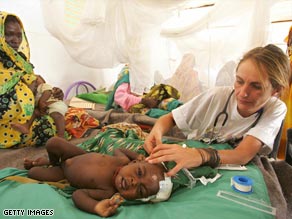
UNITED NATIONS (CNN) -- More than one million people in Darfur are at risk of losing food, water and shelter in coming months, following the expulsion of international aid groups by Sudan's government, the United Nations' chief humanitarian coordinator said Tuesday.
The statement by coordinator John Holmes comes after a joint U.N.-Sudanese assessment of the situation.
The information was gathered from March 11-18 in hopes of stemming further troubles in Darfur after Sudan's government expelled 13 international relief organizations from the wartorn region.
The announcement came on the same day that President Omar al-Bashir, now an indicted war criminal, ignored the threat of arrest by traveling abroad to Eritrea. Also Tuesday, a Sudanese staffer working for a Canadian relief group was shot dead in Darfur.
A full report of the assessment will be released soon, according to the U.N., but an executive summary and recommendations were made available on Tuesday. Read more >>>>>>>>>>
Sunday, March 22, 2009
Expulsion of Aid Groups Puts Millions at Risk in Darfur
NYALA, Sudan — The sign outside the clinic in Otash camp reads “8-hour service daily.”
On Friday, Haider Ismael al-Amin lay in his mother’s arms, his 10-year-old body withered and weak from dehydration after a night of vomiting. But the door to the clinic was locked. After 30 minutes of waiting, his family gave up.
“The white people used to come every day,” said Hawa Hamal Mohammed, a relative of the boy. “Now the clinic is closed.”
The American aid group that operated the clinic, the International Rescue Committee, was one of more than a dozen aid groups expelled from Darfur this month by President Omar Hassan al-Bashir. He accused them of cooperating with the International Criminal Court in The Hague, which had issued a warrant for his arrest on charges of war crimes in the conflict that has consumed Darfur for years.
Since then, local health workers have been struggling, with almost no medicine, to keep the clinic open on a limited basis. Thousands of people in this sprawling camp depend on it for primary care.
But on Friday it was closed altogether. Read more >>>>>>>>>>>>>>>>>>>>>>
On Friday, Haider Ismael al-Amin lay in his mother’s arms, his 10-year-old body withered and weak from dehydration after a night of vomiting. But the door to the clinic was locked. After 30 minutes of waiting, his family gave up.
“The white people used to come every day,” said Hawa Hamal Mohammed, a relative of the boy. “Now the clinic is closed.”
The American aid group that operated the clinic, the International Rescue Committee, was one of more than a dozen aid groups expelled from Darfur this month by President Omar Hassan al-Bashir. He accused them of cooperating with the International Criminal Court in The Hague, which had issued a warrant for his arrest on charges of war crimes in the conflict that has consumed Darfur for years.
Since then, local health workers have been struggling, with almost no medicine, to keep the clinic open on a limited basis. Thousands of people in this sprawling camp depend on it for primary care.
But on Friday it was closed altogether. Read more >>>>>>>>>>>>>>>>>>>>>>
Saturday, March 21, 2009
Darfur, an ICC Arrest Warrant, and the Humanitarian Imperative
By Eric Reeves
EARLIER this month, Sudan’s National Islamic Front regime expelled 13
humanitarian organizations from Darfur and Northern Sudan. The expulsion
order followed immediately the announcement by the International
Criminal Court of an arrest warrant for Sudan’s President Omar
al-Bashir, charging him with crimes against humanity and war crimes. All
evidence points to a well-planned response by Khartoum to a judicial
decision that was universally expected.
The consequences of these expulsions are enormous. All expelled
organizations played key roles in humanitarian assistance; together they
constituted more than 50 percent of total aid capacity. Now 1.5 million
people no longer have access to primary healthcare, and a deadly
meningitis outbreak threatens tens of thousands. General food
distributions to more than 1 million people have been halted, including
to children and the malnourished. More than 1 million people will no
longer have access to clean water; shortages are already being reported,
and will spread quickly.
On Monday, the regime went further and announced its intention to
expel all international aid organizations within a year, despite being
unable to replace the work or resources of these organizations. This
amounts to genocide by other means. With many months to anticipate the
inevitable ICC announcement, Khartoum was determined to make the most of
the occasion, and elimination of an international humanitarian presence
in Darfur had long been a central ambition. The ICC announcement was not
so much the cause of the expulsions as a singularly opportune pretext. Read more >>>>>>>>.
EARLIER this month, Sudan’s National Islamic Front regime expelled 13
humanitarian organizations from Darfur and Northern Sudan. The expulsion
order followed immediately the announcement by the International
Criminal Court of an arrest warrant for Sudan’s President Omar
al-Bashir, charging him with crimes against humanity and war crimes. All
evidence points to a well-planned response by Khartoum to a judicial
decision that was universally expected.
The consequences of these expulsions are enormous. All expelled
organizations played key roles in humanitarian assistance; together they
constituted more than 50 percent of total aid capacity. Now 1.5 million
people no longer have access to primary healthcare, and a deadly
meningitis outbreak threatens tens of thousands. General food
distributions to more than 1 million people have been halted, including
to children and the malnourished. More than 1 million people will no
longer have access to clean water; shortages are already being reported,
and will spread quickly.
On Monday, the regime went further and announced its intention to
expel all international aid organizations within a year, despite being
unable to replace the work or resources of these organizations. This
amounts to genocide by other means. With many months to anticipate the
inevitable ICC announcement, Khartoum was determined to make the most of
the occasion, and elimination of an international humanitarian presence
in Darfur had long been a central ambition. The ICC announcement was not
so much the cause of the expulsions as a singularly opportune pretext. Read more >>>>>>>>.
Friday, March 20, 2009
SUDAN: Fallout scenarios
CAIRO, 20 March 2009 (IRIN) - The expulsion or closure of 16 aid groups in Sudan could worsen North-South relations, stall the Darfur peace process and deter future humanitarian action, analysts said.
The decision, and the 16 March announcement that Sudan would "nationalise" all humanitarian work within one year, have attracted condemnation from the highest levels of the UN and the US.
"The ICC [International Criminal Court] row in general, and the expulsion of the aid agencies in particular, certainly have the potential to destabilise North-South relations," says Wolfram Lacher, a Sudan analyst with the London-based Control Risks Group consultancy.
Though partners in a national unity government since a 2005 peace deal, the North's National Congress Party (NCP) and the South's Sudan People's Liberation Movement (SPLM) have been at odds over the border demarcation, distribution of oil revenue and timing of elections.
"The [expulsion] decisions were made by the NCP without consultation and against the will of the SPLM and that certainly puts an additional strain on relations between the two parties," Lacher said. "The relations between the two are very volatile, very fragile, and on these relations depends the big question whether the North and the South will go back to war in the next few years." Read more >>>>>>>>>>>>
The decision, and the 16 March announcement that Sudan would "nationalise" all humanitarian work within one year, have attracted condemnation from the highest levels of the UN and the US.
"The ICC [International Criminal Court] row in general, and the expulsion of the aid agencies in particular, certainly have the potential to destabilise North-South relations," says Wolfram Lacher, a Sudan analyst with the London-based Control Risks Group consultancy.
Though partners in a national unity government since a 2005 peace deal, the North's National Congress Party (NCP) and the South's Sudan People's Liberation Movement (SPLM) have been at odds over the border demarcation, distribution of oil revenue and timing of elections.
"The [expulsion] decisions were made by the NCP without consultation and against the will of the SPLM and that certainly puts an additional strain on relations between the two parties," Lacher said. "The relations between the two are very volatile, very fragile, and on these relations depends the big question whether the North and the South will go back to war in the next few years." Read more >>>>>>>>>>>>
Time for justice in Darfur
For the first time in history, an arrest warrant has been issued by the International Criminal Court (ICC) for an acting Head of State. On March 4, President Omar al Bashir of Sudan was charged with seven counts of crimes against humanity and war crimes in Darfur.
Congratulations world. We finally acknowledged that a man who has orchestrated the genocide of more than 300,000 people and the displacement of nearly 2.7 million people should be punished. But this begs the question: who is going to arrest him? And more importantly, who will bring peace to Darfur? With no Jack Bauer-led ICC police force in existence, the responsibility falls to a motley crew called the African Union/United Nations Hybrid operation in Darfur (known as UNAMID). However, only with a more robust mandate, more troops and better co-ordination with aid organizations could they possibly become Darfur’s saviour.
Unfortunately, due to the overriding right to sovereignty, foreign forces can only enter Sudan with permission from the criminal in question or by military invasion endorsed by the UN Security Council. Considering Sudan has a 394,250 member army supported by 95,000 reserve troops, not to mention tanks, fighter jets and helicopters kindly supplied by China in exchange for oil and influence, I doubt anyone currently has the balls to try. Read more >>>>>>>>>>>>
Congratulations world. We finally acknowledged that a man who has orchestrated the genocide of more than 300,000 people and the displacement of nearly 2.7 million people should be punished. But this begs the question: who is going to arrest him? And more importantly, who will bring peace to Darfur? With no Jack Bauer-led ICC police force in existence, the responsibility falls to a motley crew called the African Union/United Nations Hybrid operation in Darfur (known as UNAMID). However, only with a more robust mandate, more troops and better co-ordination with aid organizations could they possibly become Darfur’s saviour.
Unfortunately, due to the overriding right to sovereignty, foreign forces can only enter Sudan with permission from the criminal in question or by military invasion endorsed by the UN Security Council. Considering Sudan has a 394,250 member army supported by 95,000 reserve troops, not to mention tanks, fighter jets and helicopters kindly supplied by China in exchange for oil and influence, I doubt anyone currently has the balls to try. Read more >>>>>>>>>>>>
Wednesday, March 18, 2009
Where is the Arab outrage over Darfur?

In recent years, a media revolution has been taking place in the Arab world, so that the media now reflect to a great extent the atmosphere of the Arab street as well as the consensus in the Arab regimes. Criticism against the crimes committed by the Zionist occupier in Palestine receives substantial resonance, whereas other horrors that take place in the region get little coverage, especially when they are the work of local players and not of Europeans, Americans or Jews. The regional condemnation of Israel doesn't reflect global humanitarian standards but is reserved especially for the Israeli-Palestinian conflict.
The criticism against Israel, by its volume and severity, overshadows the coverage of the ongoing conflict in Darfur, for example, which in the past few years has already claimed a quarter of a million victims and created millions of refugees. The ethnic cleansing taking place in Darfur is far worse than any other regional crisis and cannot be compared to the Israeli-Palestinian political conflict, neither in volume nor in essence. Read more >>>>>>>>>>
Sudan's Bashir rallies Arab tribesmen in Darfur
KHARTOUM (Reuters) - Sudan's president rallied thousands of spear-waving Arab tribesmen in Darfur on Wednesday as he maintained his defiant stance against international moves to arrest him for war crimes.
President Omar Hassan al-Bashir vowed to confront Western "colonisers" at the gathering of Rizeigat tribespeople -- a group including clans that have produced some of the fiercest pro-government militias in the Darfur conflict.
Bashir's emotional speech came amid signs of a growing standoff between Sudan and the West following the International Criminal Court's decision to indict him for masterminding atrocities in Darfur.
The president sparked international outrage this month when he expelled 13 foreign aid groups, and shut down three local organisations, accusing them of assisting the court.
U.S. Secretary of State Hillary Clinton on Tuesday stepped up pressure on Khartoum by saying Bashir would be responsible for every death caused by the resulting drop in humanitarian cover in the remote region.
The vast crowd of Rizeigat tribespeople, many riding horses and camels, swore a mass oath of allegiance to the president at the rally in the remote Sibdu valley area in south Darfur.
In a speech broadcast live on Sudan TV, Bashir told the gathering the West was trying to remove him from power, but he was ready to confront any attack.
"These knights on horseback now have spears, but tomorrow on the battlefield they will have machine guns," he said, referring to the crowd. Read more >>>>>>>>>>>>
President Omar Hassan al-Bashir vowed to confront Western "colonisers" at the gathering of Rizeigat tribespeople -- a group including clans that have produced some of the fiercest pro-government militias in the Darfur conflict.
Bashir's emotional speech came amid signs of a growing standoff between Sudan and the West following the International Criminal Court's decision to indict him for masterminding atrocities in Darfur.
The president sparked international outrage this month when he expelled 13 foreign aid groups, and shut down three local organisations, accusing them of assisting the court.
U.S. Secretary of State Hillary Clinton on Tuesday stepped up pressure on Khartoum by saying Bashir would be responsible for every death caused by the resulting drop in humanitarian cover in the remote region.
The vast crowd of Rizeigat tribespeople, many riding horses and camels, swore a mass oath of allegiance to the president at the rally in the remote Sibdu valley area in south Darfur.
In a speech broadcast live on Sudan TV, Bashir told the gathering the West was trying to remove him from power, but he was ready to confront any attack.
"These knights on horseback now have spears, but tomorrow on the battlefield they will have machine guns," he said, referring to the crowd. Read more >>>>>>>>>>>>
Clinton Says Bashir Will Be Held Responsible for Darfur Deaths
U.S. Secretary of State Hillary Clinton said Tuesday that Sudanese President Omar al-Bashir will be held responsible for any deaths among Darfur refugees caused by his decision to expel foreign aid groups from the country. Clinton says the Obama administration will soon name a special envoy for Sudan.
Clinton had harsh words for both the Sudanese leader and countries that have been protective of his government, saying that President Bashir will be held responsible for any deaths in Darfur that result from his decisions, while his international allies should make up for the assistance lost due to his expulsion order.
The secretary's remarks, at a news conference with the top officials of the Northern Ireland administration, were the strongest to date by a senior U.S. official over the Sudanese leader's decision last week to expel 13 international aid groups and subsequent order that all such groups cease activity in Sudan by the end of the year.
Clinton said Mr. Bashir's actions, an apparent response to the International Criminal Court arrest order against him for allegedly orchestrating Darfur war crimes, has created a "horrendous situation" that will cause untold misery and suffering in Darfur, especially in refugee camps. Read more >>>>>>>>>>
Clinton had harsh words for both the Sudanese leader and countries that have been protective of his government, saying that President Bashir will be held responsible for any deaths in Darfur that result from his decisions, while his international allies should make up for the assistance lost due to his expulsion order.
The secretary's remarks, at a news conference with the top officials of the Northern Ireland administration, were the strongest to date by a senior U.S. official over the Sudanese leader's decision last week to expel 13 international aid groups and subsequent order that all such groups cease activity in Sudan by the end of the year.
Clinton said Mr. Bashir's actions, an apparent response to the International Criminal Court arrest order against him for allegedly orchestrating Darfur war crimes, has created a "horrendous situation" that will cause untold misery and suffering in Darfur, especially in refugee camps. Read more >>>>>>>>>>
Friday, March 13, 2009
SLIDESHOW: Life inside Darfur displacement camp
Sudan has closed 13 foreign and three local aid groups saying they helped Sudan's President Omar Hassan al-Bashir over charges of crimes against humanity and war crimes in Darfur.
Before the expulsions, the United Nations and aid groups were running the world's largest humanitarian operation in Darfur where, international experts say, almost six years of conflict have killed 200,000 people and displaced more than 2.7 million people from their homes.
U.N. agencies in Sudan have said it would be impossible to fill the gap left by the expelled organisations which made up around 40 percent of the humanitarian work force in Darfur.
Here is a look into life of displaced Sudanese people at Zam Zam IDP camp in Al Fasher, northern Darfur. Pictures taken by Zohra Bensemra/REUTERS
Scroll over photos for captions and more information.
For members to download photos please click here
Before the expulsions, the United Nations and aid groups were running the world's largest humanitarian operation in Darfur where, international experts say, almost six years of conflict have killed 200,000 people and displaced more than 2.7 million people from their homes.
U.N. agencies in Sudan have said it would be impossible to fill the gap left by the expelled organisations which made up around 40 percent of the humanitarian work force in Darfur.
Here is a look into life of displaced Sudanese people at Zam Zam IDP camp in Al Fasher, northern Darfur. Pictures taken by Zohra Bensemra/REUTERS
Scroll over photos for captions and more information.
For members to download photos please click here
Tuesday, March 10, 2009
250 suicide attacks vowed worldwide
250 suicide attacks vowed
A coalition of Sudanese Islamist militants have vowed to carry out 250 suicide attacks against countries that support the work of the International Criminal Court (ICC), a report said yesterday.
The Coalition of Jihad and Martyrdom Movements, made their threat in a statement released on Monday, the Akhir Lahzah newspaper reported.
“The (coalition) announces it will execute 250 jihadi martyrdom operations against the countries supporting the ICC’s decisions in their territories,” the newspaper quoted the statement as saying.
It also called for the death of ICC prosecutor Luis Moreno-Ocampo and Sudanese rebel leader Khalil Ibrahim, whom it labelled “a Zionist agent,” the newspaper reported.
The statement was reportedly signed by Mussa Hilal, a former leader of a pro-Khartoum militia in Darfur who became a government advisor, Read more >>>>>>>>
A coalition of Sudanese Islamist militants have vowed to carry out 250 suicide attacks against countries that support the work of the International Criminal Court (ICC), a report said yesterday.
The Coalition of Jihad and Martyrdom Movements, made their threat in a statement released on Monday, the Akhir Lahzah newspaper reported.
“The (coalition) announces it will execute 250 jihadi martyrdom operations against the countries supporting the ICC’s decisions in their territories,” the newspaper quoted the statement as saying.
It also called for the death of ICC prosecutor Luis Moreno-Ocampo and Sudanese rebel leader Khalil Ibrahim, whom it labelled “a Zionist agent,” the newspaper reported.
The statement was reportedly signed by Mussa Hilal, a former leader of a pro-Khartoum militia in Darfur who became a government advisor, Read more >>>>>>>>
Sunday, March 08, 2009
Your comments on my Darfur column
Your comments on my Darfur column
By Nicholas Kristof
My Sunday column is about the aid workers being expelled from Darfur. Surprisingly, the United Nations reacted with rather more vigor than the Obama administration, especially at first. Ban Ki-moon issued a tough statement and has been busy calling up leaders in the region to try to get this reversed, and the heads of WFP and other agencies made strong statements as well. In contrast, the initial State Department comment was pathetic, although it was strengthened to a condemnation on Friday. Obama, Biden, Clinton were all tough on Darfur when they were in the Senate and when they were running for office, so let’s hope they aren’t backing down now that they are in office.
Let me also try to clarify something. There are still many aid workers who have not been expelled (World Vision is one of the biggest groups that remains in place), and of course they will try to pick up the slack. But they won’t be able to, except at the margins, for a couple of reasons. First they have their own missions, and everybody is understaffed. Second, Sudan security officials have closed the offices and confiscated the equipment of the expelled NGO’s, and you can’t do a food distribution if you don’t have lists of people who are supposed to get aid; a communications technician for a group that remains can’t shift to treating children with diarrhea, particularly if the clinic and medications have been confiscated. In some areas, the camp managers were expelled, so there is no longer anyone who even knows what is needed. Third, there is a wide variation in the regional impact of the expelled NGO’s. For example, almost all the aid groups in West Darfur were expelled, but a World Vision staff member in South Darfur can’t do anything to save lives in West Darfur. Read more >>>>>>>>>>>>
By Nicholas Kristof
My Sunday column is about the aid workers being expelled from Darfur. Surprisingly, the United Nations reacted with rather more vigor than the Obama administration, especially at first. Ban Ki-moon issued a tough statement and has been busy calling up leaders in the region to try to get this reversed, and the heads of WFP and other agencies made strong statements as well. In contrast, the initial State Department comment was pathetic, although it was strengthened to a condemnation on Friday. Obama, Biden, Clinton were all tough on Darfur when they were in the Senate and when they were running for office, so let’s hope they aren’t backing down now that they are in office.
Let me also try to clarify something. There are still many aid workers who have not been expelled (World Vision is one of the biggest groups that remains in place), and of course they will try to pick up the slack. But they won’t be able to, except at the margins, for a couple of reasons. First they have their own missions, and everybody is understaffed. Second, Sudan security officials have closed the offices and confiscated the equipment of the expelled NGO’s, and you can’t do a food distribution if you don’t have lists of people who are supposed to get aid; a communications technician for a group that remains can’t shift to treating children with diarrhea, particularly if the clinic and medications have been confiscated. In some areas, the camp managers were expelled, so there is no longer anyone who even knows what is needed. Third, there is a wide variation in the regional impact of the expelled NGO’s. For example, almost all the aid groups in West Darfur were expelled, but a World Vision staff member in South Darfur can’t do anything to save lives in West Darfur. Read more >>>>>>>>>>>>
Friday, March 06, 2009
Justice for Darfur
Sudanese President Omar Hassan Ahmed Bashir has responded to the International Criminal Court's warrant for his arrest on charges of war crimes by retaliating against the civilians of Darfur. He ordered the expulsion of 13 international agencies that provide food, water and medical care to more than 4 million Darfuris, offering yet another reason to bring him to justice.
U.N. Secretary-General Ban Ki-moon said the expulsions would cause "irrevocable damage to humanitarian operations," provoking a new tragedy for people who already have suffered mass murder, rape and torture. At least 300,000 people have died in Darfur in the fighting between ethnic African rebels and Arab militiamen working for the Khartoum government, and 2.7 million have been driven out of their homes. Arguing that peace is more urgent than justice, some African and Arab leaders have criticized the ICC's decision to issue the warrant now, saying it will destabilize the region and jeopardize an already shaky deal to end the civil war between northern and southern Sudan. This is a false argument; impunity only begets more violence. Their criticism should be directed at Bashir, not at the court.
The U.N. Security Council asked the court to investigate crimes in Darfur in the first place, and has the power to defer the warrant. China, which is a member of the council and buys two-thirds of Sudan's oil exports, supports that idea. But it would be a mistake. Legal proceedings in the court should not be held up for political purposes. The international community should stand behind the court's action and press the government of Sudan to stop its collective punishment of Darfuris and fulfill its obligations under the 2005 peace agreement. The Sudanese government is obliged under international law to protect its citizens. World leaders should be pressing Bashir to allow relief in and to prevent further atrocities.Read more >>>>>>>>
U.N. Secretary-General Ban Ki-moon said the expulsions would cause "irrevocable damage to humanitarian operations," provoking a new tragedy for people who already have suffered mass murder, rape and torture. At least 300,000 people have died in Darfur in the fighting between ethnic African rebels and Arab militiamen working for the Khartoum government, and 2.7 million have been driven out of their homes. Arguing that peace is more urgent than justice, some African and Arab leaders have criticized the ICC's decision to issue the warrant now, saying it will destabilize the region and jeopardize an already shaky deal to end the civil war between northern and southern Sudan. This is a false argument; impunity only begets more violence. Their criticism should be directed at Bashir, not at the court.
The U.N. Security Council asked the court to investigate crimes in Darfur in the first place, and has the power to defer the warrant. China, which is a member of the council and buys two-thirds of Sudan's oil exports, supports that idea. But it would be a mistake. Legal proceedings in the court should not be held up for political purposes. The international community should stand behind the court's action and press the government of Sudan to stop its collective punishment of Darfuris and fulfill its obligations under the 2005 peace agreement. The Sudanese government is obliged under international law to protect its citizens. World leaders should be pressing Bashir to allow relief in and to prevent further atrocities.Read more >>>>>>>>
Thursday, March 05, 2009
ICC issues a warrant of arrest for Omar Al Bashir, President of Sudan
ICC issues a warrant of arrest for Omar Al Bashir, President of Sudan
ICC-CPI-20090304-PR394 عربي
Situation: Darfur, Sudan
Today, Pre-Trial Chamber I of the International Criminal Court (ICC) issued a warrant for the arrest of Omar Hassan Ahmad Al Bashir, President of Sudan, for war crimes and crimes against humanity. He is suspected of being criminally responsible, as an indirect (co-)perpetrator, for intentionally directing attacks against an important part of the civilian population of Darfur, Sudan, murdering, exterminating, raping, torturing and forcibly transferring large numbers of civilians, and pillaging their property. This is the first warrant of arrest ever issued for a sitting Head of State by the ICC.
Omar Al Bashir’s official capacity as a sitting Head of State does not exclude his criminal responsibility, nor does it grant him immunity against prosecution before the ICC, according to Pre-Trial Chamber I.
According to the Judges, the above-mentioned crimes were allegedly committed during a five year counter-insurgency campaign by the Government of Sudan against the Sudanese Liberation Movement/Army (SLM/A), the Justice and Equality Movement (JEM) and other armed groups opposing the Government of Sudan in Darfur. It is alleged that this campaign started soon after the April 2003 attack on El Fasher airport as a result of a common plan agreed upon at the highest level of the Government of Sudan by Omar Al Bashir and other high-ranking Sudanese political and military leaders. It lasted at least until 14 July 2008, the date of the filing of the Prosecution’s Application for the warrant of arrest for Omar Al Bashir.
A core component of that campaign was the unlawful attack on that part of the civilian population of Darfur – belonging largely to the Fur, Masalit and Zaghawa groups – perceived to be close to the organised armed groups opposing the Government of Sudan in Darfur. The said civilian population was to be unlawfully attacked by Government of Sudan forces, including the Sudanese Armed Forces and their allied Janjaweed Militia, the Sudanese Police Force, the National Intelligence and Security Service and the Humanitarian Aid Commission.
The Chamber found that Omar al Bashir, as the de jure and de facto President of Sudan and Commander-in-Chief of the Sudanese Armed Forces, is suspected of having coordinated the design and implementation of the counter-insurgency campaign. In the alternative, it also found that there are reasonable grounds to believe that he was in control of all branches of the “apparatus” of the State of Sudan and used such control to secure the implementation of the counter-insurgency campaign.
The counts
The warrant of arrest for Omar Al Bashir lists 7 counts on the basis of his individual criminal responsibility (article 25(3)(a)) including:
five counts of crimes against humanity: murder – article 7(1)(a); extermination – article 7(1)(b); forcible transfer – article 7(1)(d);
torture – article 7(1)(f); and rape – article 7(1)(g);
two counts of war crimes: intentionally directing attacks against a civilian population as such or against individual civilians not taking direct part in hostilities – article 8(2)(e)(i); and pillaging – article 8(2)(e)(v). Read more >>>>>>>>
ICC-CPI-20090304-PR394 عربي
Situation: Darfur, Sudan
Today, Pre-Trial Chamber I of the International Criminal Court (ICC) issued a warrant for the arrest of Omar Hassan Ahmad Al Bashir, President of Sudan, for war crimes and crimes against humanity. He is suspected of being criminally responsible, as an indirect (co-)perpetrator, for intentionally directing attacks against an important part of the civilian population of Darfur, Sudan, murdering, exterminating, raping, torturing and forcibly transferring large numbers of civilians, and pillaging their property. This is the first warrant of arrest ever issued for a sitting Head of State by the ICC.
Omar Al Bashir’s official capacity as a sitting Head of State does not exclude his criminal responsibility, nor does it grant him immunity against prosecution before the ICC, according to Pre-Trial Chamber I.
According to the Judges, the above-mentioned crimes were allegedly committed during a five year counter-insurgency campaign by the Government of Sudan against the Sudanese Liberation Movement/Army (SLM/A), the Justice and Equality Movement (JEM) and other armed groups opposing the Government of Sudan in Darfur. It is alleged that this campaign started soon after the April 2003 attack on El Fasher airport as a result of a common plan agreed upon at the highest level of the Government of Sudan by Omar Al Bashir and other high-ranking Sudanese political and military leaders. It lasted at least until 14 July 2008, the date of the filing of the Prosecution’s Application for the warrant of arrest for Omar Al Bashir.
A core component of that campaign was the unlawful attack on that part of the civilian population of Darfur – belonging largely to the Fur, Masalit and Zaghawa groups – perceived to be close to the organised armed groups opposing the Government of Sudan in Darfur. The said civilian population was to be unlawfully attacked by Government of Sudan forces, including the Sudanese Armed Forces and their allied Janjaweed Militia, the Sudanese Police Force, the National Intelligence and Security Service and the Humanitarian Aid Commission.
The Chamber found that Omar al Bashir, as the de jure and de facto President of Sudan and Commander-in-Chief of the Sudanese Armed Forces, is suspected of having coordinated the design and implementation of the counter-insurgency campaign. In the alternative, it also found that there are reasonable grounds to believe that he was in control of all branches of the “apparatus” of the State of Sudan and used such control to secure the implementation of the counter-insurgency campaign.
The counts
The warrant of arrest for Omar Al Bashir lists 7 counts on the basis of his individual criminal responsibility (article 25(3)(a)) including:
five counts of crimes against humanity: murder – article 7(1)(a); extermination – article 7(1)(b); forcible transfer – article 7(1)(d);
torture – article 7(1)(f); and rape – article 7(1)(g);
two counts of war crimes: intentionally directing attacks against a civilian population as such or against individual civilians not taking direct part in hostilities – article 8(2)(e)(i); and pillaging – article 8(2)(e)(v). Read more >>>>>>>>
Wednesday, March 04, 2009
VIDEO: Darfur genocide charges possible
The International Criminal Court's chief prosecutor says there is strong evidence to charge Sudanese President Omar Hassan al-Bashir.
Bashir was accused in July 2008 by the ICC chief prosecutor of masterminding a campaign of genocide in Darfur. The International Criminal Court (ICC) in the Hague is set to announce whether it will issue an arrest warrant for Bashir, for genocide, crimes against humanity and war crimes in Darfur. Penny Tweedie reports. Watch the video >>>>>>>>>>>>>>
Bashir was accused in July 2008 by the ICC chief prosecutor of masterminding a campaign of genocide in Darfur. The International Criminal Court (ICC) in the Hague is set to announce whether it will issue an arrest warrant for Bashir, for genocide, crimes against humanity and war crimes in Darfur. Penny Tweedie reports. Watch the video >>>>>>>>>>>>>>
Darfur Enmeshed Within Sudan’s Broadening National Crisis (Part 3 of 3)
Eric Reeves
March 3, 2009
On the eve of the ICC announcement of a warrant for the arrest of Omar al-Bashir, charging him with atrocity crimes, security in Darfur reaches a nadir; humanitarians continue to evacuate and their operations to contract amidst growing evidence that UNAMID cannot protect them, or civilians.
KHARTOUM’S THREATS
This analysis appears immediately prior to a much anticipated announcement (scheduled for March 4, 2009) by the Pre-Trial Chamber of the International Criminal Court. The Court will almost certainly issue an arrest warrant for National Islamic Front/National Congress Party President Omar al-Bashir---charging him with atrocity crimes in Darfur, including crimes against humanity. The consequences of this announcement are uncertain, though alarm on the part of al-Bashir and his regime has become increasingly conspicuous over the past several months. This alarm has been reflected in a wide range of threats against the international community, including supporters of the ICC, humanitarian workers in Darfur, the UN/African Union peacekeeping force in Darfur, as well as the linchpin north/south Comprehensive Peace Agreement (2005).
The most recent and revealing threat came from the head of the National Security and Intelligence Service, the powerful Saleh Abdalla Gosh. Gosh ominously threatened supporters of ICC actions with the resurgence of Islamic fundamentalism in Sudan; he declared that the ruling National Congress Party (NCP) would again become, in effect, the National Islamic Front (NIF)---the name for the current regime when it came to power by military coup in 1989, deposing an elected government, and deliberately aborting Sudan’s most promising chance for peace since Independence in 1956:Read more >>>>>>>>>>>>
March 3, 2009
On the eve of the ICC announcement of a warrant for the arrest of Omar al-Bashir, charging him with atrocity crimes, security in Darfur reaches a nadir; humanitarians continue to evacuate and their operations to contract amidst growing evidence that UNAMID cannot protect them, or civilians.
KHARTOUM’S THREATS
This analysis appears immediately prior to a much anticipated announcement (scheduled for March 4, 2009) by the Pre-Trial Chamber of the International Criminal Court. The Court will almost certainly issue an arrest warrant for National Islamic Front/National Congress Party President Omar al-Bashir---charging him with atrocity crimes in Darfur, including crimes against humanity. The consequences of this announcement are uncertain, though alarm on the part of al-Bashir and his regime has become increasingly conspicuous over the past several months. This alarm has been reflected in a wide range of threats against the international community, including supporters of the ICC, humanitarian workers in Darfur, the UN/African Union peacekeeping force in Darfur, as well as the linchpin north/south Comprehensive Peace Agreement (2005).
The most recent and revealing threat came from the head of the National Security and Intelligence Service, the powerful Saleh Abdalla Gosh. Gosh ominously threatened supporters of ICC actions with the resurgence of Islamic fundamentalism in Sudan; he declared that the ruling National Congress Party (NCP) would again become, in effect, the National Islamic Front (NIF)---the name for the current regime when it came to power by military coup in 1989, deposing an elected government, and deliberately aborting Sudan’s most promising chance for peace since Independence in 1956:Read more >>>>>>>>>>>>
Tuesday, March 03, 2009
Prosecutor: Strong case against Sudanese leader
THE HAGUE, Netherlands -- The International Criminal Court announces Wednesday whether it will issue an arrest warrant for Sudanese President Omar al-Bashir on charges of masterminding genocide in Darfur - a move that could provoke a violent backlash.
The chief prosecutor says dozens of witnesses will testify that al-Bashir controlled a genocidal campaign aimed at wiping out three ethnic African tribes in the vast nation south of Egypt.
"We have strong evidence against Mr. Bashir," prosecutor Luis Moreno Ocampo said Tuesday. "More than 30 witnesses will (testify) how he managed to control everything and we have strong evidence of his intention. I never present a case without strong evidence." Read more >>>>>>>>>>>>>
The chief prosecutor says dozens of witnesses will testify that al-Bashir controlled a genocidal campaign aimed at wiping out three ethnic African tribes in the vast nation south of Egypt.
"We have strong evidence against Mr. Bashir," prosecutor Luis Moreno Ocampo said Tuesday. "More than 30 witnesses will (testify) how he managed to control everything and we have strong evidence of his intention. I never present a case without strong evidence." Read more >>>>>>>>>>>>>
Monday, March 02, 2009
ICC decides on the indictment of Al-Bashir
In relation to the pending announcement of the judges of the International Criminal Court in the indictment case of A-Bashir, president of the Sudan, Darfur Call and Darfur Union (both are Darfuri Grassroots organizations in The Netherlands) will organize a memorial for the victims of crimes committed in Darfur and a manifestation to support the decision of the judges of ICC. In addition a joint statement by several NOGs will be released.
Place: International Criminal Court, The Hague
Date: 04 March 2009
Time: 12:00 till 17:00
Darfuris in different European countries (UK, Belgium, France and Italy) are organizing similar events.
darfurcall@gmail.com
darfurunion@yahoo.com
Place: International Criminal Court, The Hague
Date: 04 March 2009
Time: 12:00 till 17:00
Darfuris in different European countries (UK, Belgium, France and Italy) are organizing similar events.
darfurcall@gmail.com
darfurunion@yahoo.com
Sunday, March 01, 2009
DJABAL REFUGEE CAMP, Chad
After Barack Obama was elected president in November, the Darfur refugees here were so thrilled that they erupted in spontaneous dancing and singing.
Soon afterward, the refugees renamed the School No. 1 in this dusty camp the Obama School. It’s a pathetic building of mud bricks with a tin roof, and the windows are holes in the walls, but it’s caulked with hope that President Obama may help end the long slaughter and instability in Sudan.
Soon we’ll see whether those hopes are justified. Next Wednesday, the International Criminal Court is expected to issue an arrest warrant for Sudan’s president, Omar Hassan al-Bashir, for crimes against humanity in Darfur.
That would be historic — the first time the court has called for the arrest of a sitting head of state. It would be the clearest assertion that in the 21st century, mass murder is no longer a ruler’s prerogative. Read more >>>>>>>>>>>>>>>>
Soon afterward, the refugees renamed the School No. 1 in this dusty camp the Obama School. It’s a pathetic building of mud bricks with a tin roof, and the windows are holes in the walls, but it’s caulked with hope that President Obama may help end the long slaughter and instability in Sudan.
Soon we’ll see whether those hopes are justified. Next Wednesday, the International Criminal Court is expected to issue an arrest warrant for Sudan’s president, Omar Hassan al-Bashir, for crimes against humanity in Darfur.
That would be historic — the first time the court has called for the arrest of a sitting head of state. It would be the clearest assertion that in the 21st century, mass murder is no longer a ruler’s prerogative. Read more >>>>>>>>>>>>>>>>
Saturday, February 28, 2009
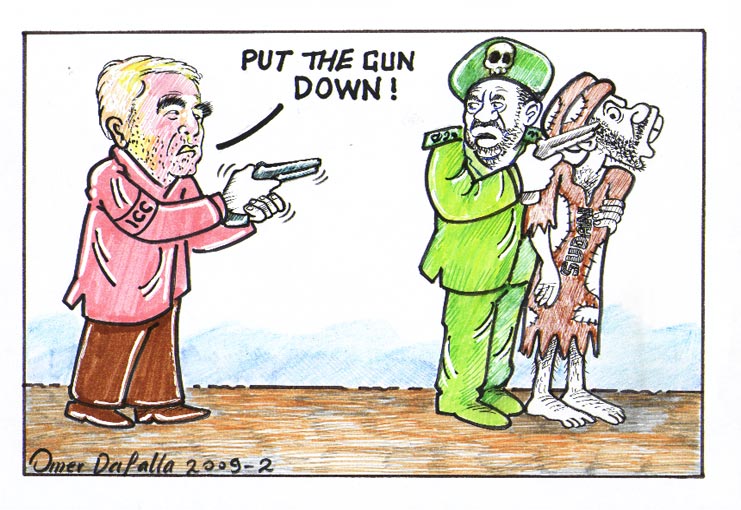
Friday, February 27, 2009
Pre-Trial Chamber I’s decision concerning President Al Bashir of Sudan to be announced during press conference on 4 March 2009
Press Release: 26.02.2009
Pre-Trial Chamber I’s decision concerning President Al Bashir of Sudan to be announced during press conference on 4 March 2009
ICC-CPI-20090226-MA35
Situation: Darfur, Sudan
The decision of Pre-Trial Chamber I of the International Criminal Court with regard to the Prosecution application of 14 July 2008 for the issuance of a warrant of arrest against President Omar Al Bashir of Sudan will be announced during a press conference which will take place on 4 March 2009 at the seat of the Court. The press conference will start at 2 p.m.
The Registrar, Ms Silvana Arbia, and the ICC Spokesperson, Ms Laurence Blairon, will make statements in English, after which there will be an opportunity for journalists to ask them questions. Interpretation into French and Arabic will be available.
Separate interviews after the press conference with audiovisual media are possible but will need to be arranged in advance. Please note that only a limited number of such requests will be granted. Read more >>>>>>>>>
Pre-Trial Chamber I’s decision concerning President Al Bashir of Sudan to be announced during press conference on 4 March 2009
ICC-CPI-20090226-MA35
Situation: Darfur, Sudan
The decision of Pre-Trial Chamber I of the International Criminal Court with regard to the Prosecution application of 14 July 2008 for the issuance of a warrant of arrest against President Omar Al Bashir of Sudan will be announced during a press conference which will take place on 4 March 2009 at the seat of the Court. The press conference will start at 2 p.m.
The Registrar, Ms Silvana Arbia, and the ICC Spokesperson, Ms Laurence Blairon, will make statements in English, after which there will be an opportunity for journalists to ask them questions. Interpretation into French and Arabic will be available.
Separate interviews after the press conference with audiovisual media are possible but will need to be arranged in advance. Please note that only a limited number of such requests will be granted. Read more >>>>>>>>>
Monday, February 23, 2009
Decision of Pre-Trial Chamber I concerning President Al Bashir of Sudan to be issued on Wednesday 4 March 2009
Situation: Darfur, Sudan
Today Pre-Trial Chamber I announced that it would issue on Wednesday 4 March 2009 its decision concerning the Prosecution application of 14 July 2008 for the issuance of a warrant of arrest against President Omar Al Bashir of Sudan.
The decision will be made public by the normal way of a press release and publication on the Court’s website. Read more >>>>>>>>>>
Today Pre-Trial Chamber I announced that it would issue on Wednesday 4 March 2009 its decision concerning the Prosecution application of 14 July 2008 for the issuance of a warrant of arrest against President Omar Al Bashir of Sudan.
The decision will be made public by the normal way of a press release and publication on the Court’s website. Read more >>>>>>>>>>
Sunday, February 22, 2009
Sisters, Victims, Heroes
By NICHOLAS D. KRISTOF
GOZ BEIDA, Chad
So I’m bunking with George Clooney in a little room in a guest house here in eastern Chad, near Darfur in Sudan. We each have a mattress on the floor, the “shower” is a rubber hose that doesn’t actually produce any water, and George’s side of the room has a big splotch of something that sure looks like blood.
He’s using me to learn more about Darfur, and I’m using him to ease you into a column about genocide. Manipulation all around — and, luckily, neither of us snores. (But stay tuned to this series for salacious gossip if he talks in his sleep.)
The slaughter in Darfur has continued for six years largely because world leaders have been complacent and preoccupied. In the coming weeks, the International Criminal Court is expected to issue an arrest warrant for Sudan’s president, Omar Hassan al-Bashir, for orchestrating the killings — and that will give the world a new opportunity to end the slaughter.
But to seize that opportunity, world leaders will have to summon some of the same moral courage that Darfuris show all the time.
Take Suad Ahmed, who is in the pantheon of my personal heroes. I introduced her to George in her little thatch hut.
Suad, 27, fled from Darfur to a refugee camp in Chad five years ago with her husband and beloved younger sister, Halima, who is now 12 — if she is still alive. Read more >>>>>>>>>
GOZ BEIDA, Chad
So I’m bunking with George Clooney in a little room in a guest house here in eastern Chad, near Darfur in Sudan. We each have a mattress on the floor, the “shower” is a rubber hose that doesn’t actually produce any water, and George’s side of the room has a big splotch of something that sure looks like blood.
He’s using me to learn more about Darfur, and I’m using him to ease you into a column about genocide. Manipulation all around — and, luckily, neither of us snores. (But stay tuned to this series for salacious gossip if he talks in his sleep.)
The slaughter in Darfur has continued for six years largely because world leaders have been complacent and preoccupied. In the coming weeks, the International Criminal Court is expected to issue an arrest warrant for Sudan’s president, Omar Hassan al-Bashir, for orchestrating the killings — and that will give the world a new opportunity to end the slaughter.
But to seize that opportunity, world leaders will have to summon some of the same moral courage that Darfuris show all the time.
Take Suad Ahmed, who is in the pantheon of my personal heroes. I introduced her to George in her little thatch hut.
Suad, 27, fled from Darfur to a refugee camp in Chad five years ago with her husband and beloved younger sister, Halima, who is now 12 — if she is still alive. Read more >>>>>>>>>
Friday, February 20, 2009
Ex-SPLM official says Sudan’s Bashir must ‘face ICC or commit suicide’

February 19, 2009 (CAIRO) — Edward Lino, a former official with the Sudan People’s Liberation Movement (SPLM) which rules the semi-autonomous south urged the Sudanese government to cooperate with the International Criminal Court (ICC) if an arrest warrant is issued for president Omer Hassan Al-Bashir.
Lino who was the former SPLM administrator for Abyei region told the Kuwaiti newspaper Al-Jarida that Sudan is a member of the United Nations and is therefore obligated to comply with the ICC.
The UN Security Council (UNSC) issued resolution 1593 under chapter VII in March 2005 referring the situation in Darfur to the ICC.
The ICC judges are expected to release a decision before the end of the month in which they agree to issue an arrest warrant for Al-Bashir on an unspecified number of counts. Read more >>>>>>>>>>>>
Friday, February 06, 2009
U.N. says 30,000 displaced by South Darfur fighting
KHARTOUM (Reuters) - At least 30,000 people have fled their homes in South Darfur state in western Sudan in recent days because of fighting between rebels and government forces, the United Nations said in a statement received on Friday.
The office of the U.N. humanitarian coordinator for Sudan said the people were from the Muhajiriya and Shearia areas. The Sudanese army said on Wednesday it had captured Muhajiriya town from rebels of the Justice and Equality Movement.
In three weeks of clashes around Muhajiriya, 80 km (50 miles) from the South Darfur capital of Nyala, at least 30 people were killed, U.N. officials have said. Read more >>>>>>
The office of the U.N. humanitarian coordinator for Sudan said the people were from the Muhajiriya and Shearia areas. The Sudanese army said on Wednesday it had captured Muhajiriya town from rebels of the Justice and Equality Movement.
In three weeks of clashes around Muhajiriya, 80 km (50 miles) from the South Darfur capital of Nyala, at least 30 people were killed, U.N. officials have said. Read more >>>>>>
Friday, January 30, 2009
Obama’s Envoy Voices Support for International Court
By Bill Varner
Jan. 29 (Bloomberg) -- Ambassador Susan Rice signaled a shift in U.S. policy toward support for the International Criminal Court, a tribunal the Bush administration opposed, in her first speech to the United Nations Security Council.
The International Criminal Court “looks to become an important and credible instrument for trying to hold accountable the senior leadership responsible for atrocities committed in the Congo, Uganda and Darfur,” Rice said in a closed council meeting, according to a text provided by the U.S. mission.
President George W. Bush opposed U.S. ratification of the treaty that created the court out of concern that it didn’t include adequate protections against politically motivated prosecutions. The U.S. sought and received UN immunity for its citizens from tribunal prosecution from 2002 to 2004.
Crimes against humanity in Yugoslavia, Rwanda and Cambodia gave impetus to creation of the Hague court, whose jurisdiction took effect on July 1, 2002. The court’s prosecutor last July sought the arrest of Sudanese President Umar Hasan al-Bashir for war crimes in the Darfur region of Sudan.
Rice’s remarks at the Security Council meeting on international humanitarian law won praise from envoys used to seeing the U.S. isolated on issues such as the International Criminal Court’s jurisdiction.
‘She Was Incredible’ Read more >>>>>>>>>>>>>>>>
Jan. 29 (Bloomberg) -- Ambassador Susan Rice signaled a shift in U.S. policy toward support for the International Criminal Court, a tribunal the Bush administration opposed, in her first speech to the United Nations Security Council.
The International Criminal Court “looks to become an important and credible instrument for trying to hold accountable the senior leadership responsible for atrocities committed in the Congo, Uganda and Darfur,” Rice said in a closed council meeting, according to a text provided by the U.S. mission.
President George W. Bush opposed U.S. ratification of the treaty that created the court out of concern that it didn’t include adequate protections against politically motivated prosecutions. The U.S. sought and received UN immunity for its citizens from tribunal prosecution from 2002 to 2004.
Crimes against humanity in Yugoslavia, Rwanda and Cambodia gave impetus to creation of the Hague court, whose jurisdiction took effect on July 1, 2002. The court’s prosecutor last July sought the arrest of Sudanese President Umar Hasan al-Bashir for war crimes in the Darfur region of Sudan.
Rice’s remarks at the Security Council meeting on international humanitarian law won praise from envoys used to seeing the U.S. isolated on issues such as the International Criminal Court’s jurisdiction.
‘She Was Incredible’ Read more >>>>>>>>>>>>>>>>
Thursday, January 29, 2009
Condemnation of Darfur Bombings
Press Statement
Robert Wood
Acting Spokesman
Washington, DC
January 27, 2009
The United States condemns the military activity carried out by the Sudanese Armed Forces (SAF) in North and South Darfur since January 22, as well as the incursion by the Justice and Equality Movement (JEM) into Muhajaria and other areas of South Darfur, which resulted in an increase of violence over the last week. This fighting and subsequent Government of Sudan bombing campaigns have reportedly resulted in the deaths, injuries and displacements of civilians. The bombing campaigns in particular are a violation of the Darfur Peace Agreement, of the Government of Sudan-initiated ceasefire, and of United Nations Security Council (UNSC) resolutions on Darfur. We welcome the statement by the Secretary-General condemning these hostilities. We demand that all parties to the conflict, including rebel movements, cease all violence and provocations in Darfur immediately, and commit to the peace process under the leadership of Joint Chief Mediator Djibril Yipènè Bassolé.
2009/083
Robert Wood
Acting Spokesman
Washington, DC
January 27, 2009
The United States condemns the military activity carried out by the Sudanese Armed Forces (SAF) in North and South Darfur since January 22, as well as the incursion by the Justice and Equality Movement (JEM) into Muhajaria and other areas of South Darfur, which resulted in an increase of violence over the last week. This fighting and subsequent Government of Sudan bombing campaigns have reportedly resulted in the deaths, injuries and displacements of civilians. The bombing campaigns in particular are a violation of the Darfur Peace Agreement, of the Government of Sudan-initiated ceasefire, and of United Nations Security Council (UNSC) resolutions on Darfur. We welcome the statement by the Secretary-General condemning these hostilities. We demand that all parties to the conflict, including rebel movements, cease all violence and provocations in Darfur immediately, and commit to the peace process under the leadership of Joint Chief Mediator Djibril Yipènè Bassolé.
2009/083
Saturday, January 17, 2009
U.N. condemns Sudan air bombing in Darfur
KHARTOUM, Sudan, Jan. 16 (UPI) -- The United Nations is calling for an end to hostilities in the Darfur region of Sudan after the government launched airstrikes Thursday.
U.N. Secretary-General Ban Ki-moon Thursday said military violence would not bring peace to the war-ravaged Darfur, where ongoing violence between government forces and the rebel militants has resulted in an estimated 300,000 deaths and the displacement of millions of civilians.
Thursday the Sudanese government launched an aerial bombing campaign and ground offensive targeting militiamen in the southern Muhajeria region of Darfur. Ban called on the Sudanese government and rebel leaders to end the military aggression, the United Nations reported. Read more >>>>>>>>>>>
U.N. Secretary-General Ban Ki-moon Thursday said military violence would not bring peace to the war-ravaged Darfur, where ongoing violence between government forces and the rebel militants has resulted in an estimated 300,000 deaths and the displacement of millions of civilians.
Thursday the Sudanese government launched an aerial bombing campaign and ground offensive targeting militiamen in the southern Muhajeria region of Darfur. Ban called on the Sudanese government and rebel leaders to end the military aggression, the United Nations reported. Read more >>>>>>>>>>>
Monday, January 05, 2009
High noon at genocide in Darfur
Sudan's president, Gen. Omar al-Bashir, is scared. Having flimflammed the United Nations and flouted its resolutions warning him to stop the mass killings and rapings of his black citizens in Darfur, the victims' avenger Luis Moreno-Ocampo, chief prosecutor of the International Criminal Court in The Hague, may finally be close to bringing this monstrous dictator to trial, the first sitting president indicted by the World Court.
Last July, Moreno-Ocampo had asked the ICC to issue arrest warrants for Al-Bashir on three counts of genocide, five counts of crimes against humanity and two of murder. The legal definition of genocide is: "intent to destroy, in whole or in part, a national, ethical, racial or religious group."
The prosecutor accuses Al-Bashir of a campaign to eliminate African Darfur tribes.
After the ICC asked for more supporting material to justify arrest warrants, on Nov. 21, Moreno-Ocampo submitted more than 700 pages of documented evidence, including witness statements. All of his previous requests for arrest warrants in other cases have been successful.
Adding to Al-Bashir's fears is the prospect of national elections next year demanded by foreign donor governments, and supported by the United Nations and many in Sudan. The Economist (Nov. 20) reports that the dictator and his henchmen "know that if even vaguely free and fair ballots were to take place throughout Sudan, they would lose heavily." Read more >>>>>>>>>>>>>>>>>
Last July, Moreno-Ocampo had asked the ICC to issue arrest warrants for Al-Bashir on three counts of genocide, five counts of crimes against humanity and two of murder. The legal definition of genocide is: "intent to destroy, in whole or in part, a national, ethical, racial or religious group."
The prosecutor accuses Al-Bashir of a campaign to eliminate African Darfur tribes.
After the ICC asked for more supporting material to justify arrest warrants, on Nov. 21, Moreno-Ocampo submitted more than 700 pages of documented evidence, including witness statements. All of his previous requests for arrest warrants in other cases have been successful.
Adding to Al-Bashir's fears is the prospect of national elections next year demanded by foreign donor governments, and supported by the United Nations and many in Sudan. The Economist (Nov. 20) reports that the dictator and his henchmen "know that if even vaguely free and fair ballots were to take place throughout Sudan, they would lose heavily." Read more >>>>>>>>>>>>>>>>>
Sunday, January 04, 2009
Add your voice for Darfur
JEFFREY GOVENDO, Hopkinton
Overshadowed by the barrage of news stories on the economy and two wars we are fighting, is the genocide in Sudan which has entered its 6th year. Up to 400,000 have perished, with nearly three million displaced and living in refugee camps with insufficient food, water and medicine.
Darfur activists have been heartened by the election of Barack Obama, who during the campaign promised "unstinting resolve" to end the genocide against the Darfuri people by the government and its surrogates.
We need to hold him to his word. The national Save Darfur Coalition is coordinating a nationwide postcard campaign - one million voices for Darfur - to be delivered electronically or in person to our new president during his first week in office.
Please add your voice! Go to www.AddYourVoice.org and let President Obama know that you support America exerting its leadership in bringing this tragedy to an end. Read more >>>>>>>>>
Overshadowed by the barrage of news stories on the economy and two wars we are fighting, is the genocide in Sudan which has entered its 6th year. Up to 400,000 have perished, with nearly three million displaced and living in refugee camps with insufficient food, water and medicine.
Darfur activists have been heartened by the election of Barack Obama, who during the campaign promised "unstinting resolve" to end the genocide against the Darfuri people by the government and its surrogates.
We need to hold him to his word. The national Save Darfur Coalition is coordinating a nationwide postcard campaign - one million voices for Darfur - to be delivered electronically or in person to our new president during his first week in office.
Please add your voice! Go to www.AddYourVoice.org and let President Obama know that you support America exerting its leadership in bringing this tragedy to an end. Read more >>>>>>>>>
Friday, January 02, 2009
Darfur Enmeshed Within Sudan’s Broadening National Crisis
By: Eric Reeves
As Darfur’s humanitarian crisis deepens, potential intra-national conflict reveals the broader failures of the National Islamic Front regime---and the ultimate threats to international humanitarian and development assistance throughout the country
With dismaying predictability, the continuing catastrophe in Darfur commands less and less news attention, largely because it has settled into a grim “genocide by attrition,” defined not so much by massive atrocities---although these continue to occur---as by relentless, if undramatic, human suffering and destruction consequent upon the Khartoum regime’s deliberate exacerbating of insecurity confronting civilians and aid workers. Most of the region has only a tenuous and fitful humanitarian presence, and many distressed populations are completely beyond reach (see UN access map at http://www.unsudanig.org/library/mapcatalogue/darfur/index.php?fid=access). Darfur’s visibility has diminished not only because the observational presence of humanitarian workers is much reduced (even as their fear of speaking out has increased), but because the Khartoum regime has imposed severe restrictions on journalists seeking access to Darfur.
As the conflict enters its seventh year, with no end in sight, the risk is that it will become perceived as a chronic problem rather than an acute threat to the lives of millions of conflict-affected Darfuris. This number has now reached a staggering 4.7 million civilians according to the UN Office for the Coordination of Humanitarian Affairs (Darfur Humanitarian Profile No. 33, representing conditions as of October 1, 2008 [hereafter DHP 33] at www.unsudanig.org/docs/DHP33_narrative_1%20October%202008.pdf )---three quarters of Darfur’s pre-war population. Conditions for these people vary tremendously, but at least 3 million depend upon international aid for all or some of their food. And yet because of insecurity, the UN’s World Food Program can provide Darfuris with only 70 percent of the minimum daily human food requirements. Malnutrition is again on the rise, and recent data from West Darfur reveal that Global Acute Malnutrition (GAM) has reached the emergency threshold (and this comes following the fall harvests, an extremely ominous development). Severe Acute Malnutrition (SAM), affecting primarily children under five, is approaching 3 percent, portending significant mortality. Read more >>>>>>>>>>>>>
As Darfur’s humanitarian crisis deepens, potential intra-national conflict reveals the broader failures of the National Islamic Front regime---and the ultimate threats to international humanitarian and development assistance throughout the country
With dismaying predictability, the continuing catastrophe in Darfur commands less and less news attention, largely because it has settled into a grim “genocide by attrition,” defined not so much by massive atrocities---although these continue to occur---as by relentless, if undramatic, human suffering and destruction consequent upon the Khartoum regime’s deliberate exacerbating of insecurity confronting civilians and aid workers. Most of the region has only a tenuous and fitful humanitarian presence, and many distressed populations are completely beyond reach (see UN access map at http://www.unsudanig.org/library/mapcatalogue/darfur/index.php?fid=access). Darfur’s visibility has diminished not only because the observational presence of humanitarian workers is much reduced (even as their fear of speaking out has increased), but because the Khartoum regime has imposed severe restrictions on journalists seeking access to Darfur.
As the conflict enters its seventh year, with no end in sight, the risk is that it will become perceived as a chronic problem rather than an acute threat to the lives of millions of conflict-affected Darfuris. This number has now reached a staggering 4.7 million civilians according to the UN Office for the Coordination of Humanitarian Affairs (Darfur Humanitarian Profile No. 33, representing conditions as of October 1, 2008 [hereafter DHP 33] at www.unsudanig.org/docs/DHP33_narrative_1%20October%202008.pdf )---three quarters of Darfur’s pre-war population. Conditions for these people vary tremendously, but at least 3 million depend upon international aid for all or some of their food. And yet because of insecurity, the UN’s World Food Program can provide Darfuris with only 70 percent of the minimum daily human food requirements. Malnutrition is again on the rise, and recent data from West Darfur reveal that Global Acute Malnutrition (GAM) has reached the emergency threshold (and this comes following the fall harvests, an extremely ominous development). Severe Acute Malnutrition (SAM), affecting primarily children under five, is approaching 3 percent, portending significant mortality. Read more >>>>>>>>>>>>>
Thursday, January 01, 2009
Darfur: The tragedy continues
WHILE THE CURTAIN descends on 2008, a great tragedy continues to play out unabated onstage: genocide in Darfur. Since 2003, more than 300,000 people have died in the western Sudan region and 2.7 million have been forced to flee their homes. The world's response? Impotence.
The Darfurian conflict is the latest segment in a half-century of strife in Sudan. A war between the largely Muslim north and the Christian south escalated in 1983 after the north tried to impose Muslim law on the entire nation. That violence killed nearly 2 million people and left millions homeless or orphaned. A 2005 treaty ended the conflict and gave the south autonomy for six years, after which a referendum will determine the region's fate.
As the north-south conflagration began to die down, hostilities between Arab and black Sudanese heated up. The janjaweed militia, Arabs armed by the government and riding horses or camels, raided Darfurian villages, killed the men, raped the women, and forced survivors to flee to camps farther west, or across the border in Chad. Their intent was "ethnic cleansing," reducing the number of blacks or diluting their race through rape.
Even in the camps, the Darfurians are not safe. Women and girls who venture away from camp looking for firewood are raped and/or abducted and used as sexual slaves, according to the human rights group Darfur Consortium. For those in the camps, disease, famine, and hopelessness are their daily fare. Read more >>>>>>>>>>>
The Darfurian conflict is the latest segment in a half-century of strife in Sudan. A war between the largely Muslim north and the Christian south escalated in 1983 after the north tried to impose Muslim law on the entire nation. That violence killed nearly 2 million people and left millions homeless or orphaned. A 2005 treaty ended the conflict and gave the south autonomy for six years, after which a referendum will determine the region's fate.
As the north-south conflagration began to die down, hostilities between Arab and black Sudanese heated up. The janjaweed militia, Arabs armed by the government and riding horses or camels, raided Darfurian villages, killed the men, raped the women, and forced survivors to flee to camps farther west, or across the border in Chad. Their intent was "ethnic cleansing," reducing the number of blacks or diluting their race through rape.
Even in the camps, the Darfurians are not safe. Women and girls who venture away from camp looking for firewood are raped and/or abducted and used as sexual slaves, according to the human rights group Darfur Consortium. For those in the camps, disease, famine, and hopelessness are their daily fare. Read more >>>>>>>>>>>
Subscribe to:
Posts (Atom)