The Save Darfur Coalition held a National Leadership Assembly on Sept. 21 at the nation's capital to highlight the urgency of the Darfur situation and the need to face the millions that are being abused, starved and displaced in Sudan.
WASHINGTON – On the day that marked the first anniversary of when President Bush declared the crimes in Darfur as genocide, leaders of religious and humanitarian aid groups came together on a strong call to stop the violence.
The Save Darfur Coalition held a National Leadership Assembly on Sept. 21 at the nation's capital to highlight the urgency of the Darfur situation and the need to face the millions that are being abused, starved and displaced in Sudan.
In the midst of such sweeping disasters as last year's tsunami, Hurricane Katrina and now Rita, the Rev. Dr. Bob Edgar, executive director of the National Council of Churches, stressed that the Darfur genocide must be the world's top issue of concern.
“The issue of genocide is one that needs to break through the haze and is one that needs to be lifted in scale," said Edgar, "and we need to stand firm against genocide wherever it happens."
With 400,000 people killed, 3.5 million suffering in hunger and 2.5 million displaced, U.S. Senator Sam Brownback (R-Kan.) encouraged the crowd of participating groups, including Bread for Life, Open Doors, World Relief and the American Jewish World Service, to make every effort in pushing the issue forward.
"Your thoughts and your prayers and your actions are all necessary," he said.
"This is a moment for civilization to step up."
Religious leaders sent a letter to President Bush on behalf of the Save Darfur Coalition to call for more action.
"The United States government has to do more," said Rev. Richard Cizik, vice president of the National Association of Evangelicals.
"There is a moral imperative to respond to these atrocities," stated the signers in the letter that called for four steps of actions.
The points of action called the President to: continue to speak out forcefully against the ongoing atrocities in Darfur, press China and other leading nations to support international action to end the crisis, employ the coalition's mission to the United Nations to propose a Security Council resolution, and instruct the State Department to issue regular reports on the situation in Darfur and the effectiveness of the involvement of the coalition and other partnering groups there.
The Security Council resolution proposes the expansion of the African Union Mission in Sudan's (AMIS) mandate to include civilian protection with the guarantee that the United States and other nations will provide the AMIS with the financial and logistical support necessary to fulfill the mandate.
Drawing attention to the grassroots involvement in what the United Nations dubbed as "the worst humanitarian crisis in the world," Brownback said that "there are a lot of people who care about this."
A phone call from Faisal Hussain Omar, a witness to the genocide in Darfur, made the situation more real to the assembly attendants as he described his burned down village and murdered family members.
"We need to stand up when others tell us to sit down, and we need to speak out when others tell us to be silent," stated Edgar during the assembly.
Students, religious groups, and church communities spoke out as they hosted local events across the states to spread awareness.
Access Sudan, a student organization led by Askia Tariq West, a senior at Washington International School, hosted a screening of "Hotel Rwanda" to get the word out about the atrocities in Sudan to the youth.
"We want to take a holistic view of Sudan and we wanted to give context to [the situation] in Sudan," said West.
Following the National Day of Action that brought hundreds to their feet in action, the Save Darfur Coalition will be reconvening Thursday to review the words spoken and steps taken on Wednesday and plan for further action.
"The real heroes of the movement, of history will be the people who unite together behind this – the Darfurians who are being so mercilessly slaughtered," said Cizik.
lillian@christianpost.com
Thursday, September 22, 2005


Wednesday, September 21, 2005
NATO extends Darfur airlift mission:
Posted on 22 Sep 2005 # Reuters
BRUSSELS: NATO has agreed to extend by a month a mission to airlift African troops joining peace efforts in Sudan's Darfur region and is studying other ways to help, an alliance official said.
NATO chiefs agreed today to prolong until the end of October its first mission on the African continent and added it was considering an African Union (AU) request for help in training of African officers and in providing transport for future troop rotations.
''The AU came to NATO with a new request,'' said the official, who requested anonymity, adding the alliance would by the end of this week have airlifted a total of 3,500 African troops, including from Nigeria and Rwanda.
Fighting between government troops and rebels has caused tens of thousands of deaths and driven about 2 million people from their homes in Darfur. Aid officials have said banditry has increased and is disrupting aid deliveries.
There have been calls from non-governmental organisations and others for NATO to send its own troops to act as a buffer between opposing forces in Darfur.
The alliance is sceptical of such a role and insists any involvement must be sanctioned both by the AU and the Sudanese government.
source: www.newkerala.com
BRUSSELS: NATO has agreed to extend by a month a mission to airlift African troops joining peace efforts in Sudan's Darfur region and is studying other ways to help, an alliance official said.
NATO chiefs agreed today to prolong until the end of October its first mission on the African continent and added it was considering an African Union (AU) request for help in training of African officers and in providing transport for future troop rotations.
''The AU came to NATO with a new request,'' said the official, who requested anonymity, adding the alliance would by the end of this week have airlifted a total of 3,500 African troops, including from Nigeria and Rwanda.
Fighting between government troops and rebels has caused tens of thousands of deaths and driven about 2 million people from their homes in Darfur. Aid officials have said banditry has increased and is disrupting aid deliveries.
There have been calls from non-governmental organisations and others for NATO to send its own troops to act as a buffer between opposing forces in Darfur.
The alliance is sceptical of such a role and insists any involvement must be sanctioned both by the AU and the Sudanese government.
source: www.newkerala.com
U.S. has 'Moral Duty' to Stop Genocide Against Civilians in Darfur
By NewsWires
MichNews.com
Sep 21, 2005
The Save Darfur Coalition, an alliance of 134 faith-based, humanitarian and human rights groups representing 130 million Americans, today met with Deputy Secretary of State Robert Zoellick and members of Congress and delivered a letter urging them to make stopping the genocide by government-sponsored militias in Darfur, Sudan, against civilians their No. 1 priority (see letter to President Bush at http://savedarfur.org/go.php?q=/misc/letterToPresidentBush.html.) Simultaneously, Coalition members in more than 50 local communities in 21 states held "National Day of Action" vigils and wrote postcards to President Bush urging him to lead the world in protecting the civilians of Darfur (see list of local events with local contact information at http://www.savedarfur.org/takeActionNow/participate.php?ftype=everything&fval=0).
"We told senators and Deputy Secretary of State Zoellick when we met with them that, as the world's most powerful country, the United States has a moral duty to lead the world to stop the slaughter of innocent civilians in Darfur," said Rev. Richard Cizik, vice president of government affairs for the National Association of Evangelicals, based in Washington, D.C. "But we didn't just say 'do something'; we proposed specific steps to resolve this horrific humanitarian crisis that is killing one Darfurian civilian every four minutes."
According to recent reports by the World Food Program, the United Nations (U.N.) and Coalition for International Justice, 3.5 million people are now hungry, 2.5 million have been displaced due to violence, and up to 400,000 people have been killed in Darfur since February 2003.
"In 1999, Arab militia burned the Dilli village where my family and I lived. I was outside the village with my cattle, but my brother and sister were burned alive and my mother ran away and I still don't know where she is," said Faisal Hussain Omar, a Darfurian farmer and cattle trader. "We moved to the Shoba village, but another militia attack later that year killed my father. In 2002, a huge militia wearing army clothes burned down 47 houses and all of the huts in the village when I was outside the village with my cattle, but my wife who was five months pregnant was there. I don't know if she is alive or dead. We desperately need the United States' help to protect us."
"Currently, the only security on the ground is an undermanned African Union force that cannot protect civilians or aid workers," said Rev. Dr. Bob Edgar, general secretary of the National Council of Churches, based in New York City. "To stop the bloodshed, the African Union will need a stronger civilian protection mandate, a major increase in the number of troops on the ground, and much larger logistical and monetary contributions from the U.N., European Union, and NATO. Only the United States has the power to lead that effort."
"We commend the efforts of the Bush administration in brokering a peace deal to end the gruesome 21-year civil war in the south Sudan and its generous pledge of $300 million in U.S. humanitarian aid," said Rabbi David Saperstein, director, Religious Action Center of Reform Judaism, based in Washington, D.C. "Now, the Bush administration needs to press the United Nations to approve a Chapter 7 mandate allowing the African Union to use force to protect both civilians and themselves and Congress needs to pass The Darfur Peace and Accountability Act, so the perpetrators of this genocidal activity are held responsible for their crimes against humanity."
The Darfur Peace and Accountability Act is bipartisan legislation sponsored by Sens. Sam Brownback (R-Kan.) and Jon Corzine (D-N.J.), and U.S. Reps. Henry Hyde (R-Ill.), Donald Payne (D-N.J.) and Robert Wexler (D-Fla.). It would:
Intensify political and economic pressure on the Sudanese government by authorizing the President to place severe restrictions on Sudan's ability to sell oil, and to block the assets of those responsible for acts of genocide.
Increase direct U.S. involvement by authorizing increased logistical aid to the African Union forces already on the ground in Darfur, and by pushing for limited NATO (North Atlantic Treaty Organization) reinforcement of those forces.
Build further international support for action by introducing a U.N. Security Council resolution supporting an expansion of the African Union's efforts in Darfur, and by prohibiting U.S. aid to countries found to be providing arms to Sudan in violation of existing U.N. embargos.
"The decision of whether or not to stop the genocide in Darfur may be one of the defining moral questions of our time," said the Rev. Bill Sinkford, president of the Unitarian Universalists Association, based in Boston. "When the cost of failure is six to ten thousand lives lost for every month the conflict continues, responsible nations of the world have a clear ethical and religious obligation to act."
"Last week, the World Summit enshrined the principle that the international community has the responsibility to protect civilians from genocide and crimes against humanity," said Dr. James Smith, chief executive of Aegis Trust for Genocide Prevention, based in the United Kingdom. "Now it's time for the U.N. Security Council to put that into action with a mandate for protection of civilians in Darfur. This would provide the force on the ground with the authority it needs, and oblige the international community to provide it with sufficient resources and reinforcements to enable Darfur's displaced Africans to return home and rebuild their lives in safety."
MichNews.com
Sep 21, 2005
The Save Darfur Coalition, an alliance of 134 faith-based, humanitarian and human rights groups representing 130 million Americans, today met with Deputy Secretary of State Robert Zoellick and members of Congress and delivered a letter urging them to make stopping the genocide by government-sponsored militias in Darfur, Sudan, against civilians their No. 1 priority (see letter to President Bush at http://savedarfur.org/go.php?q=/misc/letterToPresidentBush.html.) Simultaneously, Coalition members in more than 50 local communities in 21 states held "National Day of Action" vigils and wrote postcards to President Bush urging him to lead the world in protecting the civilians of Darfur (see list of local events with local contact information at http://www.savedarfur.org/takeActionNow/participate.php?ftype=everything&fval=0).
"We told senators and Deputy Secretary of State Zoellick when we met with them that, as the world's most powerful country, the United States has a moral duty to lead the world to stop the slaughter of innocent civilians in Darfur," said Rev. Richard Cizik, vice president of government affairs for the National Association of Evangelicals, based in Washington, D.C. "But we didn't just say 'do something'; we proposed specific steps to resolve this horrific humanitarian crisis that is killing one Darfurian civilian every four minutes."
According to recent reports by the World Food Program, the United Nations (U.N.) and Coalition for International Justice, 3.5 million people are now hungry, 2.5 million have been displaced due to violence, and up to 400,000 people have been killed in Darfur since February 2003.
"In 1999, Arab militia burned the Dilli village where my family and I lived. I was outside the village with my cattle, but my brother and sister were burned alive and my mother ran away and I still don't know where she is," said Faisal Hussain Omar, a Darfurian farmer and cattle trader. "We moved to the Shoba village, but another militia attack later that year killed my father. In 2002, a huge militia wearing army clothes burned down 47 houses and all of the huts in the village when I was outside the village with my cattle, but my wife who was five months pregnant was there. I don't know if she is alive or dead. We desperately need the United States' help to protect us."
"Currently, the only security on the ground is an undermanned African Union force that cannot protect civilians or aid workers," said Rev. Dr. Bob Edgar, general secretary of the National Council of Churches, based in New York City. "To stop the bloodshed, the African Union will need a stronger civilian protection mandate, a major increase in the number of troops on the ground, and much larger logistical and monetary contributions from the U.N., European Union, and NATO. Only the United States has the power to lead that effort."
"We commend the efforts of the Bush administration in brokering a peace deal to end the gruesome 21-year civil war in the south Sudan and its generous pledge of $300 million in U.S. humanitarian aid," said Rabbi David Saperstein, director, Religious Action Center of Reform Judaism, based in Washington, D.C. "Now, the Bush administration needs to press the United Nations to approve a Chapter 7 mandate allowing the African Union to use force to protect both civilians and themselves and Congress needs to pass The Darfur Peace and Accountability Act, so the perpetrators of this genocidal activity are held responsible for their crimes against humanity."
The Darfur Peace and Accountability Act is bipartisan legislation sponsored by Sens. Sam Brownback (R-Kan.) and Jon Corzine (D-N.J.), and U.S. Reps. Henry Hyde (R-Ill.), Donald Payne (D-N.J.) and Robert Wexler (D-Fla.). It would:
Intensify political and economic pressure on the Sudanese government by authorizing the President to place severe restrictions on Sudan's ability to sell oil, and to block the assets of those responsible for acts of genocide.
Increase direct U.S. involvement by authorizing increased logistical aid to the African Union forces already on the ground in Darfur, and by pushing for limited NATO (North Atlantic Treaty Organization) reinforcement of those forces.
Build further international support for action by introducing a U.N. Security Council resolution supporting an expansion of the African Union's efforts in Darfur, and by prohibiting U.S. aid to countries found to be providing arms to Sudan in violation of existing U.N. embargos.
"The decision of whether or not to stop the genocide in Darfur may be one of the defining moral questions of our time," said the Rev. Bill Sinkford, president of the Unitarian Universalists Association, based in Boston. "When the cost of failure is six to ten thousand lives lost for every month the conflict continues, responsible nations of the world have a clear ethical and religious obligation to act."
"Last week, the World Summit enshrined the principle that the international community has the responsibility to protect civilians from genocide and crimes against humanity," said Dr. James Smith, chief executive of Aegis Trust for Genocide Prevention, based in the United Kingdom. "Now it's time for the U.N. Security Council to put that into action with a mandate for protection of civilians in Darfur. This would provide the force on the ground with the authority it needs, and oblige the international community to provide it with sufficient resources and reinforcements to enable Darfur's displaced Africans to return home and rebuild their lives in safety."
Day of Action for Darfur, Sudan
Sept. 21, 2005
Proclamation
WHEREAS, since 2003, over 400,000 people in Darfur, Sudan have died; tens of thousands of women and girls have been victimized; more than 600 villages burned or destroyed; and more than 2.5 million Darfurians, mainly women and children, have been displaced; and
WHEREAS, fearing for their lives, the millions of displaced persons have been forced to flee from their destroyed villages to refugee camps where they face, without sufficient humanitarian aid, an ongoing crisis leading to disease and starvation; and
WHEREAS, the United States Congress has termed the humanitarian crisis in Darfur, Sudan as genocide and while there has been some indication of bipartisan concern for the people of Darfur, to date little action has been taken to effectively address this important issue; and
WHEREAS, the people of Martin Luther King, Jr. County make up a diverse local community and represent groups who have experienced inhumane treatment, and on many occasions have expressed their commitment to fair treatment for all people; and
WHEREAS, with overwhelming evidence that the atrocities occurring in Darfur, Sudan have been government sponsored and aimed at a specific group, we must all educate ourselves about the current situation and answer the call to action;
NOW, THEREFORE, I, Ron Sims, Executive of Martin Luther King, Jr. County, do hereby proclaim Wednesday, September 21, 2005 to be
Day of Action for Darfur , Sudan
in King County . I encourage all residents to take time during this day to raise the community's awareness about Darfur, Sudan; to take time to reflect about this crisis, its causes and the commitment to end genocide; to take time to let elected officials at all levels of government know that now is the time for leadership to give meaning to the phrase "never again."
Ron Sims
King County Executive
Proclamation
WHEREAS, since 2003, over 400,000 people in Darfur, Sudan have died; tens of thousands of women and girls have been victimized; more than 600 villages burned or destroyed; and more than 2.5 million Darfurians, mainly women and children, have been displaced; and
WHEREAS, fearing for their lives, the millions of displaced persons have been forced to flee from their destroyed villages to refugee camps where they face, without sufficient humanitarian aid, an ongoing crisis leading to disease and starvation; and
WHEREAS, the United States Congress has termed the humanitarian crisis in Darfur, Sudan as genocide and while there has been some indication of bipartisan concern for the people of Darfur, to date little action has been taken to effectively address this important issue; and
WHEREAS, the people of Martin Luther King, Jr. County make up a diverse local community and represent groups who have experienced inhumane treatment, and on many occasions have expressed their commitment to fair treatment for all people; and
WHEREAS, with overwhelming evidence that the atrocities occurring in Darfur, Sudan have been government sponsored and aimed at a specific group, we must all educate ourselves about the current situation and answer the call to action;
NOW, THEREFORE, I, Ron Sims, Executive of Martin Luther King, Jr. County, do hereby proclaim Wednesday, September 21, 2005 to be
Day of Action for Darfur , Sudan
in King County . I encourage all residents to take time during this day to raise the community's awareness about Darfur, Sudan; to take time to reflect about this crisis, its causes and the commitment to end genocide; to take time to let elected officials at all levels of government know that now is the time for leadership to give meaning to the phrase "never again."
Ron Sims
King County Executive
Tuesday, September 20, 2005
U.S. blocks tougher words on genocide
Posted on Tue, Sep. 20, 2005
Bush administration, with help from Cuba, guts U.N. measure
NICHOLAS KRISTOF
New York Times
President Bush doesn't often find common cause with Cuba, Zimbabwe, Iran, Syria and Venezuela. But this month the Bush administration joined with those countries and others to eviscerate a forthright U.N. statement that nations have an obligation to respond to genocide.
It was our own Axis of Medieval, and it reflected the feckless response of Bush to genocide in Darfur. It's not that he favors children being tossed onto bonfires or teenage girls being gang-raped and mutilated, but he can't bother himself to try very hard to stop these horrors, either.
It's been a year since Bush -- ahead of other world leaders, and to his credit -- acknowledged genocide was unfolding in Darfur. But since then he has used that finding of genocide not to spur action but to substitute for it.
Bush's position in the U.N. negotiations got little attention. But in effect, the United States successfully blocked language in the declaration saying countries have an "obligation" to respond to genocide. In the end the declaration was diluted to say, "We are prepared to take collective action on a case by case basis" to prevent genocide.
Bush's base active in Darfur
That was still an immensely important statement. But it's embarrassing that in the 21st century we can't even accept a vague obligation to fight genocide as we did in the Genocide Convention of 1948. If the Genocide Convention were proposed today, Bush apparently would fight to kill it.I can't understand why Bush is soft on genocide. His political base, the religious right, has been one of the groups leading the campaign against genocide in Darfur. As the National Association of Evangelicals noted in a reproachful statement about Darfur a few days ago, the Bush administration "has made minimal progress protecting millions of victims of the world's worst humanitarian crisis."
Incredibly, the Bush administration has even emerged as Sudan's little helper, threatening an anti-genocide campaigner in an effort to keep him quiet. Brian Steidle, a former Marine captain, served in Darfur as a military adviser and grew heartsick at seeing corpses of children who'd been bludgeoned to death.
In March, I wrote a column about Steidle and separately published photos he had taken of men, women and children hacked to death. Other photos were too wrenching to publish: One showed a pupil at the Suleia Girls School; she appeared to have been burned alive, probably after being raped. Her charred arms were still in handcuffs.
Steidle is an American hero for blowing the whistle on the genocide. But, according to Steidle, the State Department has ordered him on three occasions to stop showing the photos for fear of complicating our relations with Sudan. Steidle has also been told he has been blacklisted from all U.S. government jobs.
Why cover up atrocities?
The State Department should be publicizing photos of atrocities to galvanize the international community against the genocide -- not conspiring with Sudan to cover them up.
I'm a broken record on Darfur because I can't get out of my head the people I've met there. On my first visit, 18 months ago, I met families hiding in the desert from the militias and soldiers. The only place to get water was at the occasional well -- where soldiers would wait to shoot the men who showed up, and rape the women. So anguished families sent their youngest children, 6 or 7 years old, to the wells with donkeys to fetch water -- because they were least likely to be killed or raped. The parents hated themselves for doing this, but they had no choice. They had been abandoned by the world.
Passivity costs, too
That's the cost of our passivity. Perhaps it's unfair to focus so much on Bush, for there are no neat solutions and he has done more than most leaders. He at least dispatched Condoleezza Rice to Darfur this summer, more interest in genocide than the TV anchors have shown.
Still, others' failures don't excuse Bush's own unwillingness to speak out, impose a no-fly zone, appoint a presidential envoy or build an international coalition to pressure Sudan.
So, Mr. Bush, let me ask you just one question: Since you portray yourself as a bold leader, since you pride yourself on your willingness to use blunt terms like "evil" -- why is it that you're so wimpish on genocide?
Nicholas
Kristof
--------------------------------------------------------------------------------
Nicholas Kristof is a columnist for The New York Times, 229 W. 43rd St., Room 943, New York, NY 10036.
Bush administration, with help from Cuba, guts U.N. measure
NICHOLAS KRISTOF
New York Times
President Bush doesn't often find common cause with Cuba, Zimbabwe, Iran, Syria and Venezuela. But this month the Bush administration joined with those countries and others to eviscerate a forthright U.N. statement that nations have an obligation to respond to genocide.
It was our own Axis of Medieval, and it reflected the feckless response of Bush to genocide in Darfur. It's not that he favors children being tossed onto bonfires or teenage girls being gang-raped and mutilated, but he can't bother himself to try very hard to stop these horrors, either.
It's been a year since Bush -- ahead of other world leaders, and to his credit -- acknowledged genocide was unfolding in Darfur. But since then he has used that finding of genocide not to spur action but to substitute for it.
Bush's position in the U.N. negotiations got little attention. But in effect, the United States successfully blocked language in the declaration saying countries have an "obligation" to respond to genocide. In the end the declaration was diluted to say, "We are prepared to take collective action on a case by case basis" to prevent genocide.
Bush's base active in Darfur
That was still an immensely important statement. But it's embarrassing that in the 21st century we can't even accept a vague obligation to fight genocide as we did in the Genocide Convention of 1948. If the Genocide Convention were proposed today, Bush apparently would fight to kill it.I can't understand why Bush is soft on genocide. His political base, the religious right, has been one of the groups leading the campaign against genocide in Darfur. As the National Association of Evangelicals noted in a reproachful statement about Darfur a few days ago, the Bush administration "has made minimal progress protecting millions of victims of the world's worst humanitarian crisis."
Incredibly, the Bush administration has even emerged as Sudan's little helper, threatening an anti-genocide campaigner in an effort to keep him quiet. Brian Steidle, a former Marine captain, served in Darfur as a military adviser and grew heartsick at seeing corpses of children who'd been bludgeoned to death.
In March, I wrote a column about Steidle and separately published photos he had taken of men, women and children hacked to death. Other photos were too wrenching to publish: One showed a pupil at the Suleia Girls School; she appeared to have been burned alive, probably after being raped. Her charred arms were still in handcuffs.
Steidle is an American hero for blowing the whistle on the genocide. But, according to Steidle, the State Department has ordered him on three occasions to stop showing the photos for fear of complicating our relations with Sudan. Steidle has also been told he has been blacklisted from all U.S. government jobs.
Why cover up atrocities?
The State Department should be publicizing photos of atrocities to galvanize the international community against the genocide -- not conspiring with Sudan to cover them up.
I'm a broken record on Darfur because I can't get out of my head the people I've met there. On my first visit, 18 months ago, I met families hiding in the desert from the militias and soldiers. The only place to get water was at the occasional well -- where soldiers would wait to shoot the men who showed up, and rape the women. So anguished families sent their youngest children, 6 or 7 years old, to the wells with donkeys to fetch water -- because they were least likely to be killed or raped. The parents hated themselves for doing this, but they had no choice. They had been abandoned by the world.
Passivity costs, too
That's the cost of our passivity. Perhaps it's unfair to focus so much on Bush, for there are no neat solutions and he has done more than most leaders. He at least dispatched Condoleezza Rice to Darfur this summer, more interest in genocide than the TV anchors have shown.
Still, others' failures don't excuse Bush's own unwillingness to speak out, impose a no-fly zone, appoint a presidential envoy or build an international coalition to pressure Sudan.
So, Mr. Bush, let me ask you just one question: Since you portray yourself as a bold leader, since you pride yourself on your willingness to use blunt terms like "evil" -- why is it that you're so wimpish on genocide?
Nicholas
Kristof
--------------------------------------------------------------------------------
Nicholas Kristof is a columnist for The New York Times, 229 W. 43rd St., Room 943, New York, NY 10036.
Faith-Based Groups to Urge Bush Administration, Congress to Make Stopping Genocide Against Civilians in Darfur No. 1 Priority
9/20/2005 11:14:00 AM
To: Assignment Desk, Daybook Editor
Contact: Sean Crowley, 202-478-6128 or 202-550-6524 (cell) or scrowley@mrss.com, for the Save Darfur Coalition
News Advisory:
-- Faith-based Groups to Urge Bush Administration, Congress to Make Stopping Genocide against Civilians in Darfur No. 1 Priority
-- Christian, Jewish Group Leaders to Hold Briefings for Journalists, Senior Bush Administration Officials, Congress
WHAT: The Save Darfur Coalition, an alliance of 134 faith-based, humanitarian and human rights groups representing 130 million Americans, will hold a National Leadership Assembly to urge President Bush and Congress to make stopping the genocide by government-sponsored militias in Darfur, Sudan against civilians their No. 1 priority. The Save Darfur Coalition leaders will hold issue briefings for journalists, senior Bush administration officials and members of Congress to propose solutions to the world's worst humanitarian crisis. Simultaneously, Save Darfur Coalition members in over 50 local communities in 21 states will hold National Day of Action vigils and write postcards to President Bush urging him to lead the world in protecting the civilians of Darfur (see list of local events with local contact information at http://www.savedarfur.org/takeActionNow/participate.php?ftype=everything&fval=0 )
WHO:
-- U.S. Senator Sam Brownback (R-Kan.), member, Senate Appropriations Committee
-- U.S. Rep. Robert Wexler (D-Fla.), member, House International Relations Committee
-- Rev. Richard Cizik, VP, Government Affairs, National Association of Evangelicals, Washington, D.C.
-- Rev. Dr. Bob Edgar, general secretary, National Council of Churches, New York
-- Rabbi David Saperstein, director, Religious Action Center of Reform Judaism, Washington, D.C.
-- Rev. Bill Sinkford, president, Unitarian Universalists, Boston
-- Ruth Messinger, executive director, American Jewish World Service, New York
-- Faisal Hussain Omar, Darfurian farmer/cattle trader whose brother and sister were burned alive and whose father was killed in militia attacks (via conference call)
WHERE: U.S. Capitol Building, Room HC-7, Washington, D.C.
WHEN: Wednesday, Sept. 21, 12:15 p.m. EDT: issue briefing for journalists
CONTACT: Sean Crowley 202-478-6128-w, 202-550-6524-c, scrowley@mrss.com
WHY: According to recent reports by the World Food Program, United Nations (U.N.) and Coalition for International Justice, 3.5 million people are now hungry, 2.5 million have been displaced due to violence, and up to 400,000 people have died in Darfur since February 2003. The only security now on the ground is an undermanned African Union force that cannot protect civilians or aid workers. To be effective, the AU will need a stronger civilian protection mandate, a major increase in the number of troops on the ground, and much larger logistical and monetary contributions from the U.N., European Union, and North Atlantic Treaty Organization (NATO).
http://www.usnewswire.com/
To: Assignment Desk, Daybook Editor
Contact: Sean Crowley, 202-478-6128 or 202-550-6524 (cell) or scrowley@mrss.com, for the Save Darfur Coalition
News Advisory:
-- Faith-based Groups to Urge Bush Administration, Congress to Make Stopping Genocide against Civilians in Darfur No. 1 Priority
-- Christian, Jewish Group Leaders to Hold Briefings for Journalists, Senior Bush Administration Officials, Congress
WHAT: The Save Darfur Coalition, an alliance of 134 faith-based, humanitarian and human rights groups representing 130 million Americans, will hold a National Leadership Assembly to urge President Bush and Congress to make stopping the genocide by government-sponsored militias in Darfur, Sudan against civilians their No. 1 priority. The Save Darfur Coalition leaders will hold issue briefings for journalists, senior Bush administration officials and members of Congress to propose solutions to the world's worst humanitarian crisis. Simultaneously, Save Darfur Coalition members in over 50 local communities in 21 states will hold National Day of Action vigils and write postcards to President Bush urging him to lead the world in protecting the civilians of Darfur (see list of local events with local contact information at http://www.savedarfur.org/takeActionNow/participate.php?ftype=everything&fval=0 )
WHO:
-- U.S. Senator Sam Brownback (R-Kan.), member, Senate Appropriations Committee
-- U.S. Rep. Robert Wexler (D-Fla.), member, House International Relations Committee
-- Rev. Richard Cizik, VP, Government Affairs, National Association of Evangelicals, Washington, D.C.
-- Rev. Dr. Bob Edgar, general secretary, National Council of Churches, New York
-- Rabbi David Saperstein, director, Religious Action Center of Reform Judaism, Washington, D.C.
-- Rev. Bill Sinkford, president, Unitarian Universalists, Boston
-- Ruth Messinger, executive director, American Jewish World Service, New York
-- Faisal Hussain Omar, Darfurian farmer/cattle trader whose brother and sister were burned alive and whose father was killed in militia attacks (via conference call)
WHERE: U.S. Capitol Building, Room HC-7, Washington, D.C.
WHEN: Wednesday, Sept. 21, 12:15 p.m. EDT: issue briefing for journalists
CONTACT: Sean Crowley 202-478-6128-w, 202-550-6524-c, scrowley@mrss.com
WHY: According to recent reports by the World Food Program, United Nations (U.N.) and Coalition for International Justice, 3.5 million people are now hungry, 2.5 million have been displaced due to violence, and up to 400,000 people have died in Darfur since February 2003. The only security now on the ground is an undermanned African Union force that cannot protect civilians or aid workers. To be effective, the AU will need a stronger civilian protection mandate, a major increase in the number of troops on the ground, and much larger logistical and monetary contributions from the U.N., European Union, and North Atlantic Treaty Organization (NATO).
http://www.usnewswire.com/
Darfur militias raid rebel bases
By Agencies ( Wednesday, September 21, 2005)
At least 30 people have been killed in fresh fighting in Sudan's troubled Darfur region.
Pro-government Arab militia launched an offensive at the weekend against the headquarters of one of Darfur's rebel movements, the Sudan Liberation Army.
Talks aimed at finding a solution to the area's two-and-a-half-year long conflict are continuing in Nigeria.
Over two million people have been made homeless by the violence.
This latest violence is being seen as a retaliation for a rebel attack three weeks ago.
Then, the SLA killed nomadic camel herders and seized 3,000 of their animals.
But when mediation failed, pro-government Arab militia launched an offensive against the rebel stronghold of Jebel (Mountain) Marra.
The relationship between the Sudanese government and the Arab militia is complex.
Khartoum has admitted arming them, but now says they are bandits outside of their control.
The last few weeks have seen an upsurge of fighting in Darfur.
Militias have clashed with the rebels and aid agencies and humanitarian convoys have been targeted.
Against a backdrop of this violence, talks aimed at achieving a lasting settlement in Darfur continue in Nigeria.
Five previous rounds of discussions have made little difference to the situation on the ground.
At least 30 people have been killed in fresh fighting in Sudan's troubled Darfur region.
Pro-government Arab militia launched an offensive at the weekend against the headquarters of one of Darfur's rebel movements, the Sudan Liberation Army.
Talks aimed at finding a solution to the area's two-and-a-half-year long conflict are continuing in Nigeria.
Over two million people have been made homeless by the violence.
This latest violence is being seen as a retaliation for a rebel attack three weeks ago.
Then, the SLA killed nomadic camel herders and seized 3,000 of their animals.
But when mediation failed, pro-government Arab militia launched an offensive against the rebel stronghold of Jebel (Mountain) Marra.
The relationship between the Sudanese government and the Arab militia is complex.
Khartoum has admitted arming them, but now says they are bandits outside of their control.
The last few weeks have seen an upsurge of fighting in Darfur.
Militias have clashed with the rebels and aid agencies and humanitarian convoys have been targeted.
Against a backdrop of this violence, talks aimed at achieving a lasting settlement in Darfur continue in Nigeria.
Five previous rounds of discussions have made little difference to the situation on the ground.
Monday, September 19, 2005
Don't let Darfur repeat in Chad
By JOHN HEFFERNAN AND KIRSTEN JOHNSON
Sunday, September 18, 2005 Posted at 11:54 PM EDT
Special to Globe and Mail Update
As the conflict in Darfur, Sudan, continues to destroy the lives and livelihoods of millions of people, another crisis looms next door. Last month, while we were in Chad, its ailing President was in France seeking medical care for an unknown, reportedly serious illness. Chadians we spoke to were anxious that he might not return. The tension was palpable. The demise of the long-time Chadian ruler could trigger regional unrest and directly affect the 200,000 Sudanese refugees living in Chad.
Chad's President, Idriss Deby, maintains a precarious balance between the Islamist dictatorship in Sudan, which helped put him into power, and his ethnic brethren, the Zaghawa, who live along the Chad-Sudan border. It is the Zaghawa and other non-Arab groups that have been systemically targeted by the Arab Sudanese government and their proxy forces - the janjaweed - in an attempt to cleanse Darfur of its non-Arab population.
The refugees from Darfur are housed in camps not far from the Sudan-Chad border. They crossed into Chad after repeated attacks by the Government of Sudan and the janjaweed, beginning in February, 2003, which forced them from their land and homes. Talking with members of the Zaghawa, Fur and Massaleit tribes in Chad a few weeks ago, we found that many of these refugees have witnessed the rape and/or killing of family members. The overwhelming majority have had their livestock stolen or killed, crops burned, water supply destroyed and property looted. Many faced starvation and illness and were separated from families as they fled their villages. In some camps we visited, up to 70 per cent of the heads of household are women - their husbands and sons murdered by the janjaweed.
Although life as a refugee in Chad is almost certainly better than the plight of more than two million of their counterparts in the camps inside Sudan, these people still do not have it easy. And if Mr. Deby's rule comes to an end, their fate may well be even worse if Chad's fragile stability unravels.
Tensions between the refugees and their Chadian hosts are on the rise, principally due to scarcity of resources and ethnic divisiveness between the Chadian Arabs and the non-Arab refugees. As water supplies dwindle, refugee women have to wait for hours for a turn at the pump. The wood supply for cooking is diminishing; in some areas, refugee women are forced to walk more than 10 kilometres, going through Arab-controlled villages, to search for it, which puts them at great risk of assault. We were told of one 13-year-old refugee girl who was raped by local bandits while her family was returning to their camp after searching for wood.
The refugees have nowhere to go and no resources to help them become more self-sufficient. They are reliant on humanitarian assistance and whatever else they can scrape together. To resolve the problem in some camps, aid organizations have been able to provide refugees with all of their food supplies, water requirements and shelter needs, and have been trucking in firewood to use as fuel. The local Chadians, who in many places are worse off than their refugee neighbours, feel increasingly marginalized and resentful. One relief worker told us of an armed clash in his camp in May that left three dead and many seriously injured.
To date, Mr. Deby's regime has provided some security to the refugees and considerable access to them by the humanitarian organizations. If the President cannot maintain his rule and the fragile balance is lost, the government of Sudan could exert its influence during a power vacuum. The refugees' situation would become more precarious. Tensions that would likely erupt into violence might force humanitarian organizations to pull out of the country.
The future of those living near the Chad-Sudan border region rides not only on a resolution of the conflict in Darfur, but also on a stable Chad. A fragile balance in which the different groups can peacefully co-exist must be found soon. Chadian authorities, with the help of the international community, must address these problems or dire widespread consequences could result.
Canada has an opportunity to exercise a leadership role in this festering crisis. It can, for example, push for more international assistance to Chadians. For the Darfurians, the ideal solution would be for them to return to their homes, but as the security outlook in Sudan remains grim, there is little chance they will be going home any time soon - yet another reason to help assure a stable Chad.
The world failed to intervene effectively in Darfur, and hundreds of thousands have died. As disaster looms in Chad, will we fail again?
John Heffernan, a senior investigator for Physicians for Human Rights, has led three investigations to the Chad-Sudan border; Kirsten Johnson, a Canadian physician and recent graduate of Harvard School of Public Health, participated in a human-rights investigation to Chad for the U.S.-based Physicians for Human rights.
Sunday, September 18, 2005 Posted at 11:54 PM EDT
Special to Globe and Mail Update
As the conflict in Darfur, Sudan, continues to destroy the lives and livelihoods of millions of people, another crisis looms next door. Last month, while we were in Chad, its ailing President was in France seeking medical care for an unknown, reportedly serious illness. Chadians we spoke to were anxious that he might not return. The tension was palpable. The demise of the long-time Chadian ruler could trigger regional unrest and directly affect the 200,000 Sudanese refugees living in Chad.
Chad's President, Idriss Deby, maintains a precarious balance between the Islamist dictatorship in Sudan, which helped put him into power, and his ethnic brethren, the Zaghawa, who live along the Chad-Sudan border. It is the Zaghawa and other non-Arab groups that have been systemically targeted by the Arab Sudanese government and their proxy forces - the janjaweed - in an attempt to cleanse Darfur of its non-Arab population.
The refugees from Darfur are housed in camps not far from the Sudan-Chad border. They crossed into Chad after repeated attacks by the Government of Sudan and the janjaweed, beginning in February, 2003, which forced them from their land and homes. Talking with members of the Zaghawa, Fur and Massaleit tribes in Chad a few weeks ago, we found that many of these refugees have witnessed the rape and/or killing of family members. The overwhelming majority have had their livestock stolen or killed, crops burned, water supply destroyed and property looted. Many faced starvation and illness and were separated from families as they fled their villages. In some camps we visited, up to 70 per cent of the heads of household are women - their husbands and sons murdered by the janjaweed.
Although life as a refugee in Chad is almost certainly better than the plight of more than two million of their counterparts in the camps inside Sudan, these people still do not have it easy. And if Mr. Deby's rule comes to an end, their fate may well be even worse if Chad's fragile stability unravels.
Tensions between the refugees and their Chadian hosts are on the rise, principally due to scarcity of resources and ethnic divisiveness between the Chadian Arabs and the non-Arab refugees. As water supplies dwindle, refugee women have to wait for hours for a turn at the pump. The wood supply for cooking is diminishing; in some areas, refugee women are forced to walk more than 10 kilometres, going through Arab-controlled villages, to search for it, which puts them at great risk of assault. We were told of one 13-year-old refugee girl who was raped by local bandits while her family was returning to their camp after searching for wood.
The refugees have nowhere to go and no resources to help them become more self-sufficient. They are reliant on humanitarian assistance and whatever else they can scrape together. To resolve the problem in some camps, aid organizations have been able to provide refugees with all of their food supplies, water requirements and shelter needs, and have been trucking in firewood to use as fuel. The local Chadians, who in many places are worse off than their refugee neighbours, feel increasingly marginalized and resentful. One relief worker told us of an armed clash in his camp in May that left three dead and many seriously injured.
To date, Mr. Deby's regime has provided some security to the refugees and considerable access to them by the humanitarian organizations. If the President cannot maintain his rule and the fragile balance is lost, the government of Sudan could exert its influence during a power vacuum. The refugees' situation would become more precarious. Tensions that would likely erupt into violence might force humanitarian organizations to pull out of the country.
The future of those living near the Chad-Sudan border region rides not only on a resolution of the conflict in Darfur, but also on a stable Chad. A fragile balance in which the different groups can peacefully co-exist must be found soon. Chadian authorities, with the help of the international community, must address these problems or dire widespread consequences could result.
Canada has an opportunity to exercise a leadership role in this festering crisis. It can, for example, push for more international assistance to Chadians. For the Darfurians, the ideal solution would be for them to return to their homes, but as the security outlook in Sudan remains grim, there is little chance they will be going home any time soon - yet another reason to help assure a stable Chad.
The world failed to intervene effectively in Darfur, and hundreds of thousands have died. As disaster looms in Chad, will we fail again?
John Heffernan, a senior investigator for Physicians for Human Rights, has led three investigations to the Chad-Sudan border; Kirsten Johnson, a Canadian physician and recent graduate of Harvard School of Public Health, participated in a human-rights investigation to Chad for the U.S.-based Physicians for Human rights.
Genocide should be acted upon
2005-09-19 /
New York Times / BY Nicholas Kristoff
President Bush doesn't often find common cause with Cuba, Zimbabwe, Iran, Syria and Venezuela. But this month the Bush administration joined with those countries and others to eviscerate a forthright U.N. statement that nations have an obligation to respond to genocide.
It was our own Axis of Medieval, and it reflected the feckless response of Bush to genocide in Darfur. It's not that he favors children being tossed onto bonfires or teenage girls being gang-raped and mutilated, but he can't bother himself to try very hard to stop these horrors, either.
A cursory nod to abuses
It's been a year since Bush - ahead of other world leaders, and to his credit - acknowledged that genocide was unfolding in Darfur. But since then he has used that finding of genocide not to spur action but to substitute for it.
Bush's position in the U.N. negotiations got little attention. But in effect the United States successfully blocked language in the declaration saying that countries have an "obligation" to respond to genocide. In the end the declaration was diluted to say that "We are prepared to take collective action on a case by case basis" to prevent genocide.
That was still an immensely important statement. But it's embarrassing that in the 21st century, we can't even accept a vague obligation to fight genocide as we did in the Genocide Convention of 1948. If the Genocide Convention were proposed today, Bush apparently would fight to kill it.
I can't understand why Bush is soft on genocide, particularly because his political base - the religious right - has been one of the groups leading the campaign against genocide in Darfur. As the National Association of Evangelicals noted in a reproachful statement about Darfur a few days ago, the Bush administration "has made minimal progress protecting millions of victims of the world's worst humanitarian crisis."
Incredibly, the Bush administration has even emerged as Sudan's little helper, threatening an anti-genocide campaigner in an effort to keep him quiet. Brian Steidle, a former Marine captain, served in Darfur as a military adviser - and grew heartsick at seeing corpses of children who'd been bludgeoned to death.
In March, I wrote a column about Steidle and separately published photos that he had taken of men, women and children hacked to death. Other photos were too wrenching to publish: One showed a pupil at the Suleia Girls School; she appeared to have been burned alive, probably after being raped, and her charred arms were still in handcuffs.
Not allowed to show photos
Steidle is an American hero for blowing the whistle on the genocide. But, according to Steidle, the State Department has ordered him on three occasions to stop showing the photos, for fear of complicating our relations with Sudan. Steidle has also been told that he has been blacklisted from all U.S. government jobs.
The State Department should be publicizing photos of atrocities to galvanize the international community against the genocide - not conspiring with Sudan to cover them up.
I'm a broken record on Darfur because I can't get out of my head the people I've met there. On my very first visit, 18 months ago, I met families who were hiding in the desert from the militias and soldiers. But the only place to get water was at the occasional well - where soldiers would wait to shoot the men who showed up, and rape the women. So anguished families sent their youngest children, 6 or 7 years old, to the wells with donkeys to fetch water - because they were least likely to be killed or raped. The parents hated themselves for doing this, but they had no choice - they had been abandoned by the world.
That's the cost of our passivity. Perhaps it's unfair to focus so much on Bush, for there are no neat solutions and he has done more than most leaders. He at least dispatched Condi Rice to Darfur this summer - which is more interest in genocide than the TV anchors have shown.
Still, the failure of networks to cover the genocide does not excuse Bush's own unwillingness to speak out, to impose a no-fly zone, to appoint a presidential envoy or to build an international coalition to pressure Sudan. So, Mr. Bush, let me ask you just one question: Since you portray yourself as a bold leader, since you pride yourself on your willingness to use blunt terms like "evil" - then why is it that you're so wimpish on genocide?
Nicholas Kristoff is a columnist for the New York Times.
New York Times / BY Nicholas Kristoff
President Bush doesn't often find common cause with Cuba, Zimbabwe, Iran, Syria and Venezuela. But this month the Bush administration joined with those countries and others to eviscerate a forthright U.N. statement that nations have an obligation to respond to genocide.
It was our own Axis of Medieval, and it reflected the feckless response of Bush to genocide in Darfur. It's not that he favors children being tossed onto bonfires or teenage girls being gang-raped and mutilated, but he can't bother himself to try very hard to stop these horrors, either.
A cursory nod to abuses
It's been a year since Bush - ahead of other world leaders, and to his credit - acknowledged that genocide was unfolding in Darfur. But since then he has used that finding of genocide not to spur action but to substitute for it.
Bush's position in the U.N. negotiations got little attention. But in effect the United States successfully blocked language in the declaration saying that countries have an "obligation" to respond to genocide. In the end the declaration was diluted to say that "We are prepared to take collective action on a case by case basis" to prevent genocide.
That was still an immensely important statement. But it's embarrassing that in the 21st century, we can't even accept a vague obligation to fight genocide as we did in the Genocide Convention of 1948. If the Genocide Convention were proposed today, Bush apparently would fight to kill it.
I can't understand why Bush is soft on genocide, particularly because his political base - the religious right - has been one of the groups leading the campaign against genocide in Darfur. As the National Association of Evangelicals noted in a reproachful statement about Darfur a few days ago, the Bush administration "has made minimal progress protecting millions of victims of the world's worst humanitarian crisis."
Incredibly, the Bush administration has even emerged as Sudan's little helper, threatening an anti-genocide campaigner in an effort to keep him quiet. Brian Steidle, a former Marine captain, served in Darfur as a military adviser - and grew heartsick at seeing corpses of children who'd been bludgeoned to death.
In March, I wrote a column about Steidle and separately published photos that he had taken of men, women and children hacked to death. Other photos were too wrenching to publish: One showed a pupil at the Suleia Girls School; she appeared to have been burned alive, probably after being raped, and her charred arms were still in handcuffs.
Not allowed to show photos
Steidle is an American hero for blowing the whistle on the genocide. But, according to Steidle, the State Department has ordered him on three occasions to stop showing the photos, for fear of complicating our relations with Sudan. Steidle has also been told that he has been blacklisted from all U.S. government jobs.
The State Department should be publicizing photos of atrocities to galvanize the international community against the genocide - not conspiring with Sudan to cover them up.
I'm a broken record on Darfur because I can't get out of my head the people I've met there. On my very first visit, 18 months ago, I met families who were hiding in the desert from the militias and soldiers. But the only place to get water was at the occasional well - where soldiers would wait to shoot the men who showed up, and rape the women. So anguished families sent their youngest children, 6 or 7 years old, to the wells with donkeys to fetch water - because they were least likely to be killed or raped. The parents hated themselves for doing this, but they had no choice - they had been abandoned by the world.
That's the cost of our passivity. Perhaps it's unfair to focus so much on Bush, for there are no neat solutions and he has done more than most leaders. He at least dispatched Condi Rice to Darfur this summer - which is more interest in genocide than the TV anchors have shown.
Still, the failure of networks to cover the genocide does not excuse Bush's own unwillingness to speak out, to impose a no-fly zone, to appoint a presidential envoy or to build an international coalition to pressure Sudan. So, Mr. Bush, let me ask you just one question: Since you portray yourself as a bold leader, since you pride yourself on your willingness to use blunt terms like "evil" - then why is it that you're so wimpish on genocide?
Nicholas Kristoff is a columnist for the New York Times.
Sunday, September 18, 2005
A Wimp on Genocide
September 18, 2005
By NICHOLAS D. KRISTOF
President Bush doesn't often find common cause with Cuba, Zimbabwe, Iran, Syria and Venezuela. But this month the Bush administration joined with those countries and others to eviscerate a forthright U.N. statement that nations have an obligation to respond to genocide.
It was our own Axis of Medieval, and it reflected the feckless response of President Bush to genocide in Darfur. It's not that he favors children being tossed onto bonfires or teenage girls being gang-raped and mutilated, but he can't bother himself to try very hard to stop these horrors, either.
It's been a year since Mr. Bush - ahead of other world leaders, and to his credit - acknowledged that genocide was unfolding in Darfur. But since then he has used that finding of genocide not to spur action but to substitute for it.
Mr. Bush's position in the U.N. negotiations got little attention. But in effect the United States successfully blocked language in the declaration saying that countries have an "obligation" to respond to genocide. In the end the declaration was diluted to say that "We are prepared to take collective action ... on a case by case basis" to prevent genocide.
That was still an immensely important statement. But it's embarrassing that in the 21st century, we can't even accept a vague obligation to fight genocide as we did in the Genocide Convention of 1948. If the Genocide Convention were proposed today, President Bush apparently would fight to kill it.
I can't understand why Mr. Bush is soft on genocide, particularly because his political base - the religious right - has been one of the groups leading the campaign against genocide in Darfur. As the National Association of Evangelicals noted in a reproachful statement about Darfur a few days ago, the Bush administration "has made minimal progress protecting millions of victims of the world's worst humanitarian crisis."
Incredibly, the Bush administration has even emerged as Sudan's little helper, threatening an antigenocide campaigner in an effort to keep him quiet. Brian Steidle, a former Marine captain, served in Darfur as a military adviser - and grew heartsick at seeing corpses of children who'd been bludgeoned to death.
In March, I wrote a column about Mr. Steidle and separately published photos that he had taken of men, women and children hacked to death. Other photos were too wrenching to publish: one showed a pupil at the Suleia Girls School; she appeared to have been burned alive, probably after being raped, and her charred arms were still in handcuffs.
Mr. Steidle is an American hero for blowing the whistle on the genocide. But, according to Mr. Steidle, the State Department has ordered him on three occasions to stop showing the photos, for fear of complicating our relations with Sudan. Mr. Steidle has also been told that he has been blacklisted from all U.S. government jobs.
The State Department should be publicizing photos of atrocities to galvanize the international community against the genocide - not conspiring with Sudan to cover them up.
I'm a broken record on Darfur because I can't get out of my head the people I've met there. On my very first visit, 18 months ago, I met families who were hiding in the desert from the militias and soldiers. But the only place to get water was at the occasional well - where soldiers would wait to shoot the men who showed up, and rape the women. So anguished families sent their youngest children, 6 or 7 years old, to the wells with donkeys to fetch water - because they were least likely to be killed or raped. The parents hated themselves for doing this, but they had no choice - they had been abandoned by the world.
That's the cost of our passivity. Perhaps it's unfair to focus so much on Mr. Bush, for there are no neat solutions and he has done more than most leaders. He at least dispatched Condi Rice to Darfur this summer - which is more interest in genocide than the TV anchors have shown.
One group, www.beawitness.org, prepared a television commercial scolding the networks for neglecting the genocide - and affiliates of NBC, CBS and ABC all refused to run it.
Still, the failures of others do not excuse Mr. Bush's own unwillingness to speak out, to impose a no-fly zone, to appoint a presidential envoy or to build an international coalition to pressure Sudan. So, Mr. Bush, let me ask you just one question: Since you portray yourself as a bold leader, since you pride yourself on your willingness to use blunt terms like "evil" - then why is it that you're so wimpish on genocide?
E-mail: nicholas@nytimes.com
By NICHOLAS D. KRISTOF
President Bush doesn't often find common cause with Cuba, Zimbabwe, Iran, Syria and Venezuela. But this month the Bush administration joined with those countries and others to eviscerate a forthright U.N. statement that nations have an obligation to respond to genocide.
It was our own Axis of Medieval, and it reflected the feckless response of President Bush to genocide in Darfur. It's not that he favors children being tossed onto bonfires or teenage girls being gang-raped and mutilated, but he can't bother himself to try very hard to stop these horrors, either.
It's been a year since Mr. Bush - ahead of other world leaders, and to his credit - acknowledged that genocide was unfolding in Darfur. But since then he has used that finding of genocide not to spur action but to substitute for it.
Mr. Bush's position in the U.N. negotiations got little attention. But in effect the United States successfully blocked language in the declaration saying that countries have an "obligation" to respond to genocide. In the end the declaration was diluted to say that "We are prepared to take collective action ... on a case by case basis" to prevent genocide.
That was still an immensely important statement. But it's embarrassing that in the 21st century, we can't even accept a vague obligation to fight genocide as we did in the Genocide Convention of 1948. If the Genocide Convention were proposed today, President Bush apparently would fight to kill it.
I can't understand why Mr. Bush is soft on genocide, particularly because his political base - the religious right - has been one of the groups leading the campaign against genocide in Darfur. As the National Association of Evangelicals noted in a reproachful statement about Darfur a few days ago, the Bush administration "has made minimal progress protecting millions of victims of the world's worst humanitarian crisis."
Incredibly, the Bush administration has even emerged as Sudan's little helper, threatening an antigenocide campaigner in an effort to keep him quiet. Brian Steidle, a former Marine captain, served in Darfur as a military adviser - and grew heartsick at seeing corpses of children who'd been bludgeoned to death.
In March, I wrote a column about Mr. Steidle and separately published photos that he had taken of men, women and children hacked to death. Other photos were too wrenching to publish: one showed a pupil at the Suleia Girls School; she appeared to have been burned alive, probably after being raped, and her charred arms were still in handcuffs.
Mr. Steidle is an American hero for blowing the whistle on the genocide. But, according to Mr. Steidle, the State Department has ordered him on three occasions to stop showing the photos, for fear of complicating our relations with Sudan. Mr. Steidle has also been told that he has been blacklisted from all U.S. government jobs.
The State Department should be publicizing photos of atrocities to galvanize the international community against the genocide - not conspiring with Sudan to cover them up.
I'm a broken record on Darfur because I can't get out of my head the people I've met there. On my very first visit, 18 months ago, I met families who were hiding in the desert from the militias and soldiers. But the only place to get water was at the occasional well - where soldiers would wait to shoot the men who showed up, and rape the women. So anguished families sent their youngest children, 6 or 7 years old, to the wells with donkeys to fetch water - because they were least likely to be killed or raped. The parents hated themselves for doing this, but they had no choice - they had been abandoned by the world.
That's the cost of our passivity. Perhaps it's unfair to focus so much on Mr. Bush, for there are no neat solutions and he has done more than most leaders. He at least dispatched Condi Rice to Darfur this summer - which is more interest in genocide than the TV anchors have shown.
One group, www.beawitness.org, prepared a television commercial scolding the networks for neglecting the genocide - and affiliates of NBC, CBS and ABC all refused to run it.
Still, the failures of others do not excuse Mr. Bush's own unwillingness to speak out, to impose a no-fly zone, to appoint a presidential envoy or to build an international coalition to pressure Sudan. So, Mr. Bush, let me ask you just one question: Since you portray yourself as a bold leader, since you pride yourself on your willingness to use blunt terms like "evil" - then why is it that you're so wimpish on genocide?
E-mail: nicholas@nytimes.com
Wednesday, September 14, 2005
Genocide, One Year On
Wednesday, September 14, 2005
A YEAR AGO, then-Secretary of State Colin L. Powell declared that the violence in the Darfur region of Sudan justified the term "genocide." That was the first time since the adoption of the U.N. Genocide Convention in 1948 that a government had accused a sitting counterpart of this worst of all humanitarian crimes, and Mr. Powell chose his words carefully. His language was based on a survey of Darfurian refugees commissioned by the State Department: Of 1,136 civilians interviewed, a third had heard racial epithets while being attacked, suggesting that the mass killings and evictions in Darfur constituted genocide. The survey also found that three in four refugees had seen government insignia on the uniforms of their attackers, leaving no doubt as to the guilt of Sudan's government.
Since that finding, the United States has led an international effort to end the genocide. The effort has not been as quick or decisive as the genocide finding warranted: The Bush administration's attempt to pressure Sudan's government with U.N. sanctions was feckless, and it made no effort to deploy a robust NATO peacekeeping force. But, little by little, American diplomacy has made headway. For now, the horror has abated.
The first success of Western diplomacy was to improve access to Darfur for humanitarian workers and supplies, ending the government's policy of systematically denying visas to aid officials and bottling up their equipment in customs. Next, Sudan's rulers were persuaded to accept the deployment of 7,700 African Union troops in Darfur, up from the handful who were there a year ago. Partly thanks to the presence of these troops, violence between government forces and rebels, and between government and civilians, has greatly diminished.
But the progress is incomplete and reversible. Fully 3.2 million people have been affected by the war, half of Darfur's population. Many of these subsist in crowded camps for displaced people, where they depend on Western charity. Although humanitarian access has improved since last year, it remains imperfect. In the Kalma camp, which is home to something like 160,000 displaced people, the government has refused to extend a Norwegian group's authority to coordinate the distribution of relief supplies and has imposed an economic blockade. Meanwhile low-level violence continues. Although the government has authorized the deployment of 7,700 A.U. troops, only 5,800 are in place so far -- a failure both of the African governments that had promised troops and of the Western governments that promised to support them logistically.
The progress over the past year demonstrates that the United States and its allies do have the power to save lives by the tens of thousands. It also suggests that, if the Bush administration had pushed harder and earlier, it could have saved many more people. This lesson must be remembered over the coming weeks and months. Outsiders need to persist in their efforts to broker peace negotiations between Sudan's government and Darfur's rebels; they must complete the deployment of the African Union force and continue to pressure the government for humanitarian access. The past year demonstrates that, if the United States and its allies pursue these goals with determination, they can get what they want. But if they lose interest in Darfur, violence may resume and humanitarian access may dry up. With so much of the population already displaced and weakened, Darfur's death rate could easily return to the horrific levels of a year ago
source: washingtonpost.com
A YEAR AGO, then-Secretary of State Colin L. Powell declared that the violence in the Darfur region of Sudan justified the term "genocide." That was the first time since the adoption of the U.N. Genocide Convention in 1948 that a government had accused a sitting counterpart of this worst of all humanitarian crimes, and Mr. Powell chose his words carefully. His language was based on a survey of Darfurian refugees commissioned by the State Department: Of 1,136 civilians interviewed, a third had heard racial epithets while being attacked, suggesting that the mass killings and evictions in Darfur constituted genocide. The survey also found that three in four refugees had seen government insignia on the uniforms of their attackers, leaving no doubt as to the guilt of Sudan's government.
Since that finding, the United States has led an international effort to end the genocide. The effort has not been as quick or decisive as the genocide finding warranted: The Bush administration's attempt to pressure Sudan's government with U.N. sanctions was feckless, and it made no effort to deploy a robust NATO peacekeeping force. But, little by little, American diplomacy has made headway. For now, the horror has abated.
The first success of Western diplomacy was to improve access to Darfur for humanitarian workers and supplies, ending the government's policy of systematically denying visas to aid officials and bottling up their equipment in customs. Next, Sudan's rulers were persuaded to accept the deployment of 7,700 African Union troops in Darfur, up from the handful who were there a year ago. Partly thanks to the presence of these troops, violence between government forces and rebels, and between government and civilians, has greatly diminished.
But the progress is incomplete and reversible. Fully 3.2 million people have been affected by the war, half of Darfur's population. Many of these subsist in crowded camps for displaced people, where they depend on Western charity. Although humanitarian access has improved since last year, it remains imperfect. In the Kalma camp, which is home to something like 160,000 displaced people, the government has refused to extend a Norwegian group's authority to coordinate the distribution of relief supplies and has imposed an economic blockade. Meanwhile low-level violence continues. Although the government has authorized the deployment of 7,700 A.U. troops, only 5,800 are in place so far -- a failure both of the African governments that had promised troops and of the Western governments that promised to support them logistically.
The progress over the past year demonstrates that the United States and its allies do have the power to save lives by the tens of thousands. It also suggests that, if the Bush administration had pushed harder and earlier, it could have saved many more people. This lesson must be remembered over the coming weeks and months. Outsiders need to persist in their efforts to broker peace negotiations between Sudan's government and Darfur's rebels; they must complete the deployment of the African Union force and continue to pressure the government for humanitarian access. The past year demonstrates that, if the United States and its allies pursue these goals with determination, they can get what they want. But if they lose interest in Darfur, violence may resume and humanitarian access may dry up. With so much of the population already displaced and weakened, Darfur's death rate could easily return to the horrific levels of a year ago
source: washingtonpost.com
Tuesday, September 13, 2005
We must not be silent
Posted on Tue, Sep. 13, 2005
EDITORIAL
SILENCE IS NOT GOLDEN, not when it comes to genocide. In fact, it is nothing short of complicity. That is why we praise the efforts of local people who have banded together to spread the word about the genocide taking place in Darfur, Sudan.
Their group -- called the Dear Sudan: Love Contra Costa County Campaign -- is committed to helping tell about atrocities going on in Sudan, especially in Darfur, that are being sponsored by the Sudanese government.
The United Nation estimates that more than 3 million people have been displaced or killed.
Demonstrating the sickness of this situation, the Sudanese government used the distraction of the South Asia tsunami last year to step up its campaign of murder. Now, in the wake of Hurricane Kartrina, it wants the United States to retract the term genocide, which would relieve the United Nations of its obligations.
The United States should do no such thing.
The local campaign has vowed not to be silent. We will not be silent, either.
On Oct. 9 at 6:30 p.m. in Danville Oak Hill Park an interfaith group will conduct a vigil to raise awareness and promote action to stop the Darfur genocide.
We urge all in the community -- regardless of political stripe -- to come and raise their voices against genocide.
The only way this horror can continue is if the world remains silent. We cannot allow that to happen.
source : www.contracostatimes.com
EDITORIAL
SILENCE IS NOT GOLDEN, not when it comes to genocide. In fact, it is nothing short of complicity. That is why we praise the efforts of local people who have banded together to spread the word about the genocide taking place in Darfur, Sudan.
Their group -- called the Dear Sudan: Love Contra Costa County Campaign -- is committed to helping tell about atrocities going on in Sudan, especially in Darfur, that are being sponsored by the Sudanese government.
The United Nation estimates that more than 3 million people have been displaced or killed.
Demonstrating the sickness of this situation, the Sudanese government used the distraction of the South Asia tsunami last year to step up its campaign of murder. Now, in the wake of Hurricane Kartrina, it wants the United States to retract the term genocide, which would relieve the United Nations of its obligations.
The United States should do no such thing.
The local campaign has vowed not to be silent. We will not be silent, either.
On Oct. 9 at 6:30 p.m. in Danville Oak Hill Park an interfaith group will conduct a vigil to raise awareness and promote action to stop the Darfur genocide.
We urge all in the community -- regardless of political stripe -- to come and raise their voices against genocide.
The only way this horror can continue is if the world remains silent. We cannot allow that to happen.
source : www.contracostatimes.com
Human-Rights, Faith-Based Groups Call U.S. Attention to Darfur
The ELCA hosted a rally and vigil in Washington, D.C., along with more than a dozen human-rights and faith-based organizations to mark the one-year anniversary of the Bush Administration's declaration of genocide in Sudan's Darfur region.
2038-01-18 19:14
Though news media are rightly focused on recovery efforts following Hurricane Katrina, many of the world's "silent emergencies" have been long forgotten, according to a research assistant for the federal public policy office of the Evangelical Lutheran Church in America (ELCA).
One such emergency is that in Darfur, Sudan, where ELCA’s Kimberly C. Stietz said government-backed militias, known as the Janjaweed, have killed an estimated 400,000 Darfurians in the past two years and displaced another 2.5 million Darfurians when the militias destroyed their villages.
There is a false sense that the violence is subsiding, Stietz said according to the ELCA News Service (ENS), because there are fewer reports of fighting in the villages.
Recently, the ELCA hosted a rally and vigil in Washington, D.C., along with more than a dozen human-rights and faith-based organizations to mark the one-year anniversary of the Bush Administration's declaration of genocide in the Darfur region of western Sudan in Africa.
On Sept. 9, 2004, President Bush had expressed the United State’s dismay over the violence in Darfur, concluding that genocide had taken place in war-ravaged African region.
“We urge the international community to work with us to prevent and suppress acts of genocide," he said last year. "We call on the United Nations to undertake a full investigation of the genocide and other crimes in Darfur."
By declaring the conflict in Darfur genocide, the U.S. government has placed itself in a position of global leadership to protect the people of Darfur and bring the conflict to an end, Stietz said, yet "completely not enough" has been done in the past year.
At the recent rally on Sept. 8, about 500 people gathered in Lafayette Park in front of the White House to hear a series of speakers and to unfurl a petition with 100,000 names that Africa Action collected, Stietz said. She reported to ENS that the unfolded petition and signatures reached the White House gates.
Rally organizers and speakers suggested that the United States support full funding for African Union forces in Darfur and back African Union efforts to assemble a multinational presence in that region of Sudan, ENS reported.
The speakers included Salih Booker, executive director, Africa Action; the Rev. Robert W. Edgar, general secretary, National Council of Churches USA; Fatima Haroun, Sudan Peace Advocates Network; Ruth Messinger, president, American Jewish World Service; David Rubenstein, coordinator, Save Darfur Coalition; and the Rev. Jim Wallis, founder and editor-in-chief, Sojourners Magazine.
In addition to the ELCA and other organizations the speakers represented, the day's events were planned by the Armenian National Committee of America, Faithful America, Greater Washington Jewish Task Force on Darfur, National Association for the Advancement of Colored People, National STAND Coalition (Students Taking Action Now: Darfur), Religious Action Center of Reform Judaism, Sudan Peace Advocates Network, TransAfrica Forum and United Methodist Church.
joseph@christianpost.com
Copyright © 2005 The Christian Post. Click for reprint information
2038-01-18 19:14
Though news media are rightly focused on recovery efforts following Hurricane Katrina, many of the world's "silent emergencies" have been long forgotten, according to a research assistant for the federal public policy office of the Evangelical Lutheran Church in America (ELCA).
One such emergency is that in Darfur, Sudan, where ELCA’s Kimberly C. Stietz said government-backed militias, known as the Janjaweed, have killed an estimated 400,000 Darfurians in the past two years and displaced another 2.5 million Darfurians when the militias destroyed their villages.
There is a false sense that the violence is subsiding, Stietz said according to the ELCA News Service (ENS), because there are fewer reports of fighting in the villages.
Recently, the ELCA hosted a rally and vigil in Washington, D.C., along with more than a dozen human-rights and faith-based organizations to mark the one-year anniversary of the Bush Administration's declaration of genocide in the Darfur region of western Sudan in Africa.
On Sept. 9, 2004, President Bush had expressed the United State’s dismay over the violence in Darfur, concluding that genocide had taken place in war-ravaged African region.
“We urge the international community to work with us to prevent and suppress acts of genocide," he said last year. "We call on the United Nations to undertake a full investigation of the genocide and other crimes in Darfur."
By declaring the conflict in Darfur genocide, the U.S. government has placed itself in a position of global leadership to protect the people of Darfur and bring the conflict to an end, Stietz said, yet "completely not enough" has been done in the past year.
At the recent rally on Sept. 8, about 500 people gathered in Lafayette Park in front of the White House to hear a series of speakers and to unfurl a petition with 100,000 names that Africa Action collected, Stietz said. She reported to ENS that the unfolded petition and signatures reached the White House gates.
Rally organizers and speakers suggested that the United States support full funding for African Union forces in Darfur and back African Union efforts to assemble a multinational presence in that region of Sudan, ENS reported.
The speakers included Salih Booker, executive director, Africa Action; the Rev. Robert W. Edgar, general secretary, National Council of Churches USA; Fatima Haroun, Sudan Peace Advocates Network; Ruth Messinger, president, American Jewish World Service; David Rubenstein, coordinator, Save Darfur Coalition; and the Rev. Jim Wallis, founder and editor-in-chief, Sojourners Magazine.
In addition to the ELCA and other organizations the speakers represented, the day's events were planned by the Armenian National Committee of America, Faithful America, Greater Washington Jewish Task Force on Darfur, National Association for the Advancement of Colored People, National STAND Coalition (Students Taking Action Now: Darfur), Religious Action Center of Reform Judaism, Sudan Peace Advocates Network, TransAfrica Forum and United Methodist Church.
joseph@christianpost.com
Copyright © 2005 The Christian Post. Click for reprint information
Monday, September 12, 2005
Sudan: assaults mean nightmares, suicidal impulses
Monday, 12 September 2005, 8:22 pm
Press Release: United Nations
People of western Sudan report nightmares, suicidal impulses as result of assaults – UN
The Janjaweed Arab militia's sexual and other assaults on the people of Darfur, western Sudan, have resulted not only in physical injuries, but a range of psychological traumas, including suicidal impulses and nightmares, the United Nations Children's Fund (UNICEF) says.
In a new report, "The Effect of Conflicts on Health and Well-Being of Women and Girls in Darfur: Situational Analysis Report, Conversations with the Community," based on testimony from women, as well as men, UNICEF said that on questions of safety and security, "sexual violence and abuse was mentioned in every group discussion as an existent and serious problem for girls and women," with a deep impact on fathers and husbands.
Girls and women reported that incidents of sexual violence, abuse and abductions by the Janjaweed Arab militia were continuous, with most cases of sexual assault taking place outside of the camps for the internally displaced, usually when they were collecting firewood, or grass, UNICEF said in its summary.
The girls and women added that in addition to pregnancy, sexually transmitted diseases and other illnesses, the psychosocial consequences for them included shame, depression, social stigma, difficulty coping, and at the worst, some girls and women had committed suicide, the study said.
All of the groups, but especially the men, felt powerless and humiliated by the ongoing violence directed at the women and girls. In one location, the men also said the only reason they had not committed suicide was because it was forbidden by the Muslim religion.
The men summed up their situation by saying, "Their eyes see, but their hands cannot reach," UNICEF said.
Many men said if their daughters were raped, they would have no choice but to deal with it. As husbands, they would care for a child of rape, but would always bear in mind that that was a Janjaweed child and that the identity would be a problem for such a child in the future in their communities.
Unmarried girls were the most affected by sexual violence and some failed to go to clinics or hospitals due to stigma and shame, UNICEF said.
The study's main objectives were to increase humanitarian understanding of how the conflict affected women's and girls' health, it said, to determine the men's perceptions of those consequences, to gain insight into the community's coping mechanisms and to recommend donor action.
In its recommendations, UNICEF highlighted the need for better access to improved, more extensive health care services and increased prevention of and response to sexual violence, including training the police and the military of the Sudanese Government and African Union (AU) peacekeepers.
Refugees and internally displaced people (IDPs) need fuel-efficient stoves, community-driven income generation activities, access to education for girls, and community-based psychosocial treatments. In addition, an in-depth investigation needs to be undertaken to examine the barriers to seeking health care and education, it said.
source: www.scoop.co.nz
Press Release: United Nations
People of western Sudan report nightmares, suicidal impulses as result of assaults – UN
The Janjaweed Arab militia's sexual and other assaults on the people of Darfur, western Sudan, have resulted not only in physical injuries, but a range of psychological traumas, including suicidal impulses and nightmares, the United Nations Children's Fund (UNICEF) says.
In a new report, "The Effect of Conflicts on Health and Well-Being of Women and Girls in Darfur: Situational Analysis Report, Conversations with the Community," based on testimony from women, as well as men, UNICEF said that on questions of safety and security, "sexual violence and abuse was mentioned in every group discussion as an existent and serious problem for girls and women," with a deep impact on fathers and husbands.
Girls and women reported that incidents of sexual violence, abuse and abductions by the Janjaweed Arab militia were continuous, with most cases of sexual assault taking place outside of the camps for the internally displaced, usually when they were collecting firewood, or grass, UNICEF said in its summary.
The girls and women added that in addition to pregnancy, sexually transmitted diseases and other illnesses, the psychosocial consequences for them included shame, depression, social stigma, difficulty coping, and at the worst, some girls and women had committed suicide, the study said.
All of the groups, but especially the men, felt powerless and humiliated by the ongoing violence directed at the women and girls. In one location, the men also said the only reason they had not committed suicide was because it was forbidden by the Muslim religion.
The men summed up their situation by saying, "Their eyes see, but their hands cannot reach," UNICEF said.
Many men said if their daughters were raped, they would have no choice but to deal with it. As husbands, they would care for a child of rape, but would always bear in mind that that was a Janjaweed child and that the identity would be a problem for such a child in the future in their communities.
Unmarried girls were the most affected by sexual violence and some failed to go to clinics or hospitals due to stigma and shame, UNICEF said.
The study's main objectives were to increase humanitarian understanding of how the conflict affected women's and girls' health, it said, to determine the men's perceptions of those consequences, to gain insight into the community's coping mechanisms and to recommend donor action.
In its recommendations, UNICEF highlighted the need for better access to improved, more extensive health care services and increased prevention of and response to sexual violence, including training the police and the military of the Sudanese Government and African Union (AU) peacekeepers.
Refugees and internally displaced people (IDPs) need fuel-efficient stoves, community-driven income generation activities, access to education for girls, and community-based psychosocial treatments. In addition, an in-depth investigation needs to be undertaken to examine the barriers to seeking health care and education, it said.
source: www.scoop.co.nz
Neglect of Darfur under scrutiny
By Indiana University Staff Editorial
September 11, 2005
One year ago today, the Bush administration declared the situation in Sudan constituted genocide.
Yet one year later, where does the international community stand? Have the killings stopped? Can we even point Darfur out on a map? And more importantly, do we even care?
Approximately 400,000 people have died in Darfur at the hands of the Janjaweed armed militia, and 200,000 have been forced to flee to the neighboring country of Chad. There have also been instances of rape and starvation, not to mention outbreaks of numerous infectious and deadly diseases within refugee camps.
With all this cruelty and devastation, we have to wonder, where is the media?
After the genocide of Rwanda, journalists vowed to “never again” allow such an incident to go uncovered, and yet, many Americans today remain ignorant about what’s happening in Sudan.
According to an articleby Sherry Ricchiardi of The American Journalism Review, in 2004, nightly newscasts at the three major networks dedicated a grand total of 26 minutes to the Darfur crisis.
We at the IDS feel the lack of media coverage on Darfur is unacceptable. We realize it is our duty, as journalists, to expose such events to the public.
We do not believe Americans feel apathy toward what is going on in Sudan, it’s simply that they are not aware of the situation.
Not everyone is completely ignorant to Darfur, however. Computer users can access information about the events in Sudan on the Internet at www.savedarfur.org.
Admittedly, gaining entrance into Darfur has proven difficult, and journalists, therefore, cannot readily access first-hand information. And with the war in Iraq taking center stage, much of the attention of news organizations has turned toward the Middle East. Hurricane Katrina has shoved Darfur further down the list of priorities for media coverage.
Even when some journalists have attempted to write about the genocide, their stories are often shoved into the inside pages of newspapers.
One could certainly make a case, however, that if more people were aware of this tragedy, they would be more interested in what is going on and try to find ways to get involved. Journalist Emily Wax of The Washington Post points out, “Most Americans don’t know where Sudan is,” and most won’t make an effort to find out until they’ve been given a good reason to.
Certainly, the U.S. government, as well as others around the world, have an obligation to help Darfur’s victims. However, we recognize it might take a spark of pressure in order to ignite such action, and it is up to the media to provide the matches.
September 11, 2005
One year ago today, the Bush administration declared the situation in Sudan constituted genocide.
Yet one year later, where does the international community stand? Have the killings stopped? Can we even point Darfur out on a map? And more importantly, do we even care?
Approximately 400,000 people have died in Darfur at the hands of the Janjaweed armed militia, and 200,000 have been forced to flee to the neighboring country of Chad. There have also been instances of rape and starvation, not to mention outbreaks of numerous infectious and deadly diseases within refugee camps.
With all this cruelty and devastation, we have to wonder, where is the media?
After the genocide of Rwanda, journalists vowed to “never again” allow such an incident to go uncovered, and yet, many Americans today remain ignorant about what’s happening in Sudan.
According to an articleby Sherry Ricchiardi of The American Journalism Review, in 2004, nightly newscasts at the three major networks dedicated a grand total of 26 minutes to the Darfur crisis.
We at the IDS feel the lack of media coverage on Darfur is unacceptable. We realize it is our duty, as journalists, to expose such events to the public.
We do not believe Americans feel apathy toward what is going on in Sudan, it’s simply that they are not aware of the situation.
Not everyone is completely ignorant to Darfur, however. Computer users can access information about the events in Sudan on the Internet at www.savedarfur.org.
Admittedly, gaining entrance into Darfur has proven difficult, and journalists, therefore, cannot readily access first-hand information. And with the war in Iraq taking center stage, much of the attention of news organizations has turned toward the Middle East. Hurricane Katrina has shoved Darfur further down the list of priorities for media coverage.
Even when some journalists have attempted to write about the genocide, their stories are often shoved into the inside pages of newspapers.
One could certainly make a case, however, that if more people were aware of this tragedy, they would be more interested in what is going on and try to find ways to get involved. Journalist Emily Wax of The Washington Post points out, “Most Americans don’t know where Sudan is,” and most won’t make an effort to find out until they’ve been given a good reason to.
Certainly, the U.S. government, as well as others around the world, have an obligation to help Darfur’s victims. However, we recognize it might take a spark of pressure in order to ignite such action, and it is up to the media to provide the matches.
One year later, Darfur genocide still pressing
By The Oracle
Published: Monday, September 12, 2005
The Issue: Issues of Darfur cannot be ignored
What we think: U.S. can't stand idly by during genocide
Darfur, a region in the west of the Sudan, has been the location of atrocities for several years. Thousands have been killed, raped or mutilated, which last year led to United States' officials chastising the world for standing idly by.
Exactly one year ago last week, Secretary of State Colin Powell used a widely publicized speech at the United Nations to address the situation as what it is: genocide.
One year later, little has changed for the afflicted. This cannot be said about the resolve of U.S. officials to end the plight of millions in Darfur and the surrounding regions, where refugees are holding out in camps with little food and water.
Apparently criticism over the administration's handling of Iraq quickly moved Darfur to the backburner.
Astonishingly, even numbers about the conflict remain sketchy: The World Health Organization estimates at least 71,000 deaths while the United Nations pegs the number at 180,000. Both organizations readily admit that actual numbers are certain to be much higher. The numbers regarding how many individuals have been displaced are similarly murky, but the figure is said to exceed 2 million.
No matter how the numbers add up, it's a very grim situation.
New York Times columnist Nicholas Kristof traveled to the region numerous times last year and brought back distressing tales that shockingly illustrated the gravity of the situation. Teenage girls are being raped, villages pillaged and entire regions ethnically cleansed.
With most of the nation's military either still tied up in Iraq and Afghanistan or busy with cleanup and rescue operations in the aftermath of Hurricane Katrina, military intervention seems unlikely, even if the administration was willing to do so. As Iraq continues to be compared to Vietnam, nobody seems interested in getting into a situation many find reminiscent of Rwanda.
But there is no need to send troops; pressure on the international community has great potential to shed light on the situation, alleviate suffering or end it altogether.
The visit of Secretary of State Condoleezza Rice to Sudan to initiate talks with the Sudanese government in July was a good step, but to ensure changes, diplomacy should not be abandoned as has happened in the past and must go beyond talks with Sudan.
Naturally, diplomacy will take time and effort. There is also no guarantee that pressure will lead to success.
The alternative, however - to ignore the problem while thousands suffer - is simply unacceptable. Considering the administration keeps espousing the value of democracy and freedom, the U.S. cannot afford to stand idly by. This may not be convenient or a "quick fix," but at this point is the only viable option.
-The Oracle (U of South Florida)
source: www.bcheights.com
Published: Monday, September 12, 2005
The Issue: Issues of Darfur cannot be ignored
What we think: U.S. can't stand idly by during genocide
Darfur, a region in the west of the Sudan, has been the location of atrocities for several years. Thousands have been killed, raped or mutilated, which last year led to United States' officials chastising the world for standing idly by.
Exactly one year ago last week, Secretary of State Colin Powell used a widely publicized speech at the United Nations to address the situation as what it is: genocide.
One year later, little has changed for the afflicted. This cannot be said about the resolve of U.S. officials to end the plight of millions in Darfur and the surrounding regions, where refugees are holding out in camps with little food and water.
Apparently criticism over the administration's handling of Iraq quickly moved Darfur to the backburner.
Astonishingly, even numbers about the conflict remain sketchy: The World Health Organization estimates at least 71,000 deaths while the United Nations pegs the number at 180,000. Both organizations readily admit that actual numbers are certain to be much higher. The numbers regarding how many individuals have been displaced are similarly murky, but the figure is said to exceed 2 million.
No matter how the numbers add up, it's a very grim situation.
New York Times columnist Nicholas Kristof traveled to the region numerous times last year and brought back distressing tales that shockingly illustrated the gravity of the situation. Teenage girls are being raped, villages pillaged and entire regions ethnically cleansed.
With most of the nation's military either still tied up in Iraq and Afghanistan or busy with cleanup and rescue operations in the aftermath of Hurricane Katrina, military intervention seems unlikely, even if the administration was willing to do so. As Iraq continues to be compared to Vietnam, nobody seems interested in getting into a situation many find reminiscent of Rwanda.
But there is no need to send troops; pressure on the international community has great potential to shed light on the situation, alleviate suffering or end it altogether.
The visit of Secretary of State Condoleezza Rice to Sudan to initiate talks with the Sudanese government in July was a good step, but to ensure changes, diplomacy should not be abandoned as has happened in the past and must go beyond talks with Sudan.
Naturally, diplomacy will take time and effort. There is also no guarantee that pressure will lead to success.
The alternative, however - to ignore the problem while thousands suffer - is simply unacceptable. Considering the administration keeps espousing the value of democracy and freedom, the U.S. cannot afford to stand idly by. This may not be convenient or a "quick fix," but at this point is the only viable option.
-The Oracle (U of South Florida)
source: www.bcheights.com
Wednesday, September 07, 2005
We Cannot Forget Darfur
As Ruth Messinger, President of the American Jewish World Service said, "The expression 'never again' cannot be reserved only for Jews."
By Or N. Rose
September 9th marks the one year anniversary of the Bush administration's declaration that the violence and destruction in the Darfur region of western Sudan is genocide. Sadly, since that time, the US government has done very little to stop this massacre. The Janjaweed militias, backed by the Sudanese government, continue to conduct a merciless campaign of slaughter, rape, starvation, and displacement. Since February 2003, an estimated 400,000 people have been killed, more than 1.9 million have been exiled from their homes, and an additional 200,000 people have fled across the border to Chad. Many are now living in refugee camps lacking adequate food, shelter, sanitation, and health care.
The United States is, of course, in the midst of its own crisis, recovering from the devastation of Hurricane Katrina. It will take billions of dollars and many years to rebuild New Orleans and other ravaged areas along the Gulf coast. The pain and suffering of our fellow citizens demands a compassionate and comprehensive response. Yet, we must also remain attentive to other humanitarian crises around the world. We must overcome the tendency to become so absorbed in the calamity of the moment that we ignore other ongoing social justice issues. Darfur cannot be forgotten in the wake of Katrina.
As Jews, we have a particular obligation to take action against genocide. As Ruth Messinger, President of the American Jewish World Service said, "The expression 'never again' cannot be reserved only for Jews." The American Jewish community must use its considerable political clout to press the US government to intervene in Darfur.
One year ago the House of Representatives called upon the government to take the following steps:
·Assume responsibility to act and stop genocide as mandated by the 1948 UN Genocide Convention
·Consider leading a multilateral or even unilateral intervention to stop violence in Darfur
·Impose sanctions, visa bans, and asset freezes on the Sudanese Congress and individual leaders of genocide in Darfur
·Establish a Darfur Resettlement, Rehabilitation, and Reconstruction Fund so that those driven off their land may return and begin to rebuild their communities.
It is our responsibility to insist that the White House act on these recommendations, otherwise untold numbers of innocent Sudanese people will be dead by the end of the year. As the great theologian and activist, Abraham Joshua Heschel wrote, "In a free society some are guilty all are responsible."
Or N. Rose is Director of Informal Education at The Rabbinical School of Hebrew College. He is a Contributing Editor to TIKKUN.
By Or N. Rose
September 9th marks the one year anniversary of the Bush administration's declaration that the violence and destruction in the Darfur region of western Sudan is genocide. Sadly, since that time, the US government has done very little to stop this massacre. The Janjaweed militias, backed by the Sudanese government, continue to conduct a merciless campaign of slaughter, rape, starvation, and displacement. Since February 2003, an estimated 400,000 people have been killed, more than 1.9 million have been exiled from their homes, and an additional 200,000 people have fled across the border to Chad. Many are now living in refugee camps lacking adequate food, shelter, sanitation, and health care.
The United States is, of course, in the midst of its own crisis, recovering from the devastation of Hurricane Katrina. It will take billions of dollars and many years to rebuild New Orleans and other ravaged areas along the Gulf coast. The pain and suffering of our fellow citizens demands a compassionate and comprehensive response. Yet, we must also remain attentive to other humanitarian crises around the world. We must overcome the tendency to become so absorbed in the calamity of the moment that we ignore other ongoing social justice issues. Darfur cannot be forgotten in the wake of Katrina.
As Jews, we have a particular obligation to take action against genocide. As Ruth Messinger, President of the American Jewish World Service said, "The expression 'never again' cannot be reserved only for Jews." The American Jewish community must use its considerable political clout to press the US government to intervene in Darfur.
One year ago the House of Representatives called upon the government to take the following steps:
·Assume responsibility to act and stop genocide as mandated by the 1948 UN Genocide Convention
·Consider leading a multilateral or even unilateral intervention to stop violence in Darfur
·Impose sanctions, visa bans, and asset freezes on the Sudanese Congress and individual leaders of genocide in Darfur
·Establish a Darfur Resettlement, Rehabilitation, and Reconstruction Fund so that those driven off their land may return and begin to rebuild their communities.
It is our responsibility to insist that the White House act on these recommendations, otherwise untold numbers of innocent Sudanese people will be dead by the end of the year. As the great theologian and activist, Abraham Joshua Heschel wrote, "In a free society some are guilty all are responsible."
Or N. Rose is Director of Informal Education at The Rabbinical School of Hebrew College. He is a Contributing Editor to TIKKUN.
Never Again: the Jewish community and Darfur
By JONATHAN LASKI
n Jan. 20, 1942, leaders of the Nazi regime convened the Wannsee Conference to plan their solution to the “Jewish problem.” As history has recorded, they were largely successful in their evil undertaking.
But some European Jews did survive and since then, Jewish identity has become synonymous with the term “Never again”– a pledge that the kind of evil felled upon our families, communities and religion will not threaten the existence of another people.
Our widespread apathy toward the genocides of today threatens our credibility. As Nobel Peace Prize-winner Elie Wiesel said, “The opposite of love is not hate, it’s indifference. The opposite of art is not ugliness, it’s indifference. The opposite of faith is not heresy, it’s indifference. And the opposite of life is not death, it’s indifference.”
The genocide currently taking place in Darfur, Sudan – where Arab janjaweed militias equipped and trained by the Sudanese government are killing, torturing and raping civilians, razing their villages and forcing two million people into refugee camps rife with the preconditions of famine and disease – is the issue Jews are failing to address.
What we Canadian Jews have failed to realize is that people facing genocide today are intricately connected to us – they are almost extensions of our own Jewish history from 60 years ago, and as such, we have a special duty to fight for them. In fact, I would argue that the Jewish community has the opportunity to do something about the genocide in Darfur, which is far more important than contributing Nobel laureates or producing doctors, lawyers and entrepreneurs. By fighting tirelessly for the people of Darfur and stopping the genocide before the bureaucratic global community gets around to it, we can be the first religious, ethnic or social group since our families were victims in the Shoah to put an end to a genocide. This can be done by demanding that representatives from our schools, synagogues and federations speak out in classrooms and from bimahs, and use every resource possible to affirm that although very few stood up to fight for us, we will do better.
There are organizations working to raise awareness on the streets and in the synagogues, and to stir the hallowed halls of Parliament in Ottawa. The Canadian Jewish Congress has made concerted efforts to help and student organizations, such as STAND Canada (Students Taking Action Now: Darfur), are taking up arms against acquiescence and apathy on the part of young Canadians.
There are no excuses for indifference – not because the genocide is being orchestrated in a faraway land or because the rogue government is Muslim, the militia groups are Arab and their victims tribal Africans. I would argue that this two-year-long genocide is neither exclusively a Canadian issue nor an international issue, nor is it a black issue or a white one. It is, however, very much a Jewish issue.
In every instance that we invoke the “Never again” pledge, in our Yom Hashoah commemorations and CJN-published journal entries of March of the Living participants, we implicate ourselves further to actually do more than utter these words and mark them for empty cliché. Darfur is very much a Jewish issue, as these post-Holocaust years provide the litmus test for our social conscience and determination on one hand and our indifference and hypocrisy on the other.
In historical terms, we are not very far past the time of the Shoah. In 500 years, historians will record the war years from 1939 to ’45 and today as the same era. Will we be remembered simply as people who worked with ruach to rebuild our own communities from the ashes of the Holocaust, or as more – as a group who fought against the destruction of other cultures and as a community who said “Never again” and actually meant it?
Jonathan Laski is the media relations director of Students Taking Action Now: Darfur (STAND Canada).
n Jan. 20, 1942, leaders of the Nazi regime convened the Wannsee Conference to plan their solution to the “Jewish problem.” As history has recorded, they were largely successful in their evil undertaking.
But some European Jews did survive and since then, Jewish identity has become synonymous with the term “Never again”– a pledge that the kind of evil felled upon our families, communities and religion will not threaten the existence of another people.
Our widespread apathy toward the genocides of today threatens our credibility. As Nobel Peace Prize-winner Elie Wiesel said, “The opposite of love is not hate, it’s indifference. The opposite of art is not ugliness, it’s indifference. The opposite of faith is not heresy, it’s indifference. And the opposite of life is not death, it’s indifference.”
The genocide currently taking place in Darfur, Sudan – where Arab janjaweed militias equipped and trained by the Sudanese government are killing, torturing and raping civilians, razing their villages and forcing two million people into refugee camps rife with the preconditions of famine and disease – is the issue Jews are failing to address.
What we Canadian Jews have failed to realize is that people facing genocide today are intricately connected to us – they are almost extensions of our own Jewish history from 60 years ago, and as such, we have a special duty to fight for them. In fact, I would argue that the Jewish community has the opportunity to do something about the genocide in Darfur, which is far more important than contributing Nobel laureates or producing doctors, lawyers and entrepreneurs. By fighting tirelessly for the people of Darfur and stopping the genocide before the bureaucratic global community gets around to it, we can be the first religious, ethnic or social group since our families were victims in the Shoah to put an end to a genocide. This can be done by demanding that representatives from our schools, synagogues and federations speak out in classrooms and from bimahs, and use every resource possible to affirm that although very few stood up to fight for us, we will do better.
There are organizations working to raise awareness on the streets and in the synagogues, and to stir the hallowed halls of Parliament in Ottawa. The Canadian Jewish Congress has made concerted efforts to help and student organizations, such as STAND Canada (Students Taking Action Now: Darfur), are taking up arms against acquiescence and apathy on the part of young Canadians.
There are no excuses for indifference – not because the genocide is being orchestrated in a faraway land or because the rogue government is Muslim, the militia groups are Arab and their victims tribal Africans. I would argue that this two-year-long genocide is neither exclusively a Canadian issue nor an international issue, nor is it a black issue or a white one. It is, however, very much a Jewish issue.
In every instance that we invoke the “Never again” pledge, in our Yom Hashoah commemorations and CJN-published journal entries of March of the Living participants, we implicate ourselves further to actually do more than utter these words and mark them for empty cliché. Darfur is very much a Jewish issue, as these post-Holocaust years provide the litmus test for our social conscience and determination on one hand and our indifference and hypocrisy on the other.
In historical terms, we are not very far past the time of the Shoah. In 500 years, historians will record the war years from 1939 to ’45 and today as the same era. Will we be remembered simply as people who worked with ruach to rebuild our own communities from the ashes of the Holocaust, or as more – as a group who fought against the destruction of other cultures and as a community who said “Never again” and actually meant it?
Jonathan Laski is the media relations director of Students Taking Action Now: Darfur (STAND Canada).
Sunday, September 04, 2005
Destruction of populated civilian areas
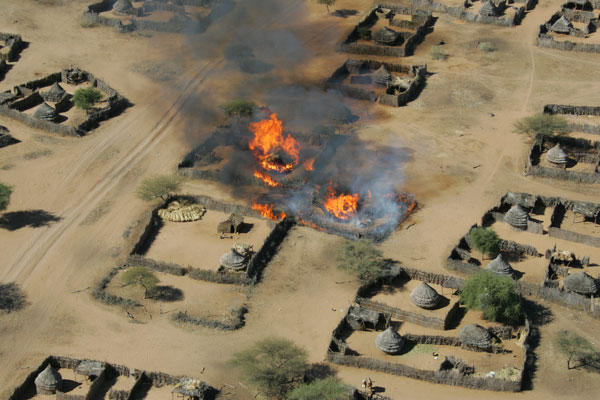
A village in Darfur in flames after air bombardment by Sudanese air force on 12/12/2004
Who Speaks for Her?
Rape is the weapon of choice in Darfur, but Sudan's government doesn't want to hear about it
By SAM DEALEY / KHOR ABECHE
The rapes continued through the day. Kicked and beaten, their hands bound behind their backs, the women lay side by side on the dusty earth beneath Sudan's scorching sun. Nine in all, they were spoils of war, taken last April from their village of Khor Abeche in a dawn raid by the Arab militiamen known as Janjaweed, who had descended on camels and horses and in pickups mounted with machine guns. The women's village, on the cusp of rebel and government redoubts in South Darfur, was burned and looted; their husbands and fathers and brothers were shot when they protested.
At the Janjaweed camp, the men took turns smothering the women's faces in their long, colorful shawls. The victims were told they were the rebels' whores and daughters, they recounted to TIME, and when they cried out, they were threatened with death. As the blistering day gave way to a chill dusk, the women lay there, denied food and water, some sobbing and others asleep from exhaustion. With the morning came the rebels' counterattack. The Janjaweed fled, leaving the women behind.
Nearly 2 1/2 years since fighting erupted between African rebels and government-backed Arab militias in Sudan's western Darfur region, the horror continues. When TIME published a cover story last October on the unfolding genocide against Darfur's non-Arab Muslims, some 50,000 had died and 1.4 million had been forced from their homes. Since then, the war has claimed tens of thousands more; 2.4 million are now displaced.
Large-scale attacks on villages like Khor Abeche are increasingly rare, and Darfur's combatants seem mostly resigned to an uneasy stalemate. Humanitarian access has improved and fewer people are dying, but in the vast swaths of land outside the control of either the government or the rebels, lawlessness prevails. Attacks on trucks and aid convoys make roads too dangerous to travel, and the scared and hungry arrive at swollen relief camps daily. Even then, their safety is not ensured. At Kalma, Darfur's largest camp, refugees complain of government harassment, and women who venture beyond in search of firewood and fodder are often raped.
Rape is a potent symbol of the government's failure to ensure security. After a March report by Doctors Without Borders documented 500 rapes over a four-month period, senior aid workers were arrested for publishing false reports, undermining state security and spying. The charges were eventually dropped, but the government still denies the assertion. In June, Western diplomats and U.N. representatives gathered with aid workers in Kalma to discuss the government's failure to halt the rapes. Even as Sudanese officials contested claims of sexual violence, a slip of paper was handed to an aid worker. Another woman had been raped.
With Khartoum unable or unwilling to provide security, the African Union hopes to increase its peacekeeping force from 2,700 to 7,700 by September. But even that may not be enough to tame an area the size of Texas. Five turbulent rounds of peace talks have made little headway, and frustration and mistrust run high.
The hope is that Sudan's new coalition government, forged in July by the peace deal that ended a separate, 21-year civil war in the south, will succeed where the regime could not. But that prospect took a blow when rebel leader John Garang, the inspiration for Sudan's disaffected, died in a helicopter crash just three weeks after becoming Vice President.
Time is running short. Unrest is growing among Sudan's other marginalized groups, many of which are armed and may not wait for the new government to address their concerns. "How many armies and militias do we have in this country?" asks Hassan al-Turabi, the former speaker of the parliament who fell out with the regime he helped build. "Ten, and even 20 and 30. We are running the risk of disintegration."
For now Khor Abeche, like Darfur itself, lies somewhere between peace and disintegration. It was a ghost town two months ago, but villagers are returning under African Union protection. On a recent day, newly thatched huts stood beside the charred remains of others. As children played among spent gun cartridges in the village square, aid workers from World Vision distributed food under the stripped limbs of a baobab tree. "I feel safe now, but what is safe?" asks Amna, one of the nine raped in April. "I have felt safe before." It's an insecurity that will not easily go away. Several of the women are now pregnant, and their children will be lifelong reminders of Darfur's hatreds.
source: www.time.com
By SAM DEALEY / KHOR ABECHE
The rapes continued through the day. Kicked and beaten, their hands bound behind their backs, the women lay side by side on the dusty earth beneath Sudan's scorching sun. Nine in all, they were spoils of war, taken last April from their village of Khor Abeche in a dawn raid by the Arab militiamen known as Janjaweed, who had descended on camels and horses and in pickups mounted with machine guns. The women's village, on the cusp of rebel and government redoubts in South Darfur, was burned and looted; their husbands and fathers and brothers were shot when they protested.
At the Janjaweed camp, the men took turns smothering the women's faces in their long, colorful shawls. The victims were told they were the rebels' whores and daughters, they recounted to TIME, and when they cried out, they were threatened with death. As the blistering day gave way to a chill dusk, the women lay there, denied food and water, some sobbing and others asleep from exhaustion. With the morning came the rebels' counterattack. The Janjaweed fled, leaving the women behind.
Nearly 2 1/2 years since fighting erupted between African rebels and government-backed Arab militias in Sudan's western Darfur region, the horror continues. When TIME published a cover story last October on the unfolding genocide against Darfur's non-Arab Muslims, some 50,000 had died and 1.4 million had been forced from their homes. Since then, the war has claimed tens of thousands more; 2.4 million are now displaced.
Large-scale attacks on villages like Khor Abeche are increasingly rare, and Darfur's combatants seem mostly resigned to an uneasy stalemate. Humanitarian access has improved and fewer people are dying, but in the vast swaths of land outside the control of either the government or the rebels, lawlessness prevails. Attacks on trucks and aid convoys make roads too dangerous to travel, and the scared and hungry arrive at swollen relief camps daily. Even then, their safety is not ensured. At Kalma, Darfur's largest camp, refugees complain of government harassment, and women who venture beyond in search of firewood and fodder are often raped.
Rape is a potent symbol of the government's failure to ensure security. After a March report by Doctors Without Borders documented 500 rapes over a four-month period, senior aid workers were arrested for publishing false reports, undermining state security and spying. The charges were eventually dropped, but the government still denies the assertion. In June, Western diplomats and U.N. representatives gathered with aid workers in Kalma to discuss the government's failure to halt the rapes. Even as Sudanese officials contested claims of sexual violence, a slip of paper was handed to an aid worker. Another woman had been raped.
With Khartoum unable or unwilling to provide security, the African Union hopes to increase its peacekeeping force from 2,700 to 7,700 by September. But even that may not be enough to tame an area the size of Texas. Five turbulent rounds of peace talks have made little headway, and frustration and mistrust run high.
The hope is that Sudan's new coalition government, forged in July by the peace deal that ended a separate, 21-year civil war in the south, will succeed where the regime could not. But that prospect took a blow when rebel leader John Garang, the inspiration for Sudan's disaffected, died in a helicopter crash just three weeks after becoming Vice President.
Time is running short. Unrest is growing among Sudan's other marginalized groups, many of which are armed and may not wait for the new government to address their concerns. "How many armies and militias do we have in this country?" asks Hassan al-Turabi, the former speaker of the parliament who fell out with the regime he helped build. "Ten, and even 20 and 30. We are running the risk of disintegration."
For now Khor Abeche, like Darfur itself, lies somewhere between peace and disintegration. It was a ghost town two months ago, but villagers are returning under African Union protection. On a recent day, newly thatched huts stood beside the charred remains of others. As children played among spent gun cartridges in the village square, aid workers from World Vision distributed food under the stripped limbs of a baobab tree. "I feel safe now, but what is safe?" asks Amna, one of the nine raped in April. "I have felt safe before." It's an insecurity that will not easily go away. Several of the women are now pregnant, and their children will be lifelong reminders of Darfur's hatreds.
source: www.time.com
Friday, September 02, 2005
Mass murder without a cause
Darfur: the ambiguous genocide
Gérard Prunier
One of the little-noticed effects of the Asian tsunami of last December was that it ended the Darfur famine. A humanitarian crisis that had dominated print and broadcast media for most of that year suddenly evaporated from the face of the earth, at least the part of the earth that is on camera. We are talking media reality here, of course, not reality per se. But as Gérard Prunier observes towards the end of this excellent and authoritative analysis of the continuing Darfur catastrophe, we live in a time when things are not seen as they are, but “in their capacity to create brand images, to warrant a ‘big story’, to mobilise TV time high in rhetoric”. The media can only handle one emotion-laden story at a time, Prunier points out, and the tsunami was “much more politically correct” than the suffering of the people of Darfur. In other words, the tsunami tragedy was heavy on emotion and light on actual politics.
This year’s African horror story is, of course, unfolding in Niger: news of the famine there broke on television screens with awkward timing immediately after the Live8 concerts. Yet the very mention of the country that was last month suddenly “hit by hunger” illustrates how much we need books like Prunier’s. Niger is the latest (though already fading) African disaster story. It is a humanitarian crisis that demands a response and charities and donors have duly responded. But explanations of the causes of the crisis are thin on the ground, and not always convincing.
The media’s – and therefore the public’s – understanding of the Darfur catastrophe was marginally less rudimentary than its apparent understanding of the Niger crisis. Ethnic cleansing was going on in Darfur, certainly. People were being driven out of their villages, and they ended up in camps where they needed feeding. The people doing the “cleansing” saw themselves in some way as Arab, while the people who were “cleansed” were African rather than Arab. So there was a racial factor. The objective of the “cleansing” was difficult to discern as there was no evidence that the aggressors – who conducted their campaign on horseback, in the manner of conflicts in the American Wild West – ever settled the land from which they drove people. They laid waste villages, raped and murdered indiscriminately and that was that. There were strong suggestions that these militias were in the pay of the government in Khartoum, but why the Sudanese Government would want them to behave like this was again something of a mystery. They just did. It was Africa, after all.
The question of the role of the government in the killings, however, led directly to a whole set of further questions about whether what was happening could be categorised as genocide. Prunier, a research professor at the University of Paris who has also written books on the Rwandan genocide and on the Congolese conflict that followed it, addresses this issue head on, with refreshing clarity and with due recognition of its complexities. Part of the reason why the violence in Darfur reached genocidal proportions, he says, was the climate within the Sudanese Government, which was one of “complete contradiction and infighting” among its various cliques, as it responded to an insurgency whose causes reached back – as Prunier demonstrates in forensic detail – to the time of the Anglo-Egyptian Condominium and before. The resulting impression of confusion was partly a deliberate ploy by the Sudanese Government: by issuing completely contradictory statements they could never be held to be in the wrong. “This is a factor”, writes Prunier, “which the international community finds very difficult to understand in its dealings with Khartoum.” For Europeans, he says, the extreme evil of genocide or ethnic cleansing is “a very serious business”. The fact that it could be carried out in haphazard conditions was “unthinkable” for the international community. “The grotesque is not part of its conceptual equipment,” he points out, “and only late in the day did foreigners begin to realise that the horror was far from coherent.” This book is worth reading for that insight alone.
The genocidal model for Europeans is of course the Nazi Holocaust, but this model does not transfer neatly to Africa. There was no Sudanese equivalent of the Wannsee Conference of 1942, in which the top brass of the Nazi regime sat down at a table and decided on the modalities of the Final Solution to the “Jewish question”. The question of intent in the Sudanese context is not so clearcut. Prunier, to his credit, deals brusquely with the semantics of death. The December 1948 International Convention on the prevention and Punishment of Crimes of Genocide defines genocide as “deliberately inflicting on the group conditions of life calculated to bring about its physical destruction in whole or in part”. By this definition, he writes, events in Darfur should certainly qualify as genocide. But Prunier employs another definition, the one that he previously used in his book on Rwanda, according to which genocide would require “a coordinated attempt to destroy a racially, religiously or politically predefined group in its entirety”. By this definition, he argues, the slaughter and deliberate starvation of the inhabitants of Darfur does not constitute genocide.
It is a measure of the jaded cynicism of our times, Prunier says, that killing 250,000 in a genocide is perceived to be more serious and a greater tragedy than killing 250,000 people in non-genocidal massacres. The media must take much of the blame: Prunier draws attention to this example of lazy journalists copying each other and reproducing obsolete data without verification –the routine repetition of a figure of 70,000 dead in Darfur in 2004. While he admits that it is difficult to be completely certain, he makes a convincing case for a figure of 280,000 to 310,000 dead by the beginning of 2005.
Others too come in for incisive criticism. The United Nations Special Envoy for Sudan, Tom Vraalsen, made statements of “almost surreal” optimism and credulousness, calling President Omar el-Beshir’s promise of “unimpeded access” for humanitarian aid a “breakthrough”. (Finally Vraalsen “sobers up”, pointing out that there is a “systematic” denial of access.) Manipulating aid was all part of the programme of destruction in Darfur. The Americans were preoccupied with extracting what information they could from Osama bin Laden’s former hosts in Khartoum, and then so obsessed with making sure the peace deal with the Sudan People’s Liberation Army (SPLA) in the South was finally signed, that the Khartoum Government could all too easily pull the strings to its own advantage. But the most poisonous role by far was that played by the Libyan leader Colonel Gaddafi, whose furtherance of his Arabist fantasies by interference in neighbouring countries brought untold suffering to millions.
The first chapters of this book offer a detailed and dispassionate account of the history of Darfur. Prunier’s horrific facts speak for themselves and the tone is restrained. The later chapters are a searing indictment of those who must be held responsible for suffering and death on an unimaginable scale. And that means most of us. As long as tragedies such as these can unfold without anyone stopping them, then humanity itself is on trial.
James Roberts
source: www.thetablet.co.uk
Gérard Prunier
One of the little-noticed effects of the Asian tsunami of last December was that it ended the Darfur famine. A humanitarian crisis that had dominated print and broadcast media for most of that year suddenly evaporated from the face of the earth, at least the part of the earth that is on camera. We are talking media reality here, of course, not reality per se. But as Gérard Prunier observes towards the end of this excellent and authoritative analysis of the continuing Darfur catastrophe, we live in a time when things are not seen as they are, but “in their capacity to create brand images, to warrant a ‘big story’, to mobilise TV time high in rhetoric”. The media can only handle one emotion-laden story at a time, Prunier points out, and the tsunami was “much more politically correct” than the suffering of the people of Darfur. In other words, the tsunami tragedy was heavy on emotion and light on actual politics.
This year’s African horror story is, of course, unfolding in Niger: news of the famine there broke on television screens with awkward timing immediately after the Live8 concerts. Yet the very mention of the country that was last month suddenly “hit by hunger” illustrates how much we need books like Prunier’s. Niger is the latest (though already fading) African disaster story. It is a humanitarian crisis that demands a response and charities and donors have duly responded. But explanations of the causes of the crisis are thin on the ground, and not always convincing.
The media’s – and therefore the public’s – understanding of the Darfur catastrophe was marginally less rudimentary than its apparent understanding of the Niger crisis. Ethnic cleansing was going on in Darfur, certainly. People were being driven out of their villages, and they ended up in camps where they needed feeding. The people doing the “cleansing” saw themselves in some way as Arab, while the people who were “cleansed” were African rather than Arab. So there was a racial factor. The objective of the “cleansing” was difficult to discern as there was no evidence that the aggressors – who conducted their campaign on horseback, in the manner of conflicts in the American Wild West – ever settled the land from which they drove people. They laid waste villages, raped and murdered indiscriminately and that was that. There were strong suggestions that these militias were in the pay of the government in Khartoum, but why the Sudanese Government would want them to behave like this was again something of a mystery. They just did. It was Africa, after all.
The question of the role of the government in the killings, however, led directly to a whole set of further questions about whether what was happening could be categorised as genocide. Prunier, a research professor at the University of Paris who has also written books on the Rwandan genocide and on the Congolese conflict that followed it, addresses this issue head on, with refreshing clarity and with due recognition of its complexities. Part of the reason why the violence in Darfur reached genocidal proportions, he says, was the climate within the Sudanese Government, which was one of “complete contradiction and infighting” among its various cliques, as it responded to an insurgency whose causes reached back – as Prunier demonstrates in forensic detail – to the time of the Anglo-Egyptian Condominium and before. The resulting impression of confusion was partly a deliberate ploy by the Sudanese Government: by issuing completely contradictory statements they could never be held to be in the wrong. “This is a factor”, writes Prunier, “which the international community finds very difficult to understand in its dealings with Khartoum.” For Europeans, he says, the extreme evil of genocide or ethnic cleansing is “a very serious business”. The fact that it could be carried out in haphazard conditions was “unthinkable” for the international community. “The grotesque is not part of its conceptual equipment,” he points out, “and only late in the day did foreigners begin to realise that the horror was far from coherent.” This book is worth reading for that insight alone.
The genocidal model for Europeans is of course the Nazi Holocaust, but this model does not transfer neatly to Africa. There was no Sudanese equivalent of the Wannsee Conference of 1942, in which the top brass of the Nazi regime sat down at a table and decided on the modalities of the Final Solution to the “Jewish question”. The question of intent in the Sudanese context is not so clearcut. Prunier, to his credit, deals brusquely with the semantics of death. The December 1948 International Convention on the prevention and Punishment of Crimes of Genocide defines genocide as “deliberately inflicting on the group conditions of life calculated to bring about its physical destruction in whole or in part”. By this definition, he writes, events in Darfur should certainly qualify as genocide. But Prunier employs another definition, the one that he previously used in his book on Rwanda, according to which genocide would require “a coordinated attempt to destroy a racially, religiously or politically predefined group in its entirety”. By this definition, he argues, the slaughter and deliberate starvation of the inhabitants of Darfur does not constitute genocide.
It is a measure of the jaded cynicism of our times, Prunier says, that killing 250,000 in a genocide is perceived to be more serious and a greater tragedy than killing 250,000 people in non-genocidal massacres. The media must take much of the blame: Prunier draws attention to this example of lazy journalists copying each other and reproducing obsolete data without verification –the routine repetition of a figure of 70,000 dead in Darfur in 2004. While he admits that it is difficult to be completely certain, he makes a convincing case for a figure of 280,000 to 310,000 dead by the beginning of 2005.
Others too come in for incisive criticism. The United Nations Special Envoy for Sudan, Tom Vraalsen, made statements of “almost surreal” optimism and credulousness, calling President Omar el-Beshir’s promise of “unimpeded access” for humanitarian aid a “breakthrough”. (Finally Vraalsen “sobers up”, pointing out that there is a “systematic” denial of access.) Manipulating aid was all part of the programme of destruction in Darfur. The Americans were preoccupied with extracting what information they could from Osama bin Laden’s former hosts in Khartoum, and then so obsessed with making sure the peace deal with the Sudan People’s Liberation Army (SPLA) in the South was finally signed, that the Khartoum Government could all too easily pull the strings to its own advantage. But the most poisonous role by far was that played by the Libyan leader Colonel Gaddafi, whose furtherance of his Arabist fantasies by interference in neighbouring countries brought untold suffering to millions.
The first chapters of this book offer a detailed and dispassionate account of the history of Darfur. Prunier’s horrific facts speak for themselves and the tone is restrained. The later chapters are a searing indictment of those who must be held responsible for suffering and death on an unimaginable scale. And that means most of us. As long as tragedies such as these can unfold without anyone stopping them, then humanity itself is on trial.
James Roberts
source: www.thetablet.co.uk
DARFUR: THE OVERKILL
The Janjaweed Spin Out of Control
by Rene Wadlow
The on-going conflicts in the provinces of Darfur in western Sudan are a textbook example of how programmed escalation of violence can go out of control. It is increasingly difficult for both the insurgency and the government-backed forces to de-escalate the conflict which has been called with reason "genocide." It will be even more difficult after the war to get the pastoralists and the settled agriculturalists to live together again in a relatively cooperative way.
Darfur (the home of the Fur) was always marginal to the politics of modern Sudan and to the two phases of the North-South civil war, which took place from 1954-1972 and 1982-2005. In the 19th century, Darfur, about the size of France, was an independent Sultanate loosely bound to the Ottoman Empire. It was on a major trade route from West Africa to Egypt, so populations from what is now northern Nigeria, Niger, Mali and Chad joined the older ethnic groups of the area, the Fur, the Masalit, the Zaghawa and the Birgit. Nomads from Libya also moved south into Darfur. As the population density was low, a style of life with mutual interaction between pastoral herdsmen and settled agriculturalists with some livestock developed. Increasingly, however, there was ever-greater competition for water and forage made scarce by environmental degradation and the spread of the desert.
France and England left Darfur as a buffer zone between the French colonial holdings --what is now Chad--and the Anglo-Egyptian-controlled Sudan. French-English rivalry in West Africa had nearly led earlier to a war, and a desert buffer was of more use than its low agricultural and livestock production would provide to either European colonial power. It was only in 1916 during the First World War when French-English colonial rivalry in Africa wilted before the common German enemy that the English annexed Darfur to the Sudan without asking anyone in either Darfur or the Sudan if such a "marriage" was desirable.
Darfur continued its existence as a peripheral and environmentally fragile area of Sudan. It was marginal in economics but largely self-sufficient. Once Sudan won its independence in 1956, Darfur was deemed politically as well as economically marginal. Darfur's people have received less education, less healthcare, less development assistance, and fewer government posts than any other region. Southerners were given governmental and administrative posts in the hope of diminishing the violent North-South divide. There was no such incentive to "share the wealth" with Darfur. Its political weight was lessened still further in a 1995 "administrative reform," when Darfur was divided into three provinces: Northern Darfur, Western Darfur, and Southern Darfur. Some areas that were historically Darfur were added to Northern and Western Bahr El-Ghazal. The division of Darfur did not lead to better local government, nor to additional services from the central government. It must be added that Darfur's local political leadership showed a special skill in supporting national political leaders just as they were about to lose power--first Al Sadig Al Mahdi (1989) and then Hassan al-Turabi (2001).
During the North-South civil war, Darfur, as a largely Muslim area, supported the North, and some militias from Darfur formed raiding parties to attack villages in Northern Bahr El-Ghazal. However, Darfur's leaders counted for little in the long North-South negotiations which finally led to a power-sharing accord in January 2005. Wealth from the oil fields, largely situated on the edge of the North-South dividing line, had been a prime issue in both the war and peace negotiations. Under the accord, oil wealth is to fund development programs for the South, while preserving a unified Sudanese state.
Ironically, it was the North-South peace negotiations which set the stage for the Darfur revolt. In 2000, Darfur's political leadership met to draw up a "Black Book" which detailed the region's systematic under-representation in national government since independence. The "Black Book" marked the start of a rapprochement between the Islamists and the secular radicals of Darfur who both wanted a better deal for the region. Three years later, these two tendencies took up arms as loosely allied guerilla groups, the more secularist Sudan Liberation Army (SLA) and the Islamist-leaning Justice and Equality Movement (JEM).
However, at the level of the central government, the "Black Book" led to no steps to address the political and economic position of Darfur. This lack of reaction convinced some in Darfur that only armed action would bring recognition and compromise, as the war in the South had done.
In July 2002, the government of Sudan and the southern Sudan People's Liberation Movement signed a framework protocol for peace in Machakos, Kenya. It seemed that peace was at hand. Therefore, if Darfur was to share in the potential new prosperity, armed violence to gain attention for the cause had to be undertaken soon. The two Darfur groups, SLA and JEM, started to structure themselves, gather weapons and men. The idea was to strike in a spectacular way that would lead the government to take notice and to start wealth-sharing negotiations. They did not envisage a long drawn out conflict of the countryside against the towns of Darfur.
By February 2003, the two groups were prepared to act, and in one night attacked and destroyed many of Sudan's military planes based at El Fasher. The Sudan military lost in one night more planes than it had in 20 years of war against the South.
However, the central government's "security elite"--battle hardened from its fight against the South but knowing that the regular army was over-extended and tired of fighting--decided to use against Darfur techniques that it had used with some success against the South: arming, and giving free reign to militias and other irregular forces.
Thus the government armed and directed existing popular defense forces and tribal militias in Darfur. The government also started pulling together a fluid and shadowy group, now called the Janjaweed ("the evildoers on horseback"). To the extent that the make-up of the Janjaweed is known, it seems to be a collection of bandits, of Chadians who had used Darfur as a safe haven for the long-lasting insurgencies in Chad, remains of Libya's Islamic Forces which had once been under the control of the Libyan government but left wandering when Libyan policy changed, probably some daytime police and military (the Janjaweed acting nearly always at night), and some traditional nomad leaders from Darfur.
The central government gave these groups guns, uniforms, equipment, and indications where to attack by first bombing villages. But they gave no regular pay. Thus the militias had to pay themselves by looting homes, crops and livestock, by taking slaves and raping women and girls. Village after village was destroyed on the pretext that some residents supported the SLA or the JEM; crops were burned; water wells filled with sand. As many people as possible fled to Chad or to areas thought safer in Darfur. The campaign has now lasted over a year and a half. As the acting UN High Commissioner for Human Rights, Dr Bertrand Ramcharan, stressed: "First, there is a reign of terror in this area; second, there is a scorched-earth policy; third, there is repeated war crimes and crimes against humanity; and fourth, this is taking place before our very eyes."
The United Nations set up an International Commission of Inquiry which confirmed the worst fears of the deliberately destructive nature of the conflict, the intended consequences of which are to destroy a way of life. The Commission of Inquiry as well as the UN Commission on Human Rights has recommended that those responsible for war crimes and crimes against humanity be tried by the International Criminal Court. This will be the first major test of the new court, and thus will be important to watch and analyze.
It is not clear to what extent the central government can now control--or disarm, as the UN has requested--the Janjaweed even if they wanted to. Darfur now represents a classic case of how violence spins out of control and goes beyond the aims for which it was first used by the powerful. For the moment, it is hard to see how the violence can be reduced. The African Union has sent in military observers to oversee a non-functioning ceasefire. Talks between the government of Sudan and the JEM and SLA leadership in the Nigerian capital Abuja have broken down. The Sudanese government has honed its survival instincts for a long time, ably playing its "Arab" character for support within the Arab League and its "African" role within the African Union. There is little external support for the JEM and SLA. However, they have been able to get arms on the international "gray market."
The situation in Sudan will be discussed by the UN General Assembly in New York just after a September summit devoted to reform of the UN--in part to cope better with intra-state conflicts such as that of Sudan. The UN and especially its Commission on Human Rights has played an increasingly active role. The Commission's 2005 resolution on Sudan stressed three path-making elements which merit wide attention:
a) the key role that is to be played by the International Criminal Court in the Hague; b) the increased cooperation and mutual support between the UN system and the African Union; c) the emphasis on preparing now for post-conflict reconstruction and ecologically-sound development based on "promoting the peaceful social coexistence between different tribes in Darfur."
As with all UN resolutions, much will depend on the follow-up which will be taken by governments and non-governmental organizations. We can all help build awareness of the innovative thinking expressed in the Sudan resolution and the need for concerted action.
------
Rene Wadlow is editor of the online journal of world politics Transnational Perspectives and an NGO representative to the UN at Geneva. Formerly, he was professor and director of research of the Graduate Institute of Development Studies, University of Geneva.
This story originally appeared in the Aug. 24 edition of Toward Freedom.
by Rene Wadlow
The on-going conflicts in the provinces of Darfur in western Sudan are a textbook example of how programmed escalation of violence can go out of control. It is increasingly difficult for both the insurgency and the government-backed forces to de-escalate the conflict which has been called with reason "genocide." It will be even more difficult after the war to get the pastoralists and the settled agriculturalists to live together again in a relatively cooperative way.
Darfur (the home of the Fur) was always marginal to the politics of modern Sudan and to the two phases of the North-South civil war, which took place from 1954-1972 and 1982-2005. In the 19th century, Darfur, about the size of France, was an independent Sultanate loosely bound to the Ottoman Empire. It was on a major trade route from West Africa to Egypt, so populations from what is now northern Nigeria, Niger, Mali and Chad joined the older ethnic groups of the area, the Fur, the Masalit, the Zaghawa and the Birgit. Nomads from Libya also moved south into Darfur. As the population density was low, a style of life with mutual interaction between pastoral herdsmen and settled agriculturalists with some livestock developed. Increasingly, however, there was ever-greater competition for water and forage made scarce by environmental degradation and the spread of the desert.
France and England left Darfur as a buffer zone between the French colonial holdings --what is now Chad--and the Anglo-Egyptian-controlled Sudan. French-English rivalry in West Africa had nearly led earlier to a war, and a desert buffer was of more use than its low agricultural and livestock production would provide to either European colonial power. It was only in 1916 during the First World War when French-English colonial rivalry in Africa wilted before the common German enemy that the English annexed Darfur to the Sudan without asking anyone in either Darfur or the Sudan if such a "marriage" was desirable.
Darfur continued its existence as a peripheral and environmentally fragile area of Sudan. It was marginal in economics but largely self-sufficient. Once Sudan won its independence in 1956, Darfur was deemed politically as well as economically marginal. Darfur's people have received less education, less healthcare, less development assistance, and fewer government posts than any other region. Southerners were given governmental and administrative posts in the hope of diminishing the violent North-South divide. There was no such incentive to "share the wealth" with Darfur. Its political weight was lessened still further in a 1995 "administrative reform," when Darfur was divided into three provinces: Northern Darfur, Western Darfur, and Southern Darfur. Some areas that were historically Darfur were added to Northern and Western Bahr El-Ghazal. The division of Darfur did not lead to better local government, nor to additional services from the central government. It must be added that Darfur's local political leadership showed a special skill in supporting national political leaders just as they were about to lose power--first Al Sadig Al Mahdi (1989) and then Hassan al-Turabi (2001).
During the North-South civil war, Darfur, as a largely Muslim area, supported the North, and some militias from Darfur formed raiding parties to attack villages in Northern Bahr El-Ghazal. However, Darfur's leaders counted for little in the long North-South negotiations which finally led to a power-sharing accord in January 2005. Wealth from the oil fields, largely situated on the edge of the North-South dividing line, had been a prime issue in both the war and peace negotiations. Under the accord, oil wealth is to fund development programs for the South, while preserving a unified Sudanese state.
Ironically, it was the North-South peace negotiations which set the stage for the Darfur revolt. In 2000, Darfur's political leadership met to draw up a "Black Book" which detailed the region's systematic under-representation in national government since independence. The "Black Book" marked the start of a rapprochement between the Islamists and the secular radicals of Darfur who both wanted a better deal for the region. Three years later, these two tendencies took up arms as loosely allied guerilla groups, the more secularist Sudan Liberation Army (SLA) and the Islamist-leaning Justice and Equality Movement (JEM).
However, at the level of the central government, the "Black Book" led to no steps to address the political and economic position of Darfur. This lack of reaction convinced some in Darfur that only armed action would bring recognition and compromise, as the war in the South had done.
In July 2002, the government of Sudan and the southern Sudan People's Liberation Movement signed a framework protocol for peace in Machakos, Kenya. It seemed that peace was at hand. Therefore, if Darfur was to share in the potential new prosperity, armed violence to gain attention for the cause had to be undertaken soon. The two Darfur groups, SLA and JEM, started to structure themselves, gather weapons and men. The idea was to strike in a spectacular way that would lead the government to take notice and to start wealth-sharing negotiations. They did not envisage a long drawn out conflict of the countryside against the towns of Darfur.
By February 2003, the two groups were prepared to act, and in one night attacked and destroyed many of Sudan's military planes based at El Fasher. The Sudan military lost in one night more planes than it had in 20 years of war against the South.
However, the central government's "security elite"--battle hardened from its fight against the South but knowing that the regular army was over-extended and tired of fighting--decided to use against Darfur techniques that it had used with some success against the South: arming, and giving free reign to militias and other irregular forces.
Thus the government armed and directed existing popular defense forces and tribal militias in Darfur. The government also started pulling together a fluid and shadowy group, now called the Janjaweed ("the evildoers on horseback"). To the extent that the make-up of the Janjaweed is known, it seems to be a collection of bandits, of Chadians who had used Darfur as a safe haven for the long-lasting insurgencies in Chad, remains of Libya's Islamic Forces which had once been under the control of the Libyan government but left wandering when Libyan policy changed, probably some daytime police and military (the Janjaweed acting nearly always at night), and some traditional nomad leaders from Darfur.
The central government gave these groups guns, uniforms, equipment, and indications where to attack by first bombing villages. But they gave no regular pay. Thus the militias had to pay themselves by looting homes, crops and livestock, by taking slaves and raping women and girls. Village after village was destroyed on the pretext that some residents supported the SLA or the JEM; crops were burned; water wells filled with sand. As many people as possible fled to Chad or to areas thought safer in Darfur. The campaign has now lasted over a year and a half. As the acting UN High Commissioner for Human Rights, Dr Bertrand Ramcharan, stressed: "First, there is a reign of terror in this area; second, there is a scorched-earth policy; third, there is repeated war crimes and crimes against humanity; and fourth, this is taking place before our very eyes."
The United Nations set up an International Commission of Inquiry which confirmed the worst fears of the deliberately destructive nature of the conflict, the intended consequences of which are to destroy a way of life. The Commission of Inquiry as well as the UN Commission on Human Rights has recommended that those responsible for war crimes and crimes against humanity be tried by the International Criminal Court. This will be the first major test of the new court, and thus will be important to watch and analyze.
It is not clear to what extent the central government can now control--or disarm, as the UN has requested--the Janjaweed even if they wanted to. Darfur now represents a classic case of how violence spins out of control and goes beyond the aims for which it was first used by the powerful. For the moment, it is hard to see how the violence can be reduced. The African Union has sent in military observers to oversee a non-functioning ceasefire. Talks between the government of Sudan and the JEM and SLA leadership in the Nigerian capital Abuja have broken down. The Sudanese government has honed its survival instincts for a long time, ably playing its "Arab" character for support within the Arab League and its "African" role within the African Union. There is little external support for the JEM and SLA. However, they have been able to get arms on the international "gray market."
The situation in Sudan will be discussed by the UN General Assembly in New York just after a September summit devoted to reform of the UN--in part to cope better with intra-state conflicts such as that of Sudan. The UN and especially its Commission on Human Rights has played an increasingly active role. The Commission's 2005 resolution on Sudan stressed three path-making elements which merit wide attention:
a) the key role that is to be played by the International Criminal Court in the Hague; b) the increased cooperation and mutual support between the UN system and the African Union; c) the emphasis on preparing now for post-conflict reconstruction and ecologically-sound development based on "promoting the peaceful social coexistence between different tribes in Darfur."
As with all UN resolutions, much will depend on the follow-up which will be taken by governments and non-governmental organizations. We can all help build awareness of the innovative thinking expressed in the Sudan resolution and the need for concerted action.
------
Rene Wadlow is editor of the online journal of world politics Transnational Perspectives and an NGO representative to the UN at Geneva. Formerly, he was professor and director of research of the Graduate Institute of Development Studies, University of Geneva.
This story originally appeared in the Aug. 24 edition of Toward Freedom.
Thursday, September 01, 2005
We are dying in Darfur
By Dudley Conneely, a former Maryknoll missioner who is project director for Save the Children-USA. He lives with his
wife Mary in Bolivia. They have eight children.
Sep 01, 2005 - Emboldened by the struggle of the Sudan People's Liberation Army in southeastern Sudan, some African tribesmen in the western region of Darfur have taken up arms against the Khartoum government. The Arab leaders have been trying to enforce Islamic law on the entire nation, even though 30 percent of the people are non-Muslim. In Darfur, the government armed the fierce Janjaweed nomads as a militia to put down the uprising. The Janjaweed, who had historically abused the African tribes people, took their new role as a license to indiscriminately rape and murder their neighbors. The following account was written by a relief worker in Darfur.
The elderly chief of the displaced persons camp told me, "We are dying in Darfur!" He asked me to tell the world about it. Before our Save the Children USA team arrived in western Sudan, more than 70,000 people from African tribes were murdered by the government-supported militia. This brutal slaughter of innocent people continues, but, thank God, much less frequently because of foreign observers in the area. The international media has made the world aware of the Darfur massacres, but as far as I can see, nothing serious has been done to stop the violence.
Not even the children are spared. When our Save the Children team, with whom I have been working here for the past five months, visited one of the Internally Displaced Person (IDP) camps on the Chad border, the camp chief singled out a 14-year-old girl who looked tired and depressed. He led us behind a tree, away from the crowded camp, and asked the girl to tell me her story through a translator.
She reported how the Janjaweed (the government-armed militia) horsemen rode into her village before dawn. Her father ran outside to protect his family. Her mother took her children to the back of their grass hut and huddled in the corner. The girl knew what was happening. At certain times of the year, for as long as she could remember, the Janjaweed nomads would raid, stealing what they wanted and allowing their camels and cattle to graze on the crops before harvest, but it was never like this.
The raiders threw torches into the village huts. The young girl heard gunshots and the screaming and wailing of men and women. Then three Janjaweed militia entered her hut, dragging her father who was bleeding from wounds. They raped the girl and her mother. The atrocity did not stop there. One of the horsemen took his sword, placed it on the coals of the fire, stripped the girl to her waist and branded her as if she were cattle. He laughed, telling her now she was marked for life as Janjaweed property. On their way out, they murdered her father with one shot to the head.
The village girl didn't have to cry. Her sunken eyes expressed excruciating pain. She spoke of now being an outcast in her village, of never being able to have a husband or children of her own. No man would want her. She was stigmatized, marked for life with the hot iron of the Janjaweed.
I tried to find words of comfort, to have the translator assure her that we would help, that all was not lost. I told the girl that in a camp support meeting for women victims like her, I recently heard a young mother share her story with her peers. This woman's husband had been killed in front of her, she and her sisters had been raped and her village burnt. The Janjaweed, after massacring her family and the families of her neighbors, snatched her 3-month-old baby from her breast and threw him into the blazing fire that was once her home. She tried to enter to save her infant, but the Janjaweed blocked her way with their horses. She begged and screamed at her family's assassins to kill her too, that she no longer had anything to live for. They just laughed and left behind her shattered soul—her life virtually destroyed.
I told the girl that although the young mother still suffers from her nightmare experience, she also has been able to join other women, who with the help of our trained female staff try to help each other overcome their trauma and integrate into their communities. I told her that there are such meetings being held in a provisional women's center right here in this IDP camp, and I asked the chief to help her become a member of the group.
Finally, I explained that she should not worry about being an outcast. The very high number of girls and women who have suffered from being brutally raped has changed the way the community thinks about innocent women being violated and how they should be accepted.
Read the rest of the article only in the pages of Maryknoll Magazine.
Help support Maryknoll in its work with the world's most vulnerable.
mklmag@maryknoll.org
wife Mary in Bolivia. They have eight children.
Sep 01, 2005 - Emboldened by the struggle of the Sudan People's Liberation Army in southeastern Sudan, some African tribesmen in the western region of Darfur have taken up arms against the Khartoum government. The Arab leaders have been trying to enforce Islamic law on the entire nation, even though 30 percent of the people are non-Muslim. In Darfur, the government armed the fierce Janjaweed nomads as a militia to put down the uprising. The Janjaweed, who had historically abused the African tribes people, took their new role as a license to indiscriminately rape and murder their neighbors. The following account was written by a relief worker in Darfur.
The elderly chief of the displaced persons camp told me, "We are dying in Darfur!" He asked me to tell the world about it. Before our Save the Children USA team arrived in western Sudan, more than 70,000 people from African tribes were murdered by the government-supported militia. This brutal slaughter of innocent people continues, but, thank God, much less frequently because of foreign observers in the area. The international media has made the world aware of the Darfur massacres, but as far as I can see, nothing serious has been done to stop the violence.
Not even the children are spared. When our Save the Children team, with whom I have been working here for the past five months, visited one of the Internally Displaced Person (IDP) camps on the Chad border, the camp chief singled out a 14-year-old girl who looked tired and depressed. He led us behind a tree, away from the crowded camp, and asked the girl to tell me her story through a translator.
She reported how the Janjaweed (the government-armed militia) horsemen rode into her village before dawn. Her father ran outside to protect his family. Her mother took her children to the back of their grass hut and huddled in the corner. The girl knew what was happening. At certain times of the year, for as long as she could remember, the Janjaweed nomads would raid, stealing what they wanted and allowing their camels and cattle to graze on the crops before harvest, but it was never like this.
The raiders threw torches into the village huts. The young girl heard gunshots and the screaming and wailing of men and women. Then three Janjaweed militia entered her hut, dragging her father who was bleeding from wounds. They raped the girl and her mother. The atrocity did not stop there. One of the horsemen took his sword, placed it on the coals of the fire, stripped the girl to her waist and branded her as if she were cattle. He laughed, telling her now she was marked for life as Janjaweed property. On their way out, they murdered her father with one shot to the head.
The village girl didn't have to cry. Her sunken eyes expressed excruciating pain. She spoke of now being an outcast in her village, of never being able to have a husband or children of her own. No man would want her. She was stigmatized, marked for life with the hot iron of the Janjaweed.
I tried to find words of comfort, to have the translator assure her that we would help, that all was not lost. I told the girl that in a camp support meeting for women victims like her, I recently heard a young mother share her story with her peers. This woman's husband had been killed in front of her, she and her sisters had been raped and her village burnt. The Janjaweed, after massacring her family and the families of her neighbors, snatched her 3-month-old baby from her breast and threw him into the blazing fire that was once her home. She tried to enter to save her infant, but the Janjaweed blocked her way with their horses. She begged and screamed at her family's assassins to kill her too, that she no longer had anything to live for. They just laughed and left behind her shattered soul—her life virtually destroyed.
I told the girl that although the young mother still suffers from her nightmare experience, she also has been able to join other women, who with the help of our trained female staff try to help each other overcome their trauma and integrate into their communities. I told her that there are such meetings being held in a provisional women's center right here in this IDP camp, and I asked the chief to help her become a member of the group.
Finally, I explained that she should not worry about being an outcast. The very high number of girls and women who have suffered from being brutally raped has changed the way the community thinks about innocent women being violated and how they should be accepted.
Read the rest of the article only in the pages of Maryknoll Magazine.
Help support Maryknoll in its work with the world's most vulnerable.
mklmag@maryknoll.org
The genocide continues
8/31/2005 8:00:00 PM
The genocide continuesJewish groups among sponsors of Darfur alert event
by Anath Hartmann WJW Intern
Toddler siblings with gunshot wounds, a headless man, a body burnt so badly its organs had been exposed, but its sex was impossible to discern ‹ all were recent photos from Darfur, Sudan.
Speaking to a packed District ballroom Monday night, Brian Steidle, a former Marine captain, displayed these photographs, taken while he served as an African Union monitor in that war-ravaged African nation.
"This is ongoing," Steidle said. "Has the violence slowed in recent months? Yes, it has. That's because there are very few villages left to burn ... but as you look around here," he told the 500 people at the National Press Club, "this many people will be dead by Wednesday."
Steidel was one of three panel speakers at "Taking Action on Darfur: A Capital Alert," which was sponsored by the American Jewish Committee, the Jewish Community Relations Council of Greater Washington, the Greater Washington Jewish Task Force on Darfur and the National Association for the Advancement of Colored People.
Describing how an attack on a village takes place in Darfur, he said that initially all forms of communication are shut down so that no one can contact other villages for help. Then the attack on villagers begins.
"These people," he said, displaying a photo of several bodies lined up on the ground as an example of the "attack" phase, "have had their noses cut off and their eyes poked out."
Next, Steidle said, the looting begins. He showed a picture of government trucks parked to help the militiamen, or Janjaweed, load booty taken in their raid.
The last step in the demolition of a community in Darfur is, he said, the scorching of whatever remains and the poisoning of wells. Both are done to prevent those who have managed to flee from taking up residence again.
"Calling your congressman is great," he concluded, "but it's going to take everybody."
Speaker Paul Rusesabagina, the man who inspired the movie Hotel Rwanda, drew parallels between the genocide taking place in Darfur and what he experienced in his native African nation. The former hotel manager refused to leave hundreds of refugees in an abandoned Rwandan hotel in 1994.
Recalling the tension between the Hutu and Tutsi tribes in Belgian-colonized Rwanda, he said strains culminated in April 1994, when two Hutu presidents were killed in a plane crash. The Hutus largely considered the deaths planned assassinations.
"Belgium pulled out immediately," said Rusesabagina, "And so did the rest of the world. That was when I realized we had been abandoned. That was when I decided I had to do my responsibility."
A Hutu married to a Tutsi, Rusesabagina took in and hid 26 of his neighbors who feared for their lives because of ties to rebel opposition groups. He eventually managed to negotiate the neighbors' relocation and that of his family to the Hotel des Milles Collines, where he had once been manager. The building, no longer containing a functioning business, was already a proxy home to hundreds of refugees.
That May 2, when the Hutu insurgents decided to "evacuate" some of these refugees, Rusesabagina, in a move that would forever seal his status as a hero to many, refused to leave the hotel and its remaining residents behind, despite being on the list of evacuees.
Last spring, Rusesabagina visited Darfur, keenly aware of the similarities between its situation and the one in which he found himself a decade ago.
"It is a pity to see how their life is," he said of the Darfurians he saw. "All of their goals and objectives are completely forgotten. Their children are no longer attending schools. This is a shame to mankind."
According to Talia Levin, the AJCommittee's national liaison for crisis in Darfur, 400,000 have been killed in the Sudanese region during the past 30 months, 3.5 million have gone without sufficient food and another 2.5 million have been displaced from their homes.
Rusesabagina rejected the suggestion that these are merely "African problems."
"The international community says the African nations should take over and handle the issue. But the whole of Africa, my friends, is burning."
Rusesabagina urged the audience at the Press Club not to sit idly by.
"We need to get up, raise our voices, let our leaders know they can change things if they really want. Behind every [atrocity] in Africa there is always a superpower maneuvering. It's like Nintendo," he said, referencing the popular early 1990s video game system.
Charles Snyder, the State Department's senior adviser on Sudan, took a less emotional approach than either of his colleagues on the panel.
Snyder moved quickly to discuss the root of the genocide. According to him, religion is not the problem in Darfur.
The Darfurians, he said, "are already Islamicized. The Janjaweed are burning mosques ... the underlying problem is a scarcity of land and water."
He also noted that unlike Western nations, Sudan operates on a tribal system. "We're going to have to change the government to take down the entire tribal system," he said. "This is going to take, in my opinion, a minimum of six or seven years."
Still, Snyder said, American civilian advocacy on behalf of Sudan is very much needed. He asked those attending the talk to write their state representatives.
In closing, he used an analogy that referred to both Hotel Rwanda and the photos Steidle had shown.
"Stay in this for the long haul," he urged. "Africa's a movie, it's not a snap-shot."
The genocide continuesJewish groups among sponsors of Darfur alert event
by Anath Hartmann WJW Intern
Toddler siblings with gunshot wounds, a headless man, a body burnt so badly its organs had been exposed, but its sex was impossible to discern ‹ all were recent photos from Darfur, Sudan.
Speaking to a packed District ballroom Monday night, Brian Steidle, a former Marine captain, displayed these photographs, taken while he served as an African Union monitor in that war-ravaged African nation.
"This is ongoing," Steidle said. "Has the violence slowed in recent months? Yes, it has. That's because there are very few villages left to burn ... but as you look around here," he told the 500 people at the National Press Club, "this many people will be dead by Wednesday."
Steidel was one of three panel speakers at "Taking Action on Darfur: A Capital Alert," which was sponsored by the American Jewish Committee, the Jewish Community Relations Council of Greater Washington, the Greater Washington Jewish Task Force on Darfur and the National Association for the Advancement of Colored People.
Describing how an attack on a village takes place in Darfur, he said that initially all forms of communication are shut down so that no one can contact other villages for help. Then the attack on villagers begins.
"These people," he said, displaying a photo of several bodies lined up on the ground as an example of the "attack" phase, "have had their noses cut off and their eyes poked out."
Next, Steidle said, the looting begins. He showed a picture of government trucks parked to help the militiamen, or Janjaweed, load booty taken in their raid.
The last step in the demolition of a community in Darfur is, he said, the scorching of whatever remains and the poisoning of wells. Both are done to prevent those who have managed to flee from taking up residence again.
"Calling your congressman is great," he concluded, "but it's going to take everybody."
Speaker Paul Rusesabagina, the man who inspired the movie Hotel Rwanda, drew parallels between the genocide taking place in Darfur and what he experienced in his native African nation. The former hotel manager refused to leave hundreds of refugees in an abandoned Rwandan hotel in 1994.
Recalling the tension between the Hutu and Tutsi tribes in Belgian-colonized Rwanda, he said strains culminated in April 1994, when two Hutu presidents were killed in a plane crash. The Hutus largely considered the deaths planned assassinations.
"Belgium pulled out immediately," said Rusesabagina, "And so did the rest of the world. That was when I realized we had been abandoned. That was when I decided I had to do my responsibility."
A Hutu married to a Tutsi, Rusesabagina took in and hid 26 of his neighbors who feared for their lives because of ties to rebel opposition groups. He eventually managed to negotiate the neighbors' relocation and that of his family to the Hotel des Milles Collines, where he had once been manager. The building, no longer containing a functioning business, was already a proxy home to hundreds of refugees.
That May 2, when the Hutu insurgents decided to "evacuate" some of these refugees, Rusesabagina, in a move that would forever seal his status as a hero to many, refused to leave the hotel and its remaining residents behind, despite being on the list of evacuees.
Last spring, Rusesabagina visited Darfur, keenly aware of the similarities between its situation and the one in which he found himself a decade ago.
"It is a pity to see how their life is," he said of the Darfurians he saw. "All of their goals and objectives are completely forgotten. Their children are no longer attending schools. This is a shame to mankind."
According to Talia Levin, the AJCommittee's national liaison for crisis in Darfur, 400,000 have been killed in the Sudanese region during the past 30 months, 3.5 million have gone without sufficient food and another 2.5 million have been displaced from their homes.
Rusesabagina rejected the suggestion that these are merely "African problems."
"The international community says the African nations should take over and handle the issue. But the whole of Africa, my friends, is burning."
Rusesabagina urged the audience at the Press Club not to sit idly by.
"We need to get up, raise our voices, let our leaders know they can change things if they really want. Behind every [atrocity] in Africa there is always a superpower maneuvering. It's like Nintendo," he said, referencing the popular early 1990s video game system.
Charles Snyder, the State Department's senior adviser on Sudan, took a less emotional approach than either of his colleagues on the panel.
Snyder moved quickly to discuss the root of the genocide. According to him, religion is not the problem in Darfur.
The Darfurians, he said, "are already Islamicized. The Janjaweed are burning mosques ... the underlying problem is a scarcity of land and water."
He also noted that unlike Western nations, Sudan operates on a tribal system. "We're going to have to change the government to take down the entire tribal system," he said. "This is going to take, in my opinion, a minimum of six or seven years."
Still, Snyder said, American civilian advocacy on behalf of Sudan is very much needed. He asked those attending the talk to write their state representatives.
In closing, he used an analogy that referred to both Hotel Rwanda and the photos Steidle had shown.
"Stay in this for the long haul," he urged. "Africa's a movie, it's not a snap-shot."
AFRICA: Deja vu in Darfur
Editorial
08/31/2005
FORMER NATO Commander Wesley Clark is urging the U.N. Security Council to dispatch about 12,000 NATO troops to Darfur to protect civilians and humanitarian operations until a large contingent of African troops is deployed there next year.
His idea may go nowhere, but it's a warning to the world to take its collective head out of the sand and confront a region where on average about 10,000 innocent civilians are said to die each month. The deaths result not only from malnutrition and disease but from indiscriminate killings by the Janjaweed militias. Enjoying government support for clearing civilians from areas considered disloyal to Sudan, the militias also have burned villages, raped women and displaced millions of people.
To rein in these excesses, an African Union force of 18,000 troops is expected to be on the ground in Darfur by next year. Mr. Clark says that timetable is much too slow, and that troops are needed now to prevent tens of thousand more deaths.
The Security Council has passed resolutions setting up a U.N. Mission in Sudan, expanding the arms embargo in Darfur to include the government and referring cases in Darfur to the International Criminal Court. Even so, according to a report by the International Crisis Group, a nonpartisan group, the situation remains grave and further deaths will occur in the absence of immediate measures to restore security.
Source: www.stltoday.com
08/31/2005
FORMER NATO Commander Wesley Clark is urging the U.N. Security Council to dispatch about 12,000 NATO troops to Darfur to protect civilians and humanitarian operations until a large contingent of African troops is deployed there next year.
His idea may go nowhere, but it's a warning to the world to take its collective head out of the sand and confront a region where on average about 10,000 innocent civilians are said to die each month. The deaths result not only from malnutrition and disease but from indiscriminate killings by the Janjaweed militias. Enjoying government support for clearing civilians from areas considered disloyal to Sudan, the militias also have burned villages, raped women and displaced millions of people.
To rein in these excesses, an African Union force of 18,000 troops is expected to be on the ground in Darfur by next year. Mr. Clark says that timetable is much too slow, and that troops are needed now to prevent tens of thousand more deaths.
The Security Council has passed resolutions setting up a U.N. Mission in Sudan, expanding the arms embargo in Darfur to include the government and referring cases in Darfur to the International Criminal Court. Even so, according to a report by the International Crisis Group, a nonpartisan group, the situation remains grave and further deaths will occur in the absence of immediate measures to restore security.
Source: www.stltoday.com
Subscribe to:
Posts (Atom)